

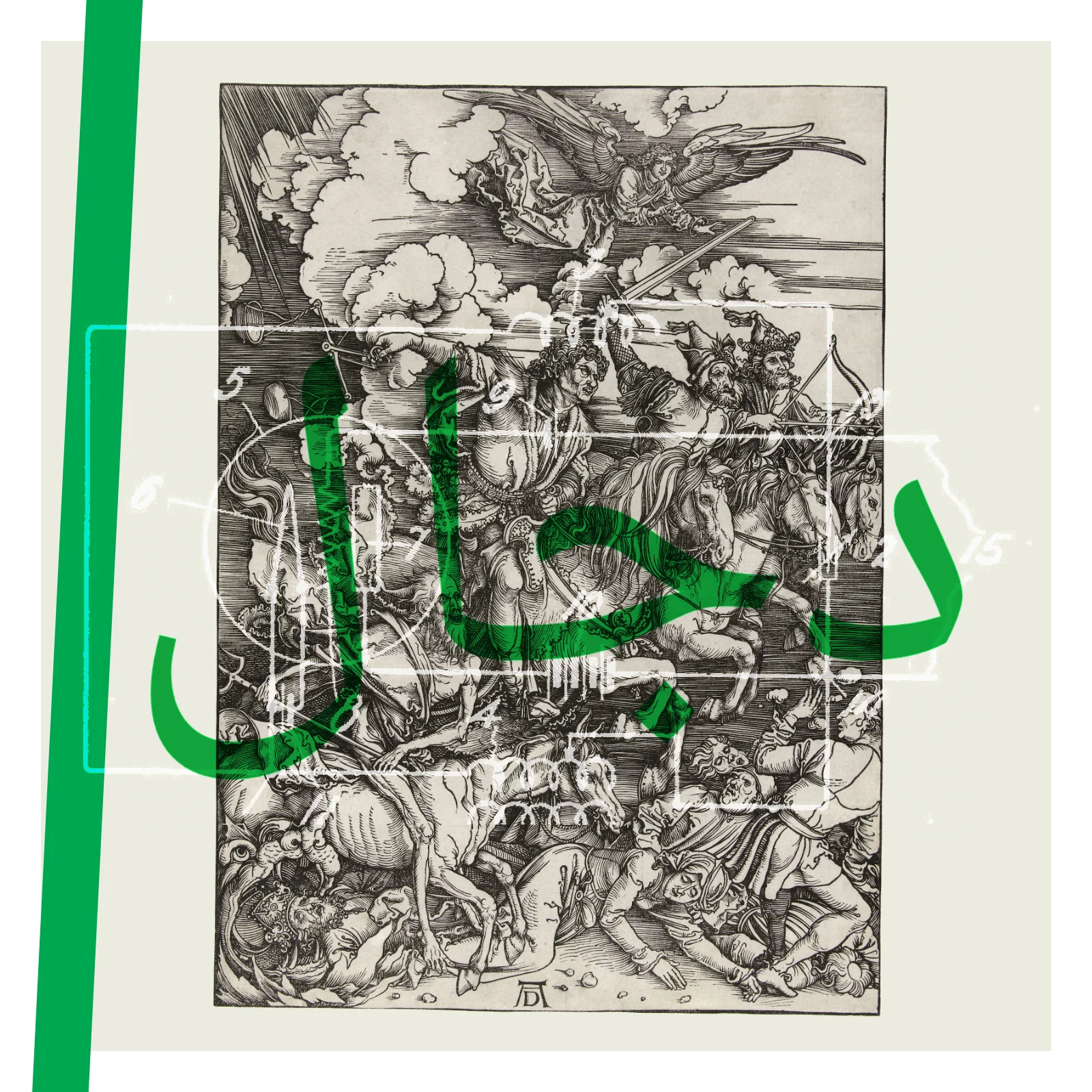
Albrecht Dürer: Die apokalyptischen Reiter © Rijksmuseum, via Wikimedia Commons, Hartleys Oszillatorschaltung (CC0)
Hérésie ou barbarie
“Le choix fondamental de tous ceux qui sont interpellés par la crise actuelle, par le 7 octobre, par Gaza, par la guerre en cours, ce choix est entre l’hérésie et la barbarie.”
Anoush Ganjipour
Crier à la crise serait recourir à un geste banalisé, tant le phénomène renvoie à une régularité qui qualifie notre temps historique, temps moderne. Pour qu’elle avance et passe d’une époque à l’autre, il faut que les crises interviennent dans notre histoire comme si c’était sa norme. Or plus les crises pullulent dans notre monde, plus leur normativité devient triviale, cache leur fondement critique et leur fonction même, en donnant l’impression qu’elles naissent et disparaissent sans que les unes ni les autres aient une signification particulière pour notre temps, sans nous interpeller particulièrement, sans modifier sensiblement le cours de l’histoire peu importe si celle-ci va dans le sens du progrès ou du déclin désormais. Aujourd’hui, le citoyen du monde passe d’une crise à l’autre au rythme de son scrolling, alors que des crises il ne tient véritablement compte qu’à leur malheureux impact sur son niveau de vie – impact, il est vrai, de plus en plus régulier. Massacres, guerres, génocides, drames migratoires, pandémies ou cataclysmes peuvent l’impliquer ou l’affecter plus ou moins ; mais pour passer pour des crises dans leur conception ordinaire, ils devraient se traduire en termes financiers ou en langage du marché. En est le dernier exemple la « crise pétrolière » actuelle.
Pourtant, sans être réductible à ses effets financiers, ce qui se passe, depuis le 7 octobre 2023, au Proche-Orient et en Occident et, de proche en proche, dans le monde entier a la signification d’une crise pour nous. Cette affirmation est le point de départ du forum al-Zman et de notre programme de recherche. On ne peut lui accorder ce rôle toutefois qu’à condition de répondre aux trois questions qu’elle recèle : qu’est-ce qu’une crise ? Quelle est la spécificité de celle que nous traversons ? Qui sommes-nous ?
Si, au sens propre, la crise reste irréductible à sa simple traduction financière, elle n’en opère pas moins un certain type de traduction. Elle a lieu lorsque le nombre des victimes, l’ampleur du désastre ou la quantité des dégâts se traduisent en un saut qualitatif dans les consciences. La réalité des faits, avec son ton sec, avec son éclat cruel, vient marquer un seuil dans la manière dont nous concevons le monde et nous y rapportons. Elle donne, de la sorte, une intensité inouïe, une actualité fatidique aux questions que ce monde ou nos rapports à celui-ci nous posent. Plus possible de les négliger ou refouler, de chercher à les contourner par des compromis avec le statu quo ; impossible désormais d’y répondre par des ajustements provisoires. A l’état critique du monde fait pendant l’état critique de notre conscience et de notre pensée. Il y a crise lorsqu’un court-circuit se produit entre les deux états.
La sortie de cette situation nécessite donc de trouver le courage de confronter nos questions fondamentales ; sans les laisser en suspens, de les formuler d’abord sans ambages et d’y porter des réponses claires en tranchant dans un sens ou dans un autre. Autant dire que, toute crise, pour être telle, constitue un moment du questionnement. Moment qui devient un tribunal en ce qu’il engage pleinement la décision, le choix et le jugement de ceux qui sont questionnés ; moment que tout un chacun traverse comme s’il était traduit devant le tribunal de l’histoire, quoiqu’avec un petit h !
Le vrai enjeu et le vrai risque d’un tel moment, nul ne les a mieux perçus que ceux qui ont vécu les grandes crises du passé, comme ce fut le cas de Hannah Arendt. Une crise fait directement dépendre, disait-elle, la grande catastrophe à venir d’un choix primordial dans le présent. Le choix, de la part des questionnés, de faire comme avant, de faire comme si rien ne s’était passé, c’est-à-dire vouloir toujours répondre aux questions portées à l’état critique, à incandescence, par des idées toutes faites, par des préjugés, par des formules prêtes-à-porter. Ou, au contraire, se rendre à l’évidence que cette manière de traiter des questions produira des effets exactement inverses ; que ce serait la meilleure façon de préparer les conditions de possibilité de la grande catastrophe et d’en aggraver les conséquences.
Le choix engage alors jusqu’au sens même des questions auxquelles la crise nous confronte. C’est le moment où choisir entre le juste et l’injuste coïncide on ne peut plus et se confond avec la décision sur le sens de l’un et de l’autre. Non pas seulement sur les moyens d’éviter la perte ou d’atteindre le salut, mais un tel choix porte du même coup sur le sens du dilemme et de ses termes. Il est, on le voit, aussi objectif que subjectif. C’est qu’en temps de crise, tout choix sur des questions, toute décision sur leur sens ou sur leurs réponses constituent eo ipso un choix existentiel, une décision à prendre sur le sens qu’on donne à sa propre vie.
* * *
De quelles questions s’agit-il précisément ? L’interrogation nous conduit à la spécificité de la crise qui est la nôtre, celle qui s’étale entre le 7 octobre et la guerre actuelle menée par les États-Unis et Israël contre l’Iran. Or, cette crise est intimement liée à l’islamique, au juif et au chrétien ; et à tous les éléments divers, hétérogènes, voire contradictoires, y compris séculiers, qui viennent historiquement s’associer à chacun de ces trois adjectifs. Plus exactement, elle implique l’islamique et le juif de près et, de loin, comme sa toile de fond, le chrétien.
Si l’on adopte cette optique, la crise devient autrement lisible : elle tient au rapport qu’entretiennent, aujourd’hui, l’islamique, le juif et le chrétien avec le politique au sens moderne du terme. Rapport se déclinant certes en trois modalités différentes, mais qui, dans tous les cas, est une construction à l’intérieur des temps modernes et à travers un long processus historique. Or s’il se trouve au fondement de cette crise, c’est parce que c’est un rapport lui-même profondément critique.
D’abord, il y a ceci que, dans un champ de conflit couvrant depuis Gaza jusqu’à Paris, Berlin et New York en passant par Jérusalem, Beyrouth et Téhéran, jamais le rôle surdéterminant du religieux ne s’était révélé de façon aussi claire dans la guerre et la paix et dans la politique. Le préfixe « sur » ne saurait plus induire en erreur, et c’est justement l’une des conséquences de cette crise. Car celle-ci s’avère une crise aussi bien théologique que politique, surtout quant aux deux religions plus directement concernées, c’est-à-dire l’islam et le judaïsme. Ce qui apparaît comme leur confrontation explosive exprime avant tout la relation, devenue problématique, éminemment critique entre le théologique et le politique au sein de chacune des deux religions.
Mais une grande leçon de cette crise – je viens d’y faire allusion – est le dévoilement du caractère inadéquat de la référence au religieux et au judaïsme, à l’islam mais aussi au christianisme comme autant de religions, pour expliquer un phénomène somme toute récent lequel, ondulant et multidimensionnel, ne cesse de nous échapper, et qui surtout nous échappe dès l’instant où l’on veut interroger son imbrication avec le politique et le social. Je préfère le désigner par les trois termes : l’islamique, le juif et le chrétien. Ce qui nous rappelle avant tout la signification différente que le concept de religion prend au sein de l’islam, du judaïsme et du christianisme, nonobstant leur fond monothéiste commun ou le paradigme abrahamique de culte qu’ils partagent.
Plus globalement, faire usage de ces adjectifs substantivés nous aide à mieux démêler des dimensions cachées du phénomène et à cerner leur interconnexion. Ensemble, ils forment un dispositif conceptuel plus dynamique et approprié peut-être, nous permettant de saisir comment le fait islamique, juif ou chrétien dépasse le simple cadre d’une croyance ou un culte, d’une théologie, d’une forme de vie, d’une appartenance identitaire ou même d’une tradition intellectuelle pour embrasser tout cela à la fois.
En ce qui concerne notre crise, le dispositif peut nous servir à distinguer de manière plus explicite le palimpseste chrétien se cachant derrière l’État, la nation, la société et la politique des modernes, et à rendre compte de la permanence de son action. Grâce à lui, nous devrions revenir sur la participation – soit historique, soit à un niveau archéologique – du juif et de l’islamique à de tels concepts ou composantes de la modernité ; reprendre, mais sous un angle nouveau, la question récalcitrante de leur compatibilité avec ceux-ci, ses limites et ses modalités.
Il faut se demander comment le nationalisme, concept récent, s’est articulé au juif et à l’islamique. Le colonialisme et la résistance décoloniale, l’immigration et l’exil, l’intégration et le séparatisme, l’antisémitisme, l’antisionisme ou l’islamophobie, eux non plus ne se rapportent tant au judaïsme et à l’islam en tant que religions, traditions etc. qu’au juif et à l’islamique en tant qu’adjectifs.
Ce qui singularise la crise actuelle est qu’elle nous pose, sans exception, les questions qui touchent ainsi, tout d’abord et tout droit, au juif et à l’islamique. La décision qu’elle nous contraint à prendre concerne elle aussi le sens de telles questions et les réponses que nous y apporterons. Nous n’avons plus de choix : tout est mis en question, et rien n’est plus inadéquat, plus caduc, surtout plus contreproductif que de négliger leur signification désormais critique et que de croire y répondre en brandissant sans relâche les mêmes arguments qu’avant.
Qu’est-ce qu’un État-nation juif ? Qu’est-ce qu’un État-nation musulman ? Qu’est-ce que le judaïsme, au-delà d’une idéologie nationaliste ? Qu’est-ce que l’islam autre qu’une obsession totalitaire, une idéologie métanationale ? Qu’est-ce qu’un juif ? Qu’est-ce qu’un musulman ? Qu’est-ce qu’un goy ? Qu’est-ce qu’un non-musulman ? Et même celles-ci : que signifie exactement l’adjectif juif ? Que signifie l’adjectif islamique ? Nous y percevons l’enchaînement des signifiants qui nous sont déjà familiers, cependant que la crise, telle une mutation sémantique, a fait comme si leur identité se réduisait à une quasi-homonymie !
* * *
Sur le long questionnaire qui se déplie ainsi, une question se distingue toutefois du fait qu’elle ressortit à la crise d’une façon essentielle, c’est-à-dire en participant de son essence même qui est une essence temporelle. Elle renvoie en effet au rapport que l’islamique, le juif ou encore le chrétien entretiennent au temps et au temporel. Ce qui veut dire qu’elle a partie liée avec le messianisme dans ses trois modalités islamique, juive et chrétienne. Question qui, d’emblée, se pose à nous dans ces termes : où en sommes-nous aujourd’hui, dans cette crise, au cœur de la guerre en cours, avec les messianismes juif, chrétien et islamique ? Ils sont d’autant plus mis en question qu’ils viennent s’entrecroiser les uns avec les autres et tous avec le régime moderne et séculier de temporalité pour constituer cette crise en tant qu’un moment historique, un moment dans notre histoire commune à nous tous, les contemporains.
La même guerre, chez ses gagnants comme chez ses perdants, provoque d’ores et déjà, et comme son effet immédiat, une crise dans leur conception du futur messianique. Le sioniste religieux interprète l’offensive victorieuse de l’État juif comme un seuil décisif franchi vers l’établissement imminent du règne messianique. Le messianiste shi’ite, naguère convaincu de la mission messianique de la République islamique, découvre maintenant dans la possibilité réelle de la défaite de cet État même le signe divin le plus clair de la fin du temps et la promesse de l’arrivée victorieuse du Sauveur, son Imâm caché. Pour l’évangélique américain, la victoire de l’État d’Israël et l’effondrement de l’État iranien sont tous les deux au service du plan divin dans sa dernière phase, contributions juive et musulmane au chaos final dont la formidable coïncidence fait signe au retour proche du Roi messie !
Ce bouleversement nouveau, introduit dans les schémas temporels des trois messianismes, n’est toutefois qu’un effet de surface comparé au profond ancrage de la crise en cours dans la vision messianique du monde. Car la crise dans tel ou tel messianisme est une chose ; la crise messianique en est une autre. Et c’est bien le cas de la nôtre. Au sens où notre temps est celui dans lequel juif, musulman, chrétien, Iranien, Gazaoui, Palestinien, Arabe, Israélien deviennent chacun l’antéchrist de l’autre. Cette crise est au fond celle de tous ceux qui se découvrent l’antéchrist de leur prochain.
Voici l’essence messianique de notre crise. Mais voici qui nous reconduit à la conception originaire de la crise dans le cadre des religions abrahamiques. Dès lors notre crise se présente sous les traits d’une crise abrahamique par excellence. Crise qui annonce l’imminence du Jugement final. La grandedécision qu’elle requiert se résume alors dans l’acte de se convertir. La conversion vient s’imposer comme condition sine qua non, et la seule, du salut. On se demande pourquoi cette insistance messianique sur la conversion, insistance partagée par les trois traditions religieuses abrahamiques, toutes les trois monothéistes et chacune exclusiviste à sa façon ; insistance aussi bien théologique que politique. N’est-ce pas qu’en fin de compte toute conversion abrahamique consiste à choisir son antéchrist ?
Chose étonnante, mais sans doute à cause de son caractère messianique, la crise d’aujourd’hui reproduit le même schéma archaïque. Elle traverse ses sujets en les confrontant au même choix, au même dilemme. En effet, deviennent sujets de cette crise tous ceux qu’elle appelle à se convertir. Musulmans et juifs, par filiation ou par culture, pratiquants ou incrédules, modernes voire ultramodernes, la crise leur a assigné à tous leur identité musulmane ou juive comme à travers un acte de conversion. Incontournable, le choix initial a été tyranniquement simple : soit se convertir, soit nier l’existence de la crise.
« Nous » faisons partie de ceux qui ont choisi de ne pas nier la crise en assumant son effet subjectivant. Seulement, il nous a d’emblée apparu que le vrai choix se cachait derrière la simplicité innocente de l’autre terme du dilemme ; que c’est précisément autour de lui que se concentrent à la fois tout le péril et tout le salut qu’une crise comme celle-ci nous réserve. Car, à quoi se convertir ? Toute la question est là !
A la série des préjugés qui s’associe aux adjectifs le juif et l’islamique ? A la conception dominante de l’islam et du judaïsme comme religions, aux formes discursives qui se sont historiquement imposées à leurs théologies ou à leurs traditions intellectuelles ? Ou encore à la vision du monde adoptée par la majorité de ceux qui portent le nom de juif ou musulman ? Dans ce cas, la conversion ne voudrait dire autre chose que choisir la voie facile de répondre aux questions par des réponses déjà prêtes, fournies dans le passé et par les ancêtres. Croire à la parole reçue comme clef de déchiffrement de la crise, à l’avenir déjà promis de celle-ci ; croire dans ses tréfonds à un Messie divin qui devra apparaître sur les décombres comme seul Sauveur. Croire à tout cela, en vérité pour contourner la crise, pour mieux oublier ses enjeux concrètement critiques, oublier tout simplement la critique pour se réfugier derrière la parole hégémonique transmise au nom de la tradition, de la mémoire collective, si ce n’est au nom d’une révélation primordiale. Conçue dans ce sens lui-même traditionnel et lié aux messianismes abrahamiques, la conversion recèle quelque chose de fondamentalement belliqueux : se convertir pour faire communauté, faire camp, faire front. Et l’objectif ultime, nous le connaissons déjà : avec les membres de sa communauté et à côté d’eux, désigner l’ennemi ; conformément à leur choix, choisir son antéchrist.
C’est en prenant la conversion dans un tel sens que ceux-là mêmes, qui dénonçaient l’injustice du puissant impérialiste ou colonisateur, ont cherché refuge non pas simplement dans la tradition islamique, mais derrière ses voix hégémoniques, assourdissantes parce qu’adossées à la terreur, au pouvoir. Nous avons vu comment, au nom de la résistance, ils ont adopté ses lectures les plus réactionnaires sources de toutes sortes d’injustices. Ou alors les mêmes, qui nous rebattaient les oreilles, dans leurs discours et dans leurs cours, avec les vertus du geste radicalement autocritique des prophètes d’Israël, les mêmes se sont métamorphosés, à la suite de cette crise, en apologistes de moins en moins pudiques de tout ce que l’État d’Israël a commis de pire. Ils voulaient faire perdurer la voix critique au sein de leur communauté ; à travers leur conversion, ils sont devenus le simple écho, sinon l’amplificateur des clameurs et des voix les plus stridentes qui y dominent, y compris lorsqu’elles expriment des penchants fascistes.
* * *
Notre choix à nous est un autre. Il n’est pas question, cela vient d’être dit, de rester indifférent à l’injonction de la crise, au péril et à la promesse messianiques que celle-ci porte en elle. Or l’erreur fatale à éviter nous semble résider précisément là. Que, dans l’urgence de la crise, l’on oublie le choix principal : quel sens donner à la conversion elle-même ? Question qui nous a conduit au constat suivant : à la prendre dans son sens ancestral et consacré, la conversion va de pair avec la catastrophe, avec la barbarie qui consiste en la chasse à l’envi des antéchrists, de tout le monde identifié à tour de rôle aux nazis.
Nous sommes donc ceux qui, avant de nous convertir, avons décidé de nous arrêter devant la question « qu’est-ce que la conversion ? », afin de la reformuler à la lumière de la crise. Et, par-delà nos orientations, nos positions ou nos parcours, quel que soit notre rapport au juif et à l’islamique, nous sommes arrivés à la même conclusion : il n’y a qu’un choix salutaire et c’est de redéfinir la conversion en retournant comme un gant son sens dicté par les traditions abrahamiques. En clair, la seule conversion digne des enjeux de cette crise ne serait selon nous ni plus, ni moins qu’une « anti-conversion ». La bifurcation décisive se fait sur ce point, entre ceux qui, propulsés par la crise, décident de se convertir et ces autres qui prennent le chemin oblique de l’anti-conversion comme pour déjouer la poussée apocalyptique de la crise.
Pris dans ce sens, l’anti-conversion n’est pas la simple négation de la conversion. Elle ne s’identifie pas à l’apostasie ni non plus à l’athéisme. Elle n’est ni tout à fait le retour au juif et à l’islamique, ni leur rejet. Par le mouvement oblique qu’elle performe, l’anti-conversion diagonalise cette dichotomie, elle vise à désactiver les frontières entre le dedans et le dehors. Nous nous donnons pour tâche, en deçà et au-delà de toute autre, de réinventer le lien que nous avons chacun au juif ou à l’islamique. Oui, mobiliser les traditions intellectuelles juive et islamique, tenter de nous les réapproprier même, non pas tant pour y trouver refuge que pour y chercher de nouvelles ressources. C’est ainsi que le choix de l’anti-conversion s’impose à nous, c’est-à-dire comme geste approprié d’une pensée libre, pleinement libre, et à la fois engagée dans cette crise.
La comparaison de la tradition juive et la tradition islamique, le fait de les convoquer ensemble, de les mettre l’une à côté de l’autre, l’une face à l’autre : nous adoptons toutes ces démarches volontiers, non pas pour faire d’une tradition l’instrument de guerre contre l’autre, mais plutôt pour introduire le conflit à l’intérieur de chacune. Celui qui, seulement au nom de l’une des deux, critique l’autre, qui fait appel au juif pour dénoncer l’islamique ou à l’inverse, celui-là fait une conversion. Pour celui qui choisit la voie de l’anti-conversion, la critique d’une tradition ne va pas sans celle de l’autre tradition, au sens où il introduit le juif dans l’islamique et vice-versa, comme si l’un était le levier de l’autocritique chez l’autre.
On voit comment, dans cette optique, l’anti-conversion cherche à réactiver les traditions intellectuelles juive et islamique. Elle ramène à trier à l’intérieur de chaque tradition et à y faire des choix qui ne vont pas dans le sens de la catastrophe. Au contraire, pour y faire éclore de nouvelles réponses, l’anti-converti multiplie des pas de côté à l’intérieur. S’il tente ainsi de se réapproprier sa tradition, c’est qu’il cherche à l’arracher à ses ornières en la faisant délibérément dévier ; à la réorienter au mépris de sa direction hégémonique imposée par le commun des convertis, génération après génération. Contre la clameur et l’acclamation de ceux-ci, il y enregistre une voix mineure, voix discordante qui est la sienne alors même que nul ne peut nier son appartenance à la tradition.
Un tel choix interne (haeresis), une telle invention (ibdâ’), une telle déviation (ilhâd), ne correspondent-ils pas précisément à ce qui a été, depuis toujours, exclu, au nom d’hérésie, des traditions juive et islamique, sans parler de sa vaste histoire chrétienne ? Le péché de l’hérétique consiste en effet à ne pas céder sur son choix interne. Son problème n’est pas comment sortir d’une tradition, d’une religion, d’une doctrine etc. Non seulement un tel choix ne répond pas à sa crise personnelle, mais il porte aussi atteinte à son entière liberté. L’hérétique est plutôt comme un chat, ce qui le gêne sont des portes, des frontières, des cloisons ; il n’aime pas qu’on lui trace a priori la trajectoire de ses mouvements.
La conversion est le choix de ceux qui, quelle que soit leur apparence, sont des hommes ou femmes de croyance, des superstitieux même. Ils ont la foi qu’il existe forcément pour eux et pour les leurs une délivrance finale. Ils croient religieusement que, d’ici là, la seule chose qu’il leur reste à faire, c’est de tenir bon contre l’antéchrist, de lui mener combat à l’aide de leurs États, bombes atomiques, bombardiers ou missiles ; à l’aide de tout ceux-ci qui ne sont en vérité que leur katechon déguisé ou leurs fétiches. Le vrai libre penseur, en revanche, est celui qui fait l’anti-conversion, l’hérétique. Sa liberté, il l’emploie pour résister à l’unité hégémonique de sa tradition. Son combat à lui, c’est d’y éliminer les éléments qu’il juge contre la vérité et contre le salut de tous ; et, dans cet objectif, il ne cesse de la déconstruire.
Contre l’hégémonie de la voix des convertis, nous assumons le caractère hérétique de nos anti-conversions, par définition éparses et en mode mineur. Celui qui se convertit rejoint la compagnie, la troupe, la foule, même si celle de la minorité. L’anti-conversion, en revanche, marque toujours un écart. La majorité ou la minorité numériques ? L’anti-converti affronte le dilemme non pas sans méfiance. Ce qui compte pour lui, c’est de cultiver, en vrai hérétique, sa voix mineure, dans n’importe quel groupe où il se trouve. Surtout ne confond-il pas la voix mineure avec la voix de la minorité. L’anti-conversion est par définition un geste solitaire. Toute paradoxale qu’elle puisse paraître, la politique de l’anti-converti est, en dernier ressort, une politique du solitaire.
Ce qui fait de tant de voix mineures, solitaires un « nous » ne tient qu’à une conviction. Qu’après tout, le choix fondamental de tous ceux qui sont interpellés par la crise actuelle, par le 7 octobre, par Gaza, par la guerre en cours, ce choix est entre l’hérésie et la barbarie. Refuser la nécessité de l’hérésie sous n’importe quel prétexte, c’est contribuer de fait à la barbarie.
- Hannah Arendt, La crise de la culture, Gallimard (Folio), p. 225.
- Sur le rapport entre la crise messianique au sens biblique et la conversion, voir Reinhart Koselleck, « Crise », trad. par R. Renault, Tracé, n° 44 (2023), pp. 143-182. Dans le cadre islamique, il reste essentiellement le même ; voir Fred M. Donner, Muhammad and the Believers, At the Origins of Islam, Cambridge, Harvard University Press, 2010.
- Les deux principaux chefs d’accusation portés contre les hérétiques dans la tradition islamique.
- Chenu Marie-Dominique, « Orthodoxie et hérésie. Le point de vue du théologien », Annales. Économies, sociétés, civilisations. 18e année, N. 1, p. 75.
Crisis: the phenomenon, and indeed the term, appear to characterize our modern age, our historical time. Yet the frequency of its invocation has led to a certain banality in its use, rendering it a trite refrain. For history to move forward and pass from one era to the next, crises must occur, as a springboard or an axle upon which it turns. Yet the more crises proliferate in our world, the more their normativity becomes trivial, concealing their critical foundations and their very function, making it seem as if they emerge and disappear without holding particular significance for our time — without truly challenging us, without meaningfully altering the course of history, regardless of whether that course tends toward progress or decline. Today, the global citizen moves from one crisis to the next at the rhythm of scrolling, taking crises seriously only insofar as they have an unfortunate impact on his or her standard of living — an impact that is, admittedly, increasingly frequent. Massacres, wars, genocides, migration tragedies, pandemics, and natural disasters may implicate or affect the individual to varying degrees; but for these to count as crises in the ordinary sense, they must be translated into financial terms or into the language of the market. The latest example is the current “oil crisis.”
Far beyond its mere financial effects, what has been happening since October 7, 2023, across the Middle East and the West — and indeed across the entire world — carries the significance of a crisis for us. This assertion is the point of departure for the al-Zman forum and for our research program. That very assertion, however, can only be granted this role on condition that we answer the three questions it contains: what is a crisis? What is specific about the one we are living through? And who are we?
Although a crisis cannot be reduced to its mere financial significance, it nonetheless operates a certain kind of translation: when the number of victims, the scale of disaster, or the extent of damage translates into a qualitative leap in consciousness. The reality of events — with its dry tone, with its cruel glare — marks a threshold in the way we conceive of the world and relate to it. It thereby gives an unprecedented intensity, a fateful urgency, to the questions that this world — or our relationship to it — poses for us. These questions can no longer be neglected or repressed, circumvented through compromises with the status quo; nor can they be answered by provisional adjustments. The critical state of the world finds its counterpart in the critical state of our consciousness and our thought. A crisis occurs when a short-circuit takes place between these two states.
Getting out of this situation therefore requires the courage to confront our fundamental questions; not to suspend them, but first to formulate them plainly and to come up with clear answers to them, deciding one way or another. Which is to say that every crisis, to be such, constitutes a moment of questioning. A moment that becomes a tribunal insofar as it fully engages the decision, the choice, and the judgment of those who are questioned — a moment that each and every one passes through as if brought before the tribunal of history, albeit history with a small h!
What is truly at stake, and the real risk, of such a moment have been perceived by no one better than those who lived through the major crises of the past — as was the case with Hannah Arendt. A crisis, she said, makes the coming catastrophe directly dependent on a primordial choice made in the present. The choice, on the part of those being questioned, to carry on as before, to act as if nothing had happened — that is, to keep answering questions brought to a critical, incandescent state with ready-made ideas, with prejudices, with off-the-shelf formulas. Or, on the contrary, to face the evidence that this way of treating questions will produce exactly the opposite effects; that it would be the surest way to prepare the conditions of possibility for the great catastrophe and to worsen its consequences ((See Hannah Arendt, Between Past and Future, Penguin Books, 2006, chaps. 4 and 5.)).
The choice thus engages even the very meaning of the questions the crisis confronts us with. This is the moment when choosing between just and unjust coincides as closely as possible — even merges — with the decision about the meaning of each. Not only the means of avoiding loss or achieving salvation, but such a choice simultaneously bears upon the meaning of the dilemma itself and its terms. It is, as one can see, as objective as it is subjective. For in times of crisis, every choice about questions, every decision about their meaning or their answers, constitutes eo ipso an existential choice, a decision about the meaning one gives to one’s own life.
* * *
What questions are we talking about, precisely? This inquiry leads us to the specificity of our crisis — the one that unfolds between October 7 and the current war waged by the United States and Israel against Iran. Now, this crisis is intimately linked with the Islamic, the Jewish, and the Christian; and to all the diverse, heterogeneous, even contradictory elements — including secular ones — that have historically come to be associated with each of these three adjectives. More precisely, it implicates the Islamic and the Jewish directly, and the Christian from a distance, as its backdrop.
If one adopts this perspective, the crisis becomes differently readable: it lies in the relationship that the Islamic, the Jewish, and the Christian maintain today with the political in the modern sense of the term. A relationship that certainly takes three different forms, but which in each case is a construction internal to modernity, shaped through a long historical process. And if such a relationship lies at the foundation of this crisis, it is because it is itself a profoundly critical relationship.
First, there is the fact that, in a field of conflict extending from Gaza to Paris, Berlin, and New York by way of Jerusalem, Beirut, and Tehran, the overdetermining role of religion has never been revealed so clearly in war and peace, nor in politics as such. The prefix “over-” can no longer mislead, and this is precisely one of the consequences of this crisis. For it proves to be a crisis that is as theological as it is political, particularly with regard to the two religions most directly concerned — Islam and Judaism. What appears as their explosive confrontation expresses above all the relationship —between the theological and the political within each of the two religions, a relationship which has become problematic, eminently critical in both.
But a great lesson of this crisis — one I have just alluded to — is the revelation of the inadequacy of referring to religion, to Judaism, to Islam, and even to Christianity as so many religions, in order to explain a phenomenon that is, all things considered, recent, fluctuating, and multidimensional, one that continually escapes us — and that escapes us above all the moment one tries to interrogate its entanglement with the political and the social. I therefore prefer to designate it by three terms: the Islamic, the Jewish, and the Christian. This recalls above all the different meaning that the concept of religion takes on within Islam, Judaism, and Christianity respectively, notwithstanding their common monotheistic foundation or the Abrahamic paradigm of belief they share.
More broadly, making use of these substantivized adjectives helps us to better disentangle hidden dimensions of the phenomenon and to grasp their interconnection. Together, they form a conceptual tool that is perhaps more dynamic and appropriate, allowing us to understand how the Islamic, Jewish, or Christian “fact” (fait) exceeds the simple framework of a belief or a form of worship, a theology, a form of life, an identity affiliation, or even an intellectual tradition — embracing all of these at once.
With regard to our crisis directly, this tool can help us to distinguish more explicitly the Christian palimpsest concealed behind the State, the nation, society, and the politics of the moderns, and to account for the permanence of its action. Through it, we should revisit the participation — whether historical or at an archaeological level — of the Jewish and the Islamic in such concepts or components of modernity; and again address, but from a new angle, the recalcitrant question of their compatibility with these concepts, its limits and its modalities.
One must ask how nationalism — a modern concept — has articulated itself with the Jewish and the Islamic. Colonialism and decolonial resistance, immigration and exile, integration and separatism, antisemitism, anti-Zionism, or Islamophobia: none of these, either, relate so much to Judaism and Islam as religions, traditions, and so forth, as to the Jewish and the Islamic as adjectives.
What singularizes the current crisis is that it confronts us with the questions that thus bear, first and foremost, on the Jewish and the Islamic. The decision it compels us to make likewise concerns the meaning of such questions and the answers we will bring to them. We no longer have a choice: everything is called into question, and nothing is more inadequate, more obsolete, or above all more counterproductive than to neglect their now critical significance and to believe one can answer them by brandishing the same arguments as before.
What is a Jewish nation-state? What is a Muslim nation-state? What is Judaism, beyond a nationalist ideology? What is Islam other than a totalitarian obsession, a meta-national ideology? What is a Jew? What is a Muslim? What is a goy? What is a non-Muslim? And even these: what exactly does the adjective “Jewish” mean? What does the adjective “Islamic” mean? We perceive in them the chain of signifiers already familiar to us — and yet the crisis, like a semantic mutation, has acted as if their identity had been reduced to a near-homonymy!
* * *
Among the long questionnaire that thus unfolds before us, one question stands out insofar as it pertains to the crisis in an essential way — that is, by participating in its very essence, which is a temporal essence. It refers to the relationship that the Islamic, the Jewish, and the Christian maintain with time and the temporal. Which is to say that it has a deep connection with messianism in its three Islamic, Jewish, and Christian modalities. The question presents itself to us at once in these terms: where do we stand today, in this crisis, at the heart of the ongoing war, with respect to Jewish, Christian, and Islamic messianisms? They are all the more called into question insofar as they come to intersect with one another, and all with the modern, secular regime of temporality — jointly constituting this crisis as a historical moment, a moment in our history common to us all.
The same war, among its winners as among its losers, is already provoking, as its immediate effect, a crisis in their conception of the messianic future. The religious Zionist interprets the victorious offensive of the “Jewish state” as a decisive threshold crossed toward the imminent establishment of the messianic reign. The Shi’ite messianist, once convinced of the messianic mission of the Islamic Republic, now discovers in the concrete possibility of that very State’s defeat the clearest divine sign of the end of time and the promise of the victorious arrival of the Savior — i.e. the hidden Imâm. For the American evangelical, the victory of the State of Israel and the collapse of the Iranian state both serve the divine plan in its final phase, according to Christian messianism: the supposedly Jewish and Muslim contributions to the ultimate chaos whose exceptional coincidence portends the imminent return of the Messiah King!
This new disruption, introduced into the temporal frameworks of the three messianisms, is nonetheless merely a surface effect compared to the deep anchoring of the current crisis in the messianic vision of the world. For a crisis within this or that messianism is one thing; a messianic crisis in and of itself is another. And ours is indeed the latter. In the sense that our time is one in which Jew, Muslim, Christian, Iranian, Gazan, Palestinian, Arab, Israeli each end up as the antichrist of the other. This crisis is ultimately the crisis of all those who discover themselves to be the antichrist of their neighbor.
Here is the messianic essence of our crisis. But here too is what leads us back to the original conception of crisis within the Abrahamic religions. Our crisis thus is revealed to be an Abrahamic crisis par excellence — a crisis that announces the imminence of the Final Judgment. The great decision required by such a crisis is nothing short of an act of conversion. Conversion imposes itself as the one and only sine qua non condition of salvation ((On the relationship between messianic crisis in the biblical sense and conversion, see Reinhart Koselleck, “Crisis,” trans. Michaela W. Richter, Journal of the History of Ideas, vol. 67, no. 2 (2006), pp. 357–400. In the Islamic context, it remains essentially the same; see Fred M. Donner, Muhammad and the Believers: At the Origins of Islam, Cambridge, Harvard University Press, 2010.)). One wonders why this messianic insistence on conversion — an insistence shared by all three Abrahamic religious traditions, all three monotheistic and each exclusivist in its own way; an insistence that is as theological as it is political. Is it not because, in the end, every Abrahamic conversion consists in choosing one’s antichrist?
Strangely enough — though no doubt because of its messianic character — today’s crisis reproduces the same archaic pattern. It confronts its subjects with the same choice, the same dilemma. Indeed, all those whom the crisis calls upon to convert become its subjects. Muslims and Jews — by lineage or by culture, observant or secular, modern or even ultramodern — the crisis has assigned them all their Muslim or Jewish identity as if through an act of conversion. Although unavoidable, the initial choice was tyrannically simple: either convert, or deny the existence of the crisis.
“We” are among those who chose not to deny the crisis, by assuming its subjectivizing effect. Yet it appeared to us from the outset that the true choice was concealed behind the innocent simplicity of the other term of the dilemma; that it is precisely around this term that both all the peril and all the salvation this kind of crisis holds in store for us are concentrated. For, convert to what? That is the whole question.
To convert to the series of prejudices associated with the adjectives “Jewish” and “Islamic”? To the dominant conception of Islam and Judaism as religions, to the discursive forms that have historically imposed themselves on their theologies or intellectual traditions? Or to the worldview adopted by the majority of those who bear the name of Jew or Muslim? In that case, conversion would mean nothing other than choosing the easy path of answering questions with ready-made answers — answers provided in the past or by one’s ancestors. Believing in the received word as the key to deciphering the present crisis, in its already-promised future; believing in one’s bones in a divine Messiah who must appear on the ruins as the sole Savior. Believing all of this, which in fact means to sidestep the crisis, to better forget its concretely critical stakes, to forget critique altogether by taking refuge behind the hegemonic word transmitted in the name of tradition, collective memory, if not in the name of a primordial revelation. Conceived in this traditional sense — itself tied to Abrahamic messianisms — conversion contains something fundamentally belligerent: converting in order to form a community, to make a camp, to form a front. And the ultimate objective, we already know it: together with the members of one’s community and beside them, to designate the enemy; in keeping with their choice, to choose one’s antichrist.
It is by taking conversion in this sense that those very people who denounced the injustice of the powerful imperialist or colonizer sought refuge not simply in the Islamic tradition, but behind its hegemonic voices. We have seen how, in the name of resistance, they adopted its most reactionary readings — sources of all manner of injustices. Or the very same people who filled our ears, in their speeches and their courses, with the beauties of the radically self-critical gesture of the prophets of Israel — these same people were metamorphosed, through crisis, into increasingly shameless apologists for the worst of what the State of Israel has committed. They wanted to keep the critical voice alive among their people; through their conversion, they became the mere echo — indeed the amplifier — of the loudest and most strident voices dominating it, including when those voices express fascist leanings.
* * *
Our choice is a different one. It is not a matter, as has just been said, of remaining indifferent to the crisis’s injunction, to the messianic peril and promise it carries within it. Yet the fatal error to be avoided seems to us to lie precisely there: that, in the urgency of the crisis, one forgets the principal choice: what meaning to give to conversion itself. This question has led us to the following observation: taking conversion in its ancestral and consecrated sense, it goes hand in hand with catastrophe, with the barbarism that consists in the competitive hunt for antichrists — for everyone identified in turn with the Nazis.
We are therefore those who, before converting, decided to stop before the question “what is conversion?” in order to reformulate it in the light of the crisis. And, beyond our respective orientations, positions, and trajectories, whatever our relationship to the Jewish and the Islamic, we arrived at the same conclusion: there is only one salutary choice, and it is to redefine conversion by turning inside out the meaning dictated by the Abrahamic traditions. In short, the only conversion worthy of the stakes of this crisis would be, in our view, neither more nor less than an “anti-conversion.” The decisive bifurcation takes place on this point — between those who, propelled by the crisis, decide to convert, and those others who take the oblique path of anti-conversion, as if to subvert the apocalyptic thrust of the crisis.
Taken in this sense, anti-conversion is not the simple negation of conversion. It is not identified with apostasy, nor with atheism. It is neither quite a return to the Jewish and the Islamic, nor their rejection. Through the oblique movement it performs, anti-conversion diagonalizes this dichotomy — it aims to deactivate the boundaries between inside and outside. We set ourselves the task, before and beyond any other, of reinventing the link each of us has to the Jewish or to the Islamic. Yes — to harness the Jewish and Islamic intellectual traditions, even to attempt to reappropriate them, not so much to find refuge in them as to seek new resources there. The choice of anti-conversion imposes itself on us thusly — as the appropriate gesture of a thought that is free, fully free, and at the same time engaged in this crisis.
The comparison of the Jewish tradition and the Islamic tradition, the act of summoning them together, of placing them side by side, face to face: we willingly adopt all these approaches. Not to weaponize one tradition against the other, but rather to introduce conflict within each. One who criticizes one tradition solely in the name of the other, who invokes the Jewish to denounce the Islamic or vice versa — that person is performing a conversion. For one who chooses the path of anti-conversion, the critique of one tradition cannot proceed without the critique of the other — in the sense that she introduces the Jewish into the Islamic and vice versa, as if each were the lever of the other’s self-critique.
We see how, in this perspective, anti-conversion seeks to reactivate the Jewish and Islamic intellectual traditions. It leads to sorting the elements of each tradition and making choices within it that do not lead toward catastrophe. On the contrary, in order to bring forth new responses, the anti-convert multiplies lateral moves from within. If he thus attempts to reappropriate his tradition, it is because he seeks to wrench it out of a rut by deliberately making it deviate — to reorient it in defiance of the hegemonic direction imposed by the common run of converts, generation after generation. Against their clamor and acclamation, he registers within it a minor voice — a discordant voice that is his own, even as no one can deny its belonging to the tradition.
Does not such an internal choice (haeresis), such an invention (ibdâ’), such a deviation (ilhâd) ((The two main charges brought against heretics in the Islamic tradition.)), correspond precisely to what has always been excluded, in the name of heresy, from the Jewish and Islamic traditions — not to mention its vast Christian history? The sin of the heretic consists precisely in not yielding on his internal choice. His problem is not how to exit a tradition, a religion, a doctrine. Not only does such a move fail to answer his personal crisis — it also undermines his entire freedom. The heretic is rather like a cat: what bothers him are doors, borders, partitions; he does not like having the trajectory of his movements traced for him in advance.
Conversion is the choice of those who, whatever their outward appearance, are people of belief, even of superstition. They have faith that there exists for them and for their fellow converts a final deliverance. They believe religiously that, until then, the only thing left to them is to hold firm against the antichrist, to wage a battle against him with the help of their states, their atomic bombs, their bombers, or their missiles: nothing but their disguised katechon or their fetishes, in truth. The true freethinker, by contrast, is the one who performs anti-conversion — the heretic. He employs his freedom to resist against the hegemonic unity of his tradition ((Marie-Dominique Chenu, “Orthodoxie et hérésie. Le point de vue du théologien,” Annales. Économies, Sociétés, Civilisations, 18th year, no. 1, 1963, p. 75.)). His struggle consists of eliminating from it elements he judges contrary to truth and to the salvation of all — and, to this end, in never ceasing to deconstruct his tradition.
Against the hegemony of the converts’ majority voice, we assume the heretical character of our anti-conversions — by definition scattered and in a minor key. One who converts joins a crew, a troop, a crowd — even if that of the minority. Anti-conversion, by contrast, always marks a departure. The numerical majority or the numerical minority? The anti-convert never stops being wary of this dilemma. What matters to him is to cultivate, as a true heretic, his minor voice, in whatever group he finds himself. He is careful, above all, not to confuse the minor voice with the voice of the minority. Anti-conversion is by definition a solitary gesture. However paradoxical it may appear, the politics of the anti-convert is, in the last resort, the politics of the solitary.
What makes so many solitary voices into a “we” rests on a single conviction: that after all, the fundamental choice of all those called upon by the current crisis, by October 7, by Gaza, by the ongoing war, is a choice between heresy and barbarism. To refuse the necessity of heresy under any pretext whatsoever is to contribute, in fact, to barbarism.
- See Hannah Arendt, Between Past and Future, Penguin Books, 2006, chaps. 4 and 5.
- On the relationship between messianic crisis in the biblical sense and conversion, see Reinhart Koselleck, “Crisis,” trans. Michaela W. Richter, Journal of the History of Ideas, vol. 67, no. 2 (2006), pp. 357–400. In the Islamic context, it remains essentially the same; see Fred M. Donner, Muhammad and the Believers: At the Origins of Islam, Cambridge, Harvard University Press, 2010.
- The two main charges brought against heretics in the Islamic tradition.
- Marie-Dominique Chenu, “Orthodoxie et hérésie. Le point de vue du théologien,” Annales. Économies, Sociétés, Civilisations, 18th year, no. 1, 1963, p. 75.
משבר: התופעה, וגם המונח, נדמה שהם מאפיינים את עידננו המודרני, את זמננו ההיסטורי. אולם תדירות ההיזקקות למונח זה יצרה בנאליות מסוימת בשימוש בו, והפכה אותו לפזמון חוזר ונדוש. כדי שההיסטוריה תתקדם ותעבור מעידן אחד למשנהו, מוכרחים משברים להתרחש, כקרש קפיצה או כציר שעליו היא סובבת. אך ככל שמתרבים המשברים בעולמנו, חוקיותם נהיית טריוויאלית. היא מסתירה את יסודותיהם הביקורתיים ואת עצם תפקודם, וגורמת לכך שהם כמו מופיעים ונעלמים מבלי שתהיה להם משמעות מיוחדת לזמננו — מבלי שיאתגרו אותנו באמת, מבלי שישנו ממש את מהלך ההיסטוריה, בין שמהלך זה נוטה אל הקִדמה ובין שאל השקיעה. כיום, האזרח הגלובלי נע ממשבר אחד למשנהו בקצב גלילת המסך, והוא לוקח משברים ברצינות רק במידה שהם פוגעים באיכות חייו — פגיעה שהולכת ומתרבה, יש להודות. טבח, מלחמות, רצח־עם, טרגדיות הגירה, מגפות ואסונות טבע עשויים לגעת או לפגוע בפרט במידות שונות; אך כדי שייחשבו למשברים במובן הרגיל, עליהם להיתרגם למונחים פיננסיים או ללשון השוק. הדוגמה האחרונה היא “משבר הנפט” הנוכחי.
הרבה מעבר להשלכות הפיננסיות גרידא, מה שמתרחש מאז ה־7 באוקטובר 2023 ברחבי המזרח התיכון והמערב — וברחבי העולם כולו — נושא עבורנו משמעות של משבר. אמירה זו היא נקודת המוצא של פורום אל־זמן ושל תוכנית המחקר שלנו. אולם האמירה יכולה למלא את תפקידה רק בתנאי שנשיב על שלוש השאלות הנכללות בה: מהו משבר? מה ייחודי במשבר שאותו אנו חווים? ומי אנחנו?
אף שאין לצמצם משבר למשמעותו הפיננסית, הוא בכל זאת מבטא סוג מסוים של תרגום: כאשר מספר הקורבנות, היקף האסון או מידת הנזק מיתרגמים לקפיצה איכותית בתודעה. מציאות האירועים — בנימתה היבשה, בזוהרה האכזרי — מסמנת סף באופן שבו אנו תופסים את העולם ומתייחסים אליו. כך היא מעניקה עוצמה חסרת תקדים, דחיפות גורלית, לשאלות שהעולם הזה — או יחסנו אליו — מציב בפנינו. שוב אי אפשר להזניח שאלות אלו או להדחיקן, לעקוף אותן באמצעות פשרות עם המצב הקיים; ואף אי אפשר להשיב עליהן בהתאמות ארעיות. מצבו הקריטי של העולם משתקף במצבן הקריטי של תודעתנו ושל מחשבתנו. המשבר מתרחש כאשר בין שני המצבים הללו מתחולל ניצוץ חשמלי.
ההיחלצות ממצב זה דורשת אפוא את האומץ להתעמת עם שאלותינו היסודיות; לא לדחותן, אלא ראשית לנסחן בבירור, למצוא להן תשובות צלולות, ולהכריע לכאן או לכאן. כל משבר, כדי להיות כזה, מהווה רגע של שאילה. רגע ההופך לבית-דין במידה שהוא תובע את ההכרעה, את הבחירה ואת השיפוט של הנשאלים — רגע שכל אחד ואחת חווים כמי שהובאו בפני טריבונל ההיסטוריה, אם כי history ב-h קטנה!
את מה שמונח באמת על כף המאזניים, ואת הסיכון האמיתי ברגע כזה, לא תפס איש טוב יותר מאשר אלו שחיו את משברי העבר הגדולים — כמו חנה ארנדט. משבר, אמרה, מתנה במישרין את האסון הממשמש ובאה בבחירה ראשונית הנעשית בהווה. הבחירה, מצד הנשאלים, להמשיך כבעבר, לנהוג כאילו דבר לא אירע — כלומר, להוסיף ולהשיב על שאלות שהגיעו למצב קריטי, לוהט, ברעיונות מן המוכן, בדעות קדומות, בנוסחאות מן המדף. או לעומת זאת, להישיר מבט אל העובדה שדרך התמודדות זו עם השאלות תוליד בדיוק את ההשפעות ההפוכות; שתהיה זו הדרך הבטוחה ביותר להכין את תנאי האפשרות לאסון הגדול ולהחמיר את השלכותיו1.
הבחירה נוגעת אפוא לעצם משמעות השאלות שהמשבר מציב בפנינו. זהו הרגע שבו הבחירה בין צודק לבלתי צודק חופפת במידה המרבית — ואף מתמזגת — עם ההכרעה על משמעותם של הצודק והבלתי-צודק. לא מדובר רק באמצעים למנוע אובדן או להשיג גאולה, אלא הבחירה מתייחסת בעת ובעונה אחת למשמעותה של הדילמה עצמה ולמונחיה. כפי שניתן לראות, זו בחירה אובייקטיבית בה במידה שהיא סובייקטיבית. שכן בעתות משבר, כל בחירה בנוגע לשאלות, כל הכרעה בנוגע למשמעותן או לתשובות עליהן, מהווה בפני עצמה בחירה קיומית, החלטה על המשמעות שאדם מעניק לחייו שלו.
* * *
על אילו שאלות מדובר בדיוק? קושיה זו מובילה אותנו אל ייחודו של המשבר שלנו — זה הנפרש בין ה־7 באוקטובר לבין המלחמה הנוכחית שמנהלות ארצות הברית וישראל נגד איראן. משבר זה קשור באופן הדוק למוסלמי, ליהודי ולנוצרי; ולכל היסודות המגוונים, ההטרוגניים ואף הסותרים — לרבות החילוניים — שהשתייכו היסטורית לכל אחד משלושת התארים הללו. ליתר דיוק, הוא מערב את המוסלמי ואת היהודי במישרין, ואת הנוצרי ממרחק, ברקע.
אם מאמצים נקודת מבט זו, ניתן לקרוא את המשבר אחרת: הוא טמון ביחס שהמוסלמי, היהודי והנוצרי מקיימים כיום עם הפוליטי במובן המודרני של המונח. זהו יחס שלובש אמנם שלוש צורות שונות, אך בכל מקרה הוא בניין פנימי למודרנה, שהתעצב בתהליך היסטורי ארוך. אם יחס כזה אכן מונח ביסוד המשבר הנוכחי, הרי זה משום שהוא עצמו יחס קריטי בעומקו.
ראשית, זו עובדה שבשדה סכסוך המשתרע מעזה עד פריז, ברלין וניו יורק דרך ירושלים, ביירות וטהראן, תפקידה המכריע-ביתר של הדת מעולם לא נחשף בבהירות כה רבה במלחמה ובשלום, ואף לא בפוליטיקה ככזו. המילית “יתר” שוב אינה יכולה להטעות, וזו בדיוק אחת מהשלכותיו של משבר זה. שכן הוא מתגלה כמשבר תיאולוגי בה במידה שהוא פוליטי, במיוחד בנוגע לשתי הדתות הנוגעות בדבר במישרין — האסלאם והיהדות. מה שמופיע כעימות הנפיץ ביניהן מבטא בראש ובראשונה את היחס בין התיאולוגי לפוליטי בתוך כל אחת משתי הדתות, יחס שנעשה בעייתי, קריטי במובהק בשתיהן.
אך לקח גדול של משבר זה — שזה עתה רמזתי עליו — טמון בכך שהוא חשף כי אין זה מספיק להפנות אל הדת, אל היהדות, אל האסלאם, ואף אל הנצרות כאל דתות שונות, כדי להסביר תופעה שהיא, בסופו של דבר, חדשה, משתנה ורב־ממדית, תופעה שחומקת מאיתנו בלי הרף — חומקת מאיתנו בעיקר ברגע שמנסים לחקור את השתלבותה במרחב הפוליטי והחברתי. לפיכך אני מעדיף לציינה באמצעות שלושה מונחים: המוסלמי, היהודי והנוצרי. זה מזכיר מעל לכול את המשמעות השונה שהמושג דת מקבל בתוך האסלאם, היהדות והנצרות בהתאמה, על אף יסודן המונותיאיסטי המשותף או הפרדיגמה האברהמית של אמונה שהן חולקות.
מעבר לכך, השימוש בתארים מומשגים אלה מסייע לנו להפריד ביתר חדות ממדים נסתרים של התופעה ולתפוס את יחסיהם ההדדיים. יחד, הם מהווים כלי מושגי שהוא אולי דינמי והולם יותר, שמאפשר לנו להבין כיצד “העובדה” (fait) המוסלמית, היהודית או הנוצרית חורגת מהמסגרת הפשוטה של אמונה או של צורת פולחן, של תיאולוגיה, של צורת חיים, של השתייכות זהותית, ואף של מסורת אינטלקטואלית — בהקיפה את כל אלה בעת ובעונה אחת.
בנוגע למשבר שלנו במישרין, כלי זה יכול לסייע לנו להבחין במפורש יותר בפלימפססט הנוצרי הנסתר מאחורי המדינה, הלאום, החברה והפוליטיקה המודרנים, ולהתחשב בהשפעתו התמידית. דרכו, עלינו לשוב ולבחון את ההשתתפות — ברמה ההיסטורית וברמה הארכיאולוגית — של היהודי והמוסלמי במושגים או ברכיבים אלה של המודרניות; ושוב להידרש, אך מזווית חדשה, לשאלה העיקשת בדבר התאמתם למושגים אלה, גבולותיה של התאמה זו ואופניה.
יש לשאול כיצד הלאומיות — מושג מודרני — נוסחה בזיקה אל היהודי ואל המוסלמי. קולוניאליזם והתנגדות דה־קולוניאלית, הגירה וגלות, הטמעות והיבדלות, אנטישמיות, אנטי־ציונות או איסלאמופוביה: אף אחד מאלה לא נוגע ליהדות ולאסלאם כדתות, כמסורות וכן הלאה, כשם שהוא נוגע ליהודי ולמוסלמי כתארים.
מה שמייחד את המשבר הנוכחי זה שהוא מעמיד אותנו בפני השאלות הנוגעות אפוא, בראש ובראשונה, ליהודי ולמוסלמי. ההכרעה שהוא כופה עלינו נוגעת אף היא למשמעותן של שאלות אלו ולתשובות שנספק להן. אין לנו יותר ברירה: הכול מועמד בסימן שאלה, ושום דבר אינו בלתי הולם, מיושן, ובעיקר קונטרה-פרודוקטיבי יותר מאשר להזניח את משמעותן הקריטית הנוכחית ולסבור שאפשר להשיב עליהן בנפנוף אותם טיעונים כתמול-שלשום.
מהי מדינת לאום יהודית? מהי מדינת לאום מוסלמית? מהי יהדות, מעבר לאידיאולוגיה לאומנית? מהו אסלאם, שאינו אובססיה טוטליטרית, אידיאולוגיה מטא־לאומית? מהו יהודי? מהו מוסלמי? מהו גוי? מהו לא־מוסלמי? ואפילו: מה בדיוק מציין התואר “יהודי”? מה מציין התואר “מוסלמי”? אנו קולטים בהם את שרשרת המסמנים המוכרת לנו זה מכבר — ובכל זאת המשבר, כמוטציה סמנטית, התרחש כאילו זהותם צומצמה לכדי הומונימיה כמעט מוחלטת!
* * *
בשאלון הארוך הנפרש כך לפנינו, שאלה אחת בולטת כנוגעת למשבר באופן מהותי — כלומר, בהשתתפה בעצם מהותו, שהיא מהות זמנית. היא נוגעת ליחס שהמוסלמי, היהודי והנוצרי מקיימים עם הזמן ועם הזמני. כלומר יש לה זיקה עמוקה למשיחיות בשלושת אופניה — המוסלמי, היהודי והנוצרי. השאלה מתייצבת בפנינו בבת אחת במונחים אלה: היכן אנו עומדים כיום, במשבר זה, בלב המלחמה הנמשכת, ביחס למשיחיות היהודית, הנוצרית והמוסלמית? צורות שונות אלו של המשיחיות מועמדות בסימן שאלה ביתר שאת ככל שהן מצטלבות זו עם זו, וכולן כאחת עם המשטר המודרני, החילוני, של הזמניות — בכוננן יחד את המשבר הזה כרגע היסטורי, רגע בהיסטוריה שלנו, רגע משותף לכולנו.
אותה מלחמה עצמה כבר מעוררת, כהשפעתה המיידית, בין בקרב מנצחיה ובין בקרב מפסידיה, משבר בתפיסתם את העתיד המשיחי. הציוני הדתי מפרש את המתקפה המנצחת של “המדינה היהודית” כסף מכריע שנחצה לעבר כינונה הקרֵב של המלכות המשיחית. המשיחיסט השיעי, שהיה משוכנע פעם בשליחותה המשיחית של הרפובליקה האסלאמית, מגלה כעת באפשרות הקונקרטית של תבוסת אותה מדינה עצמה את האות האלוהי הברור ביותר לקץ הימים ולהבטחת בואו המנצח של המושיע — הוא האִמאם הנסתר. בעבור האוונגליסט האמריקאי, ניצחון מדינת ישראל וקריסת המדינה האיראנית משרתים שניהם את התוכנית האלוהית בשלבה הסופי, על פי המשיחיות הנוצרית: התרומות היהודית והמוסלמית כביכול לתוהו האולטימטיבי, שהצטרפותן הנדירה מבשרת את שובו הקרֵב של המלך המשיח!
הפרעה חדשה זו, שמופיעה במסגרות הזמניות של שלוש צורות המשיחיות, בכל זאת אינה אלא על פני השטח בהשוואה לעיגונו העמוק של המשבר הנוכחי בחזון המשיחי של העולם. שכן משבר בתוך משיחיות זו או אחרת הוא דבר אחד; משבר משיחי כשלעצמו הוא דבר אחר – וזהו מצבנו. במובן זה שזמננו הוא זמן שבו יהודי, מוסלמי, נוצרי, איראני, עזתי, פלסטיני, ערבי, ישראלי, כל אחד מהם מגיע לסיומו כאנטי-כריסט של האחר. זהו בסופו של דבר משברם של כל אלה שמגלים כי הם האנטי-כריסט של זולתם.
זו המהות המשיחית של משברנו. אך זה גם מה שמוביל אותנו בחזרה אל התפיסה המקורית של המשבר בדתות האברהמיות. המשבר שלנו מתגלה אפוא כמשבר אברהמי במובהק — משבר המבשר את קרבת יום הדין. ההכרעה הגדולה שמשבר כזה דורש היא לא פחות ממעשה המרה. ההמרה מתחייבת כתנאי ההכרחי האחד והיחיד לגאולה2. אפשר לתהות מדוע ההתעקשות המשיחית הזו על המרה — התעקשות המשותפת לשלוש המסורות הדתיות האברהמיות, שלושתן מונותיאיסטיות וכל אחת אקסקלוסיביסטית בדרכה שלה; התעקשות שהיא תיאולוגית בה במידה שהיא פוליטית. האין זה משום שבסופו של דבר, כל המרה אברהמית מתמצה בבחירת האנטי-כריסט שלנו?
באורח מוזר — אם כי ללא ספק בשל אופיו המשיחי — המשבר של ימינו משחזר את אותה תבנית ארכאית. הוא מעמיד את הכפופים לו בפני אותה בחירה, אותה דילמה. אכן, כל אלה שהמשבר קורא להם להמיר את דתם נעשים כפופים לו, סובייקטים שלו. מוסלמים ויהודים — מכוח לידה או תרבות, שומרי מצוות או חילונים, מודרניים או אף אולטרה־מודרניים — המשבר הצמיד לכולם את זהותם המוסלמית או היהודית כמו במעשה המרה. הבחירה הראשונית, הבלתי-נמנעת, הייתה פשוטה בעריצותה: או לעבור המרה, או להכחיש את קיום המשבר.
“אנחנו” נמנים עם אלה שבחרו לא להכחיש את המשבר, וקיבלו על עצמם להפוך לסובייקטים שלו. אך נדמה היה לנו מלכתחילה שהבחירה האמיתית התחבאה מאחורי הפשטות התמימה של המונח האחר בדילמה; שבדיוק סביב מונח זה מתרכזות כל הסכנה וכל הגאולה שמשבר מסוג זה צופן עבורנו. כי להמיר למה? זוהי כל השאלה.
לעשות המרה אל שרשרת הדעות הקדומות הקשורות לתארים “יהודי” ו”מוסלמי”? אל התפיסה השלטת של האסלאם והיהדות כדתות, אל צורות השיח שהשתלטו היסטורית על התיאולוגיות או המסורות האינטלקטואליות שלהן? או אל השקפת העולם שאימצו רוב נושאי השם יהודי או מוסלמי? במקרה זה, המרה אינה אלא בחירה בדרך הקלה של מענה על שאלות בתשובות מן המוכן — תשובות שסופקו בעבר או על ידי אבותינו. להאמין בסיפור המקובל כמפתח לפענוח המשבר הנוכחי, בעתידו המובטח מראש; להאמין בכל מאודנו במשיח אלוהי שיופיע על החורבות כמושיע היחיד. להאמין בכל אלה, מה שמשמעו למעשה להתחמק מן המשבר, כדי לשכוח טוב יותר את משקלו הקריטי הקונקרטי, לשכוח את הקריטיות, את הביקורתיות כליל ולהתחבא מאחורי הדיבור ההגמוני המועבר בשם המסורת, הזיכרון הקולקטיבי, אם לא בשם התגלות ראשונית. כשהיא נתפסת במובן מסורתי זה — שבעצמו קשור למשיחיות האברהמית — ההמרה מכילה משהו לוחמני ביסודו: להמיר כדי להקים קהילה, כדי לגדור מחנה, כדי ליצור חזית. והמטרה הסופית, אנו כבר מכירים אותה: יחד עם בני קהילתנו ולצדם, לזהות את האויב; בהתאם לבחירתם, לבחור את האנטי-כריסט שלנו.
בבצעם את ההמרה במובן זה, אותם אנשים ממש שגינו את אי־הצדק של האימפריאליסט או הקולוניזטור רב-העוצמה חיפשו מקלט לא רק במסורת האסלאמית, אלא מאחורי קולותיה ההגמוניים. ראינו כיצד, בשם ההתנגדות, הם אימצו את קריאותיה הריאקציוניות ביותר — מקור לכל מיני עוולות. או אותם אנשים ממש שמילאו את אוזנינו, בנאומיהם ובשיעוריהם, ביופי הביקורת העצמית הרדיקלית של נביאי ישראל — אותם אנשים עצמם עברו מטמורפוזה, דרך המשבר, לסניגורים חסרי-בושה יותר ויותר על הגרוע ביותר שחוללה מדינת ישראל. הם רצו לשמר את הקול הביקורתי בקרב עמם; בהמרתם הם נעשו אך הד — ומגבר — לקולות הרמים והצורמים ביותר השולטים בו, גם כאשר אותם הקולות מביעים נטיות פשיסטיות.
* * *
אנו בוחרים אחרת. אין מדובר, כפי שנאמר, בלהישאר אדישים לצו המשבר, לסכנה ולהבטחה המשיחית שהוא נושא בקרבו. אך נדמה כי בדיוק שם טמונה הטעות הגורלית שממנה יש להימנע: שבדחיפות המשבר, נשכח את הבחירה העיקרית: איזו משמעות להעניק להמרה עצמה. שאלה זו הובילה אותנו אל ההבחנה הבאה: בביצוע ההמרה במובנה המסורתי והמקודש היא כרוכה בקטסטרופה, בברבריות שמתמצה בתחרות ציד של אנטי-כריסטים — של כל מי שמזוהה בתורו עם הנאצים.
אנו אפוא אלה אשר, בטרם המרה, החליטו לעצור מול השאלה “מהי המרה?” כדי לנסחה מחדש לאור המשבר. ומעבר לאוריינטציות, לעמדות ולמסלולים של כל אחד מאיתנו, יהא יחסנו אל היהודי ואל המוסלמי אשר יהא, הגענו לאותה מסקנה: יש רק בחירה מושיעה אחת, והיא להגדיר מחדש את ההמרה על ידי היפוך המשמעות שמכתיבות המסורות האברהמיות. בקצרה, ההמרה היחידה הראויה למשקל המשבר הזה הינה, לדעתנו, לא פחות ולא יותר מ”אנטי־המרה”. צומת-הדרכים המכרעת נמצאת בנקודה זו — בין אלה אשר, נוכח המשבר, מחליטים לעבור המרה, לבין אלו האחרים הנוקטים בדרך העקלקלה של אנטי־המרה, כמו כדי לחתור תחת הדחף האפוקליפטי של המשבר.
כשהיא נתפסת במובן זה, אנטי־המרה אינה השלילה הפשוטה של ההמרה. היא אינה זהה לכפירה־בעיקר (apostasy), ואף לא לאתאיזם. היא אינה ממש שיבה אל היהודי ואל המוסלמי, ואף לא דחייתם. דרך התנועה העקלקלה שהיא מבצעת, האנטי־המרה מותחת אלכסון דרך הדיכוטומיה הזו — היא חותרת לנטרל את הגבולות שבין פנים לחוץ. הצבנו לעצמנו את המשימה, לפני כל דבר אחר ומעבר לו, להמציא מחדש את הקשר שיש לכל אחד מאיתנו אל היהודי או אל המוסלמי. כן — לרתום את המסורות האינטלקטואליות היהודית והמוסלמית, ואף לנסות לנכס אותן מחדש, לא כדי למצוא בהן מקלט אלא כדי לבקש בהן משאבים חדשים. בחירת האנטי־המרה כופה את עצמה עלינו כך — כמחווה ההולמת של מחשבה חופשית, חופשית לגמרי, ובה בעת מעורבת במשבר הזה.
השוואת המסורת היהודית והמסורת המוסלמית, זימונן יחד, הצבתן זו לצד זו, פנים אל פנים: אנו מאמצים ברצון את כל הגישות הללו. לא כדי לחמש מסורת אחת נגד האחרת, אלא כדי להכניס סכסוך אל תוך כל אחת מהן. מי שמבקר מסורת אחת אך ורק בשם האחרת, המזמן את היהודי כדי לגנות את המוסלמי או להפך — אדם זה מבצע המרה. עבור מי שבוחר באנטי־המרה, ביקורת המסורת האחת אינה יכולה להתקדם ללא ביקורת האחרת — במובן זה שהיא מציבה את היהודי במוסלמי ולהפך, כאילו כל אחד מהם הוא המנוף לביקורתו העצמית של האחר.
ניתן לראות כיצד, מנקודת מבט זו, האנטי־המרה מבקשת להחיות מחדש את המסורות האינטלקטואליות היהודית והמוסלמית. היא מובילה למיון יסודותיה של כל מסורת כדי לעשות בה בחירות שאינן מובילות לאסון. להיפך, כדי להוציא לאור תשובות חדשות, האנטי-מומר מרבה במהלכים צדדיים מבפנים. אם הוא מנסה כך לנכס מחדש את מסורתו, הרי זה משום שהוא מבקש לחלץ אותה מהתלם בהטותה בכוונה תחילה — לכוונה מחדש בהתרסה נגד הכיוון ההגמוני שכופים המומרים מן השורה, דור אחר דור. כנגד תרועתם ותשואותיהם, הוא רושם בה קול מינורי — קול חולק משלו, שאיש אינו יכול להכחיש את השתייכותו למסורת.
האין בחירה פנימית כזו (haeresis), המצאה כזו (ibdâ’), סטייה כזו (ilhâd)3, תואמת בדיוק את מה שתמיד נדחה, בשם הכפירה, מן המסורות היהודית והמוסלמית — שלא לדבר על ההיסטוריה הארוכה של הכפירה הנוצרית? חטאו של הכופר נעוץ באי־ויתורו על בחירתו הפנימית. בעייתו היא לא כיצד לצאת ממסורת, מדת, מדוקטרינה. לא זו בלבד שמהלך כזה אינו מספק מענה למשברו האישי — הוא גם חותר תחת עצם חירותו. הכופר דומה יותר לחתול: מה שמטריד אותו הם דלתות, גבולות, מחיצות; הוא לא אוהב שמסלול תנועותיו נקבע לו מראש.
המרה היא בחירתם של אלה אשר, תהא חיצוניותם אשר תהא, הם אנשי אמונה, ואף אמונה תפלה. הם מאמינים שקיימת עבורם ועבור המומרים האחרים גאולה סופית. הם מאמינים באדיקות שעד אז, הדבר היחיד שנותר להם הוא להחזיק מעמד מול האנטי-כריסט, לנהל נגדו קרב בעזרת מדינותיהם, פצצות האטום שלהם, מפציציהם או טיליהם; למען האמת, אין הם דבר מלבד קטכון (katechon) בתחפושת או פֵטִישׁ. מי שבאמת חופשי במחשבתו, לעומת זאת, הוא המבצע אנטי־המרה — הכופר. הוא משתמש בחירותו כדי להתנגד לאחדות ההגמונית של מסורתו. 4מהות מאבקו היא לסלק מהמסורת יסודות שלפי שיפוטו הם מנוגדים לאמת ולגאולת הכלל — ולשם כך הוא לא חדל מלפרק את מסורתו.
כנגד הקול ההגמוני של רוב המומרים, אנו מקבלים על עצמנו את האופי ההרטי של מעשי האנטי־המרה שלנו — שהם מטבעם מפוזרים ומינוריים. מי שעובר המרה מצטרף לצוות, לגדוד, להמון — אפילו אם זה של המיעוט. אנטי־המרה, לעומת זאת, מסמנת תמיד יציאה. הרוב המספרי או המיעוט המספרי? האנטי-מומר תמיר נזהר מן הדילמה הזו. מה שחשוב לו הוא לטפח, ככופר אמיתי, את קולו המינורי, בכל קבוצה שבה ימצא את עצמו. הוא נזהר, מעל לכול, שלא לבלבל בין הקול המינורי לבין קול המיעוט. אנטי־המרה היא מטבעה פעולת בודדת. ככל שהדבר נראה פרדוקסלי, הפוליטיקה של האנטי-מומר היא, בחשבון אחרון, הפוליטיקה של הבודד.
מה שהופך ריבוי קולות בודדים ל”אנחנו” נשען על עמדה אחת ויחידה: שאחרי הכול, הבחירה היסודית של כל אלה הקרואים על-ידי המשבר הנוכחי, ה־7 באוקטובר, עזה והמלחמה הנמשכת, היא בחירה בין כפירה לברבריות. לסרב להכרחיות הכפירה בכל אמתלה שהיא משמעו לתרום, בפועל, לברבריות.
- ראו Hannah Arendt, Between Past and Future, Penguin Books, 2006, chaps. 4 and 5.
- על היחס בין משבר משיחי במובן המקראי לבין המרה, ראו Reinhart Koselleck, “Crisis,” trans. Michaela W. Richter, Journal of the History of Ideas, vol. 67, no. 2 (2006), pp. 357–400. בהקשר האסלאמי, זה במהותו אותו הדבר; ראו Fred M. Donner, Muhammad and the Believers: At the Origins of Islam, Cambridge, Harvard University Press, 2010.
- שתי ההאשמות העיקריות המוטחות בכופרים במסורת האסלאמית.
- Marie-Dominique Chenu, “Orthodoxie et hérésie. Le point de vue du théologien,” Annales. Économies, Sociétés, Civilisations, 18th year, no. 1, 1963, p. 75.
أزمة: يبدو أن هذه الظاهرة، بل والمصطلح نفسه، يميزان وقتنا التاريخي وعصرنا الحديث. ومع ذلك، فإن تكرار استخدام هذا المصطلح قد أدى إلى نوع من الابتذال، مما جعله عبارة متكررة. لكي يمضي التاريخ قدماً وينتقل من عصر إلى آخر، لا بد من حدوث الأزمات، باعتبارها نقطة الانطلاق أو المحور الذي يدار حوله. ومع ذلك، فكلما تكاثرت الأزمات في عالمنا، كلما أصبحت طبيعتها أمراً عادياً، مما يحجب أسسها الحرجة ووظيفتها الحقيقية، ويجعلها تبدو وكأنها تظهر وتختفي دون أن تحمل أهمية خاصة لعصرنا – دون أن تشكل تحدياً حقيقياً لنا، ودون أن تغير مسار التاريخ بشكل ملموس، بغض النظر عما إذا كان هذا المسار يميل نحو التقدم أو الانحدار. اليوم، ينتقل المواطن العالمي من أزمة إلى أخرى على إيقاع التقليب (سكرولينغ)، ولا يأخذ الأزمات على محمل الجد إلا إذا كان لها تأثير مؤسف على مستوى معيشته، هذا التأثير، مما لا شك فيه، يتكرر بشكل متزايد. قد تؤثر المذابح والحروب والإبادة الجماعية ومآسي الهجرة والأوبئة والكوارث الطبيعية على الفرد بدرجات متفاوتة؛ ولكن لكي تُعتبر هذه الأحداث أزمات بالمعنى التقليدي للكلمة، لا بد من ترجمتها إلى مصطلحات مالية أو إلى لغة السوق. أحدث مثال على ذلك هو «أزمة النفط» الحالية.
بعيدًا عن الآثار المالية البحتة، فإن ما يجري منذ 7 أكتوبر 2023 في الشرق الأوسط والغرب، بل وفي العالم أجمع، يحمل في طياته دلالة أزمة حقيقية بالنسبة لنا. هذا التصريح هو نقطة انطلاق منتدى «الزمن» و برنامجنا البحثي. غير أن هذا التصريح بالذات لا يمكن أن يُمنح هذا الدور إلا إذا أجبنا عن الأسئلة الثلاثة التي ينطوي عليها: ما هي الأزمة؟ وما الذي يميز الأزمة التي نعيشها؟ ومن نحن؟
على الرغم من أن الأزمة، من الناحية الدقيقة، لا يمكن اختزالها بمجرد أبعادها المالية، إلا أنها تُحدث نوعًا من الترجمة. يحدث هذا عندما يتحول عدد الضحايا، أو حجم الكارثة، أو مدى الضرر إلى قفزة نوعية في الوعي. إن الواقع المرير للأحداث، بقسوته ووضوحه، يُشكل عتبة في كيفية تصورنا للعالم وتعاملنا معه. وبذلك يضفي كثافة غير مسبوقة، وإلحاحاً مصيرياً، على الأسئلة التي يطرحها علينا هذا العالم – أو علاقتنا به. لم يعد من الممكن تجاهل هذه الأسئلة أو قمعها، أو التحايل عليها من خلال التنازلات مع الوضع الراهن؛ ولا يمكن الإجابة عليها بتعديلات مؤقتة. فالحالة الحرجة للعالم تجد نظيرتها في الحالة الحرجة لوعينا وفكرنا. وتحدث الأزمة عندما تحدث الدارة القصيرة شرارة بين هاتين الحالتين.
إن الخروج من هذا الوضع يتطلب، إذن، التحلي بالشجاعة لمواجهة أسئلتنا الجوهرية؛ لا لتعليقها، بل لصياغتها بوضوح أولاً والتوصل إلى إجابات جلية عنها، مع حسم الأمر واتخاذ قرارٍ ما. وهذا يعني أن كل أزمة -لكي تكون كذلك- تشكل لحظةً للمساءلة؛ لحظةً تتحول إلى ما يشبه المحكمة بقدر ما تضع المعنيين بها أمام استحقاق القرار والاختيار وإصدار الحكم، وهي لحظة يمر بها كل فرد وكأنه مَثُلَ أمام محكمة التاريخ، وإن كان تاريخاً بحرف صغير (أي تاريخاً خاصاً أو محلياً)!
لا أحد يدرك ما هو على المحك حقاً في لحظة كهذه، أو يدرك طبيعة المخاطر الحقيقية المحدقة بها، بقدر ما يدركه الذين عاصروا الأزمات الكبرى في الماضي؛ وهو ما ينطبق تماماً على حالة “هانا أرندت”. إذ ترى أرندت أن الأزمة تجعل الكارثة الوشيكة رهن خيارٍ جوهري يُتخذ في الحاضر؛ فإما أن يختار المعنيون بالأمر المضي قدماً على النهج ذاته والتصرف وكأن شيئاً لم يحدث – أي الاستمرار في الرد على أسئلة بلغت مرحلة حرجة ومتأججة باستخدام أفكار جاهزة، وأحكام مسبقة، وقوالب نمطية مبتذلة – وإما، على النقيض من ذلك، أن يواجهوا الحقيقة الدامغة بأن هذا الأسلوب في التعاطي مع الأسئلة سيؤدي إلى نتائج معاكسة تماماً، بل سيكون السبيل الأضمن لتهيئة الظروف المواتية لوقوع الكارثة الكبرى وتفاقم عواقبها.1
وهكذا، فإن هذا الخيار يمسّ جوهر الأسئلة التي تضعنا الأزمة في مواجهتها؛ إذ إنها اللحظة التي يتطابق فيها الاختيار بين ما هو عادل وما هو غير عادل – بل ويندمج – مع القرار المتعلق بمعنى كلٍّ منهما. ولا يقتصر الأمر على كون هذا الخيار وسيلةً لتجنب الخسارة أو تحقيق الخلاص، بل إنه ينطوي في آنٍ واحد على تحديد معنى المعضلة ذاتها ومعالمها. وكما نرى، فإن هذا الخيار يتسم بطابع موضوعي بقدر ما يتسم بطابع ذاتي؛ ففي أوقات الأزمات، يُعد كل اختيار يتعلق بالأسئلة، وكل قرار بشأن معناها أو الإجابة عنها، بمثابة اختيار وجودي في حد ذاته، وقرارٍ يحدد المعنى الذي يمنحه المرء لحياته الخاصة.
* * *
ما هي الأسئلة التي نتحدث عنها بالضبط؟ يقودنا هذا التساؤل إلى خصوصية أزمتنا – تلك التي تتكشف بين 7 أكتوبر والحرب الحالية التي تشنها الولايات المتحدة وإسرائيل ضد إيران. الآن، ترتبط هذه الأزمة ارتباطًا وثيقًا بالإسلامية واليهودية والمسيحية؛ وبجميع العناصر المتنوعة والمتباينة، بل والمتناقضة – بما في ذلك العناصر العلمانية – التي ارتبطت تاريخيًا بكل من هذه الصفات الثلاث. وبشكل أكثر دقة، فإنها تشمل الإسلام واليهودية بشكل مباشر، والمسيحية من بعيد، كخلفية لها.
وإذا ما تبنينا هذا المنظور، فإن قراءة الأزمة تصبح مختلفة: فهي تكمن في العلاقة التي تربط اليوم بين الإسلام واليهودية والمسيحية من جهة، والسياسة بالمعنى الحديث للكلمة من جهة أخرى. وهي علاقة تتخذ بالتأكيد ثلاثة أشكال مختلفة، لكنها في كل حالة من الحالات تشكل بناءً داخليًا للحداثة، تشكّلت عبر مسار تاريخي طويل. وإذا كانت هذه العلاقة هي أساس هذه الأزمة، فذلك لأنها في حد ذاتها علاقة نقدية عميقة.
أولاً، هناك حقيقة مفادها أنه في ساحة صراع تمتد من غزة إلى باريس وبرلين ونيويورك مروراً بالقدس وبيروت وطهران، لم يظهر دور الدين المفرط الحتمية أبداً بهذه الوضوح في الحرب والسلام، ولا في السياسة بحد ذاتها. لم يعد بإمكان البادئة «المفرط» أن تضللنا، وهذه بالضبط إحدى عواقب هذه الأزمة. فهي أزمة لاهوتية بقدر ما هي سياسية، لا سيما فيما يتعلق بالديانتين الأكثر ارتباطاً بها بشكل مباشر – الإسلام واليهودية. وما يبدو أنه مواجهة متفجرة بينهما يعبّر قبل كل شيء، عن العلاقة القائمة بين اللاهوتي والسياسي داخل كلتا الديانتين؛ وهي علاقة أصبحت إشكالية و بالغة الحرج في الديانتين.
غير أن ثمة درساً هاماً تفرضه هذه الأزمة – وهو ما أشرتُ إليه للتو – يتمثل في الكشف عن عدم الكفاية بالإشارة إلى الدين، أو اليهودية، أو الإسلام، أو حتى المسيحية، بوصفهم مجرد أديان متعددة، وذلك في محاولة لتفسير ظاهرةٍ تُعدّ – عند النظر في كافة جوانبها – ظاهرةً حديثة العهد، ومتقلبة، ومتعددة الأبعاد، وهي ظاهرة يستعصي فهمها – خاصةً في اللحظة التي نحاول فيها استجواب تشابكها مع السياسي والاجتماعي. ولذا، فإنني أُفضّل وصفها بثلاثة مصطلحات: “الإسلامي”، و”اليهودي”، و”المسيحي”. وهذا الاستخدام يُذكّرنا، قبل كل شيء، بالمعاني المتباينة التي يكتسبها مفهوم “الدين” في كل من الإسلام واليهودية والمسيحية على حدة، وذلك بصرف النظر عن الأساس التوحيدي المشترك بينها أو النموذج الإبراهيمي للإيمان الذي تتشارك فيه هذه الأديان.
وعلى نطاق أوسع، فإن الاستفادة من هذه الصفات الموضوعية تساعدنا على تفكيك الأبعاد الخفية للظاهرة بشكل أفضل وفهم الترابط بينها. وهي تشكل معًا أداة مفاهيمية ربما تكون أكثر ديناميكية وملاءمة، مما يسمح لنا بفهم كيف تتجاوز “الحقيقة” الإسلامية أو اليهودية أو المسيحية الإطار البسيط لمعتقد أو شكل من أشكال العبادة، أو اللاهوت، أو نمط الحياة، أو الانتماء لهوية، أو حتى التقليد الفكري – الذي يشمل كل هذه الأمور في وقت واحد.
فيما يتعلق بأزمتنا بشكل مباشر، يمكن لهذه الأداة أن تساعدنا على التمييز بشكل أكثر وضوحًا بين المخطوطة المسيحية المخفية وراء الدولة والأمة والمجتمع وسياسات العصر الحديث، وتفسير استمرارية تأثيرها. ومن خلال هذه الأداة، ينبغي لنا إعادة النظر في مساهمة العنصر اليهودي والإسلامي -سواء على الصعيد التاريخي أو الأثري – في تشكيل مفاهيم الحداثة أو مكوناتها؛ كما ينبغي لنا أن نتناول مجدداً، ولكن من زاوية أخرى, تلك المسألة الشائكة المتعلقة بمدى توافقهما مع هذه المفاهيم، وحدود ذلك التوافق وآلياته.
لا بد من التساؤل عن كيف صاغت القومية – وهي مفهوم حديث – علاقتها باليهودية والإسلامية. إن الاستعمار ومقاومة الاستعمار، والهجرة والمنفى، والاندماج والانفصالية، ومعاداة السامية، ومعاداة الصهيونية، ورهاب الإسلام (الإسلاموفوبيا)؛ كل هذه الأمور لا ترتبط باليهودية والإسلام كديانات وتقاليد وما إلى ذلك، بقدر ارتباطها بـ “اليهودية” و”الإسلامية” باعتبارهما وصفين.
ما يميز الأزمة الحالية هو أنها تضعنا أمام أسئلة تتعلق، في المقام الأول، باليهودية والإسلامية. كما أن القرار الذي تجبرنا على اتخاذه يتعلق بمعنى هذه الأسئلة والإجابات التي سنقدمها لها.لم يعد أمامنا خيار؛ فكل شيء بات موضع تساؤل لا شيء أكثر قصوراً أو تقادماً – وقبل كل شيء، أكثر إتياناً بنتائج عكسية – من تجاهل أهمية الملحة لهذه الأسئلة، ومن الاعتقاد بإمكانية الرد عليها عبر استحضار الحجج ذاتها التي استُخدمت سابقاً.
* * *
من بين الأسئلة الكثيرة التي تتكشف أمامنا على هذا النحو، يبرز سؤالٌ يتصل بالأزمة بشكلٍ جوهري؛ إذ إنه ينخرط في جوهرها، وهو جوهر زمني. إنه سؤالٌ يتعلق بالعلاقة التي تربط كل من “الإسلامية” و”اليهودية” و”المسيحية” مع الزمن وما هو زمني؛ مما يعني وجود صلة عميقة بينها وبين “المسيانية”(الخلاصية) بأشكالها الثلاثة: الإسلامية واليهودية والمسيحية. ويُطرح علينا هذا السؤال بالصيغة التالية: أين نقف اليوم في خضم هذه الأزمة وفي قلب الحرب الدائرة إزاء الرؤى المسيانية اليهودية والمسيحية والإسلامية؟ وتكتسب هذه الرؤى أهميةً خاصة وتصبح موضع تساؤلٍ ملحٍّ بقدر ما تتقاطع فيما بينها، وبقدر ما تتقاطع جميعها مع النمط الحديث والعلماني للزمنية؛ لتشكل مجتمعةً هذه الأزمة بوصفها لحظةً تاريخيةً مشتركةً بيننا جميعاً.
تُثير الحرب ذاتها ،سواء لدى المنتصرين أو المهزومين، أزمةً فوريةً في تصورهم للمستقبل المسياني (الخلاصي). ففي نظر الصهيوني المتدين، يُمثّل الهجوم المظفّر الذي شنّته “الدولة اليهودية” عتبةً حاسمةً نحو التأسيس الوشيك للمُلك المسياني. أما الشيعي المؤمن بالعقيدة المهدوية -الذي كان مقتنعاً سابقاً بالرسالة الخلاصية للجمهورية الإسلامية- فيرى الآن في الاحتمال الواقعي لهزيمة تلك الدولة عينها أوضحَ علامةٍ إلهيةٍ على اقتراب نهاية الزمان وبشارةً بالظهور المظفّر للمُخلِّص، أي الإمام الغائب. وبالنسبة للإنجيلي الأمريكي، فإن كلاً من انتصار دولة إسرائيل وانهيار الدولة الإيرانية يخدمان المخطط الإلهي في مرحلته النهائية وفقاً للمنظور المسياني المسيحي؛ إذ يُنظر إلى ما يُفترض أنه إسهامٌ يهوديٌ وإسلاميٌ في الفوضى العارمة التي يُنبئ تزامُنُها الاستثنائي بقرب عودة المسيح الملك على أنه جزءٌ لا يتجزأ من هذا المسار.
إن هذا الاضطراب الجديد، الذي طرأ على الأطر الزمنية للرؤى المسيانية الثلاث، لا يعدو كونه أثراً سطحياً مقارنةً بالتجذر العميق للأزمة الراهنة في صلب هذه الرؤى للعالم؛ فثمة فرقٌ جوهري بين أزمةٍ تقع في نطاق هذه الرؤية المسيانية أو تلك، وبين أزمةٍ مسيانيةٍ في حد ذاتها وهي الأزمة التي نمر بها حالياً ؛ إذ نعيش زمناً يجد فيه كلٌّ من اليهودي والمسلم والمسيحي والإيراني والغزي والفلسطيني والعربي والإسرائيلي نفسه وقد أصبح هو المسيح الدجال بالنسبة للآخر. وتُعد هذه الأزمة، في جوهرها، أزمةَ كل أولئك الذين يكتشفون أنهم يمثلون ” المسيح الدجال” في نظر جارهم.
هنا يكمن الجوهر المسياني لأزمتنا، وهنا أيضاً ما يعيدنا إلى المفهوم الأصلي للأزمة في الأديان الإبراهيمية. وهكذا، يتضح أن أزمتنا هي أزمة إبراهيمية بامتياز؛ أزمةٌ تُنبئ بقرب حلول الدينونة الأخيرة (القيامة). إن القرار الجسيم الذي تقتضيه أزمة كهذه ليس أقل من فعل إعتناق ؛ إذ يفرض هذا الاهتداء نفسه باعتباره الشرط الوحيد والحتمي للخلاص2. وقد يتساءل المرء عن سبب هذا الإصرار المسياني على الاهتداء وهو إصرار تشترك فيه التقاليد الدينية الإبراهيمية الثلاثة، التي تتسم جميعها بالتوحيد وبنزعةٍ حصريةٍ خاصة بكل منها؛ إصرارٌ هو لاهوتي وسياسي في آنٍ واحد. أليس السبب هو أن كل اهتداءٍ إبراهيمي، في نهاية المطاف، يتمثل في اختيار المرء لـ “المسيح الدجال” الخاص به؟
الغريب في الأمر – وإن كان ذلك بلا شك بسبب طابعها المسياني – أن أزمة اليوم تعيد إنتاج النمط القديم نفسه. فهي تضع الخاضعين لها أمام الخيار نفسه والمعضلة ذاتها. في الواقع، كل من تدعوهم الأزمة إلى الاعتناق يصبحون من رعاياها. فالمسلمون واليهود، سواء بالانتماء العرقي أو الثقافي، وسواء كانوا متدينين أو علمانيين، حداثيين أو حتى حداثویین قد حددت لهم الأزمة هويتهم الإسلامية أو اليهودية وكأن الأمر عملية “تغيير” عقائدي. ورغم أن ذلك الخيار الأولي كان حتمياً، إلا أنه اتسم ببساطة قسرية صارمة: إما الإعتناق ، أو إنكار وجود الأزمة من الأساس.
“نحن” من بين أولئك الذين اختاروا عدم إنكار الأزمة، من خلال افتراض تأثيرها على الذات. لكن بدا لنا من الخارج أن الخيار الحقيقي كان مخفياً وراء البساطة البريئة للطرف الآخر من المعضلة؛ وأن هذا الطرف تحديداً هو الذي تتركز فيه كل المخاطر وكل سبل الخلاص التي تخبئها لنا أزمة من هذا النوع. فالسؤال الجوهري برمته هو: الاعتناق بماذا؟
هل يعود ذلك إلى سلسلة الأحكام المسبقة المرتبطة بصفات «اليهودي» و«الإسلامي»؟ أم إلى التصور السائد عن الإسلام واليهودية كديانتين، وإلى الأشكال الخطابية التي فرضت نفسها تاريخياً على لاهوتهما أو تقاليدهما الفكرية؟ أم إلى النظرة إلى العالم التي يتبناها غالبية من يحملون لقب «يهودي» أو «مسلم»؟ في هذه الحالة، لن يعني الاعتناق سوى اختيار الطريق السهل للإجابة على الأسئلة بإجابات جاهزة، متوفرة من الماضي ومن قبل الأجداد. الإيمان بالكلمة المتوارثة كمفتاح لفك رموز الأزمة، وبمستقبلها الموعود ؛ الإيمان في أعماق النفس بمسيح إلهي سيظهر على الأنقاض باعتباره المخلص الوحيد. الإيمان بكل هذا، في الحقيقة، لتجاوز الأزمة، لنسيان رهاناتها الحرجة بشكل ملموس، نسيان النقد ببساطة للالتجاء وراء الكلمة المهيمنة المنقولة باسم التقاليد، والذاكرة الجماعية،بل حتى باسم وحي أزلي. الاعتناق الذي صيغ في هذا المعنى التقليدي نفسه والمرتبط المسيانية الإبراهيمية، يخفي في طياته شيئاً عدوانياً بشكل أساسي: الاعتناق من أجل تكوين مجتمع، وتشكيل معسكر، وتشكيل جبهة مع أعضاء مجتمعه وبجانبهم،؛ وفقاً لاختيارهم. والهدف النهائي، كما نعرفه مسبقاً: تحديد العدو،واختيار المسيح الدجال.
وبتفسيرهم للاعتناق بهذا المعنى، فإن أولئك أنفسهم الذين كانوا ينددون ويشجبون بظلم القوى الإمبريالية والاستعمارية، لم يلتجأوا إلى التقاليد الإسلامية فحسب، بل إلى الأصوات المهيمنة التي تتحدث باسمها. وقد رأينا كيف تبنوا، باسم المقاومة، قراءتها الأكثر رجعية التي شكلت مصدرًا لجميع أنواع الظلم. أو أن أولئك أنفسهم، الذين كانوا يملأون آذاننا، في خطبهم ودروسهم، بجمال الموقف النقدي الذاتي الجذري لأنبياء إسرائيل، تحولوا، في أعقاب هذه الأزمة، إلى مدافعين أقل حياءً عن كل ما ارتكبه دولة إسرائيل من أسوأ الأفعال. كانوا يريدون الحفاظ على الصوت النقدي داخل مجتمعهم؛ لكن من خلال التحاقهم و تحولهم، أصبحوا مجرد صدى، بل وتعزيز الأصوات الصاخبة والأكثر حدة وهيمنة، حتى عندما تُعبّر هذه الأصوات عن ميول فاشية.
* * *
أما خيارنا فهو مختلف. لم يُقصد، كما قيل للتو، أن نبقى غير مبالين تجاه ما تفرضه الأزمة، وتجاه الخطر والوعد «المسياني» اللذين تحملهما في طياتها. لكن الخطأ الفادح الذي يجب تجنبه يبدو لنا أنه يكمن في ذلك بالذات. أن ننسى، في خضم أزمة ملحة، الخيار الأساسي: ما المعنى الذي نمنحه للاعتناق نفسه؟ سؤال قادنا إلى الاستنتاج التالي: إذا أخذنا الاعتناق بمعناه الأصلي والمقدس، فإنه يقترن بالكارثة، بالهمجية المتمثلة في مطاردة المسيح الدجال، فإن كل بدوره يُعتبر نازياً.
وعليه، فنحن أولئك الذين قرروا -قبل الإقدام على “الاعتناق” التوقفَ ملياً أمام سؤال “ما هو الاعتناق؟” بغية إعادة صياغته في ضوء الأزمة الراهنة. ولقد توصلنا -بمعزل عن توجهاتنا ومواقفنا ومساراتنا المتباينة، ومهما كانت علاقتنا باليهودية والإسلام، إلى النتيجة ذاتها: ثمة خيار واحد مفيد، يتمثل في إعادة تعريف “الاعتناق” عبر قلب المعنى الذي تمليه عليه التقاليد الإبراهيمية رأساً على عقب. وباختصار، فإن الاعتناق الوحيد الذي يرقى إلى مستوى رهانات هذه الأزمة ليس -في نظرنا- سوى “مناهضة الاعتناق” (anti-conversion). عند هذه النقطة يكمن الإنقسام الحاسمة: بين أولئك الذين تدفعهم الأزمة لاتخاذ قرار ” الاعتناق”، وبين أولئك الذين يسلكون المسار المغاير المتمثل في “مناهضة الاعتناق”، وكأنهم بذلك يسعون لتقويض الطابع الكارثي (أو النذير بنهاية العالم) للأزمة.
بهذا المعنى، لا تعدّ “مناهضة الاعتناق” (anti-conversion) مجرد نفيٍ لهذا الاعتناق فهو لا يتماهى مع الإرتداد عن الدين ولا مع الإلحاد، كما أنه ليس عودةً إلى اليهودية والإسلام ولا رفضاً لهما. فمن خلال حركتها العرضية وغير المباشرة، تعمل هذه المناهضة على خلخلة الثنائية الموجودة وقطعها بشكلٍ مائل، إذ تهدف إلى تعطيل الحدود الفاصلة بين الداخل والخارج. إننا نضع نصب أعيننا – كأولوية تسبق وتتجاوز كل ما عداها – مهمةَ إعادة ابتكار الرابط الذي يجمع كلاً منا باليهودية أو بالإسلام؛ نعم، إنها دعوةٌ لاستثمار وتسخير التقاليد الفكرية اليهودية والإسلامية، بل ومحاولة إعادة توظيفها، لا طلباً للملاذ فيها، بل سعياً لاستنباط موارد جديدة منها. وهكذا يفرض خيار “مناهضة الاعتناق” نفسه علينا؛ باعتباره الموقف الملائم لفكرٍ حر – حرٌ تماماً – ومنخرطٌ في الوقت ذاته في خضم هذه الأزمة.
إن المقارنة بين التقاليد اليهودية و الإسلامية، وجمعهما معاً ووضعهما جنباً إلى جنب وفي مواجهة بعضهما البعض؛ هي مقاربات نتبناها عن طواعية و قصد. ولا نقوم بذلك بغية استخدام أحدها سلاحاً ضد الآخر، بل لإثارة النزاع في صميم كل منهما. فمن الذي ينتقد تقليداً ما باسم تقليد آخر فقط، والذي يستشهد “باليهودية” لإدانة “الإسلامية” أو العكس إنما يمارس فعلاً من أفعال “الاعتناق”. أما من يختار مسار “مناهضة الاعتناق”، فإن نقد أحد التراثين لا يمكن أن يمضي قدماً دون نقد الآخر؛ إذ يعمل الناقد هنا على إدخال اليهودي في الإسلامي والعكس، وكأن كلاً منهما يمثل أداةً (أو حافزاً) للنقد الذاتي للآخر.
نرى كيف تسعى “مناهضة الاعتناق” -من هذا المنظور- إلى إعادة إحياء التقاليد الفكرية اليهودية والإسلامية؛ إذ تفضي هذه العملية إلى فرز عناصر كل تقليد واتخاذ خيارات من ضمنها لا تؤدي إلى الكارثة. بل على العكس من ذلك، ومن أجل بلورة استجابات جديدة، يعمد “مناهض الاعتناق” إلى تكثيف التحركات الجانبية من داخل ذلك التقليد. وإذا كان يسعى بذلك إلى استعادة تقاليدها، فلأنه يريد انتشالها من حالة الجمود عبر دفعها عمداً عن مساراتها المعتادة؛ أي إعادة توجيهها في تحدٍ للمسار المهيمن الذي تفرضه جموع المعتنقين جيلاً بعد جيل. وفي مواجهة صخبهم وهتافاتهم، يطرح “مناهض الاعتناق” صوتاً هامشياً -صوتاً معارضاً يخصه وحده، كما لا يمكن لأحد إنكار انتماء هذا الصوت إلى ذلك التقليد.
ألا يتطابق هذا الاختيار الداخلي (الهرطقة)، وهذا الابتكار (الإبداع)، وهذا الخروج عن العقيدة (الإلحاد) ، تماماً مع ما استُبعِد دائماً باسم الهرطقة من التقاليد اليهودية والإسلامية، ناهيك عن تاريخه المسيحي المديد؟ تكمن خطيئة المهرطق تحديداً في عدم تخليه عن خياره الداخلي؛ فمشكلته لا تكمن في كيفية الخروج من تقليد أو دين أو عقيدة؛ إذ إن خطوة كهذه لا تعجز عن حل أزمته الشخصية فحسب، بل تقوّض حريته برمتها. إن الهرطيق أشبه بالقط: فما يزعجه هو الأبواب والحدود والحواجز، وهو لا يروق له أن يُرسم له مسار تحركاته مسبقاً.
إن الاعتناق هو خيار أولئك الذين -مهما كانت مظاهرهم الخارجية- هم أناس ذوو إيمان، بل وحتى ذوو خرافات ومعتقدات؛ فهم يؤمنون بوجود خلاص نهائي لهم ولأمثالهم من المعتنقين. وهم يؤمنون -إيمانًا دينيًا- بأنه لا سبيل أمامهم، سوى الصمود في وجه “المسيح الدجال” وخوض معركة ضده إلى حين حلول ذلك الخلاص، مستعينين بدولهم و قنابلهم الذرية وقاذفاتهم وصواريخهم؛ وهي في حقيقتها ليست سوى تجليات لـ “الكاتيكون” (الكابح لظهور المسيح الدجال) في ثوبها المموّه أو مجرد أصنام مقدسة. وفي المقابل، فإن “المفكر الحر” الحقيقي هو من يمارس فعل مناهضة الاعتناق؛ أي “الهرطيق”. إنه يوظف حريته لمقاومة الوحدة المهيمنة لتقاليده3؛ إذ يتمثل نضاله في إزالة العناصر التي يرى أنها تتعارض مع الحقيقة وخلاص الجميع، ولتلك الغاية، لا يدأب عن الإستمرار في تفكيك تقاليده تلك.
في مواجهة هيمنة الصوت الغالب للمعتنقين، نتبنّى الطابع “الهرطقي” لمواقفنا المناهضة للاعتناق وهي مواقف تتسم، بحكم تعريفها، بالتشتت والانتماء إلى “نبرة صغرى” (أو هامشية) ذات نطاق ضيق. إن من يعتنق ينضم إلى طاقم، أو فرقة، أو حشد حتى وإن كان هذا حشد أقلية. وفي المقابل، يمثل الموقف المناهض للإعتناق حالة من الانفصال أو الخروج عن السائد. هل هي الأغلبية العددية أم الأقلية العددية؟ لا يكف المناهض للاعتناق عن الحذر إزاء هذه المعضلة؛ فما يهمه — بصفته هرطقياً حقيقياً — هو تنمية صوته “الصغير” (أو الهامشي) أياً كانت المجموعة التي يجد نفسه فيها. وهو يحرص، قبل كل شيء، على ألا يخلط بين هذا الصوت “الصغير” وصوت الأقلية. إن مناهضة الاعتناق هي، بحكم تعريفها، فعلٌ منفرد ؛ ومهما بدا الأمر متناقضاً، فإن سياسة مناهض الاعتناق هي، في نهاية المطاف، سياسة الفرد المنعزل.
إن ما يحوّل هذا العدد الكبير من الأصوات الفردية إلى صيغة “نحن” يرتكز على قناعة واحدة: وهي أن الخيار الجوهري المطروح على كل من استنهضتهم الأزمة الراهنة بأحداث السابع من أكتوبر، وما يجري في غزة، والحرب المستمرة هو خيارٌ بين الهرطقة والهمجية. إن رفض ضرورة الهرطقة، تحت أي ذريعة كانت، هو في الواقع تكريس للهمجية.
- .Hannah Arendt, La crise de la culture, Gallimard (Folio), p. 225
- للاطلاع على العلاقة بين الأزمة المسيانية (بالمفهوم الكتابي) والاعتناق، انظر: راينهارت كوزيليك، “الأزمة” (Crisis)، ترجمة ميكاييلا دبليو. ريختر، مجلة تاريخ الأفكار (Journal of the History of Ideas)، المجلد 67، العدد 2 (2006)، ص 357–400. أما في السياق الإسلامي، فيظل الأمر ذاته من حيث الجوهر؛ انظر: فريد إم. دونر، محمد والمؤمنون: في أصول الإسلام (Muhammad and the Believers: At the Origins of Islam)، كامبريدج، مطبعة جامعة هارفارد، 2010.
- Marie-Dominique Chenu, “Orthodoxie et hérésie. Le point de vue du théologien,Annales. Économies, Sociétés, Civilisations, 18th year, no. 1, 1963, p. 75.
« وا بحرانا!» سردادن دیگر رفتاری شده پیش پا افتاده، از بس بحران به پدیدهای عادی مبدل گشته و مبتلابهِ زمان تاریخیای که در آن زندگی میکنیم، یعنی زمان مدرن. تا که تاریخ به پیش برود و از دورهای به دورهی دیگر گذر کند، تو گویی قاعده بر این است که بحرانها پیش بیایند و در آن دخالت کنند. لیکن هر چه به شمار بحرانها در جهان میافزاید، به همان اندازه کارکرد قاعدهگونشان بدیهی فرض شده و به همان میزان بنیانهای بحرانزا و حتا کارکردشان به خفا رانده میشود: انگار که میآیند و میروند بی آن که هیچ دلالت خاصی برای زمانهی ما داشته باشند، یا ما را مخاطب خویشتن قرار داده و یا حتا جریان تاریخ را به گونهای محسوس تغییر دهند، چه این تغییر در جهت پیشرفت باشد و چه در راستای زوال. امروزه، شهروند جهانی، بسته به سرعت تورقش در شبکههای اجتماعی، از این بحران به آن بحران میغلطد، و حال آن که تنها بسته به تأثیر بحرانها بر سطح زندگیش آنها را جدی میگیرد – تأثیری که البته روز به روز بیشتر به روال بدل میشود. قتل عام، جنگ، نسلکشی، محنت مهاجران، بیماری فراگیر، بلای طبیعی، هر بار ذهن وی را کمابیش درگیر و خاطرش را مشوش میکنند. منتها، تا به معنای رایج کلمه بحران به حساب بیایند، میبایست به متر و معیار مالی یا به زبان بازار ترجمه شوند. آخرین نمونه، همین «بحران نفتی» ناشی از بسته شدن تنگهی هرمز!
با این همه، آنچه از ۷ اکتبر ۲۰۲۳ در خاورمیانه و در غرب و مآلاً در سرتاسر جهان میگذرد، برای ما معنای بحران دارد، بحرانی غیر قابل تقلیل به پیامدهای مالی یا تأثیر صرفش بر سطح زندگیهایمان. گزارهی فوق نقطهی عزیمت کانون مجازی «الزمن» و نیز برنامهی پژوهشی ماست.منتها فقط بشرطی میشود چنین نقش مبناییای برای این گزاره قائل شد که به سه پرسش مستتر در آن پاسخ داد: بحران چیست ؟ چه ویژگیای بحرانی را که از سر میگذرانیم متمایز میکند ؟ ما کیستیم ؟
* * *
اگر بحران به معنای حقیقی کلمه به ترجمهی مالی خود فروکاستنی نیست، با این همه نوعی از سازوکار ترجمه در کنه هر بحران نهفته است. از این لحاظ که بحران زمانی رخ میدهد که شمار قربانیان، وسعت فاجعه یا میزان خسارتها به جهشی کیفی در وجدان و آگاهی ما میانجامد. امر واقع، با آن لحن خشکش و با درخشش بیرحمانهاش، آستانهای را در شیوهی تصور ما از جهان و در نسبتمان با آن رقم میزند. و از این رهگذر، به پرسشهایی که در این هر دو مورد مطرح میشود، شدتی بدیع و موضوعیتی محتوم میبخشد. نه میشود دیگر نادیدهشان گرفت و یا سرکوبشان کرد و نه از طریق مصالحه با وضع موجود راهی برای دور زدنشان یافت؛ و نه حتا با وصلهکاریهای موقت پاسخهایی برایشان بافت.این زمانیست که حالت بحرانی جهان در حالت بحرانیِ وجدان و تفکر ما انعکاس مییابد. در اصل، بحران آن زمانیست که بین دو حالت اتصالی انفجاری روی میدهد.
خروج از چنین وضعیتی پس نیازمند شجاعت رویارویی با پرسشهای بنیادینمان، به جای تعلیق آنهاست؛ نخست نیازمند صورتبندی بیمجاملهشان و بعد تعیین تکلیف با آنها و رسیدن به پاسخهایی روشن. به سخن دیگر، هر بحرانی، به ما هو بحران، عبارت است از لحظهای پرسمانی: لحظهای که به محکمهای بدل میشود از آن رو که بی برو برگرد تصمیم، گزینش و قوهی داوری آنانی را میطلبد که به پرسش گرفته شدهاند. همان لحظهای که هر یک این لحظه را انگار که در برابر محکمهی تاریخ از سر میگذرانند، گیریم که این تاریخ تاریخی باشد نه جهانشمول و کلان که خرد! چالش و خطر راستین چنین لحظهای را هیچکس بهتر از آنانی در نیافته که خود بحرانهای خطیر را زیسته بودند.نمونهاش هانا آرنت. همو که میگفت بحران فاجعهی عظیم آینده را مستقیماً منوط میکند به انتخابی اساسی در حال حاضر: اینکه پرسش شدگان انتخاب کنند که کما فی السابق رفتار کنند، که چنان کنند که انگار آب از آب تکان نخورده ؛ یعنی اینکه به پرسشهای به غایت انتقادی، بغایت داغ، کماکان بخواهند با همان افکار از پیش آماده، همان پیش داوریها و با همان نسخههای دم دستی جواب دهند. یا اینکه برعکس، شعور به این امر که چنین شیوهای در پرداختن به پرسشها اثری دقیقاً معکوس به بار خواهد آورد، یعنی درست بهترین شیوه خواهد بود در جهت فراهم آوردن شرایط امکان آن فاجعهی بزرگِ در راه و تشدید پیامدهای شوم آن1.
از این حیث، انتخاب حتا معنای پرسشهایی را در برمیگیرد که بحران با آنها مواجهمان میکند. آن لحظهای که انتخاب میان ظلم و عدالت با تصمیم دربارهی معنای هر کدام مقارن و بلکه آمیخته میشود. یک چنین انتخابی دیگر نه فقط معطوف به راههای اجتناب از تباهی و یا نیل به رستگاری، بل به خودی خود بر سر معنای این دو راهی و نیز معنای هر کدام از دو شقهاش خواهد بود. چنان که میبینیم، این انتخاب انتخابیست هم عینی و هم ذهنی. چه، در زمان بحران، هرگونه انتخابی دربارهی پرسشها، هر تصمیمی پیرامون معنا یا پاسخهایشان فینفسه عبارت از انتخابیست وجودی، از تصمیمی در باب معنایی که میخواهیم به حیات خویشتن بدهیم.
* * *
و اماً دقیقاً پای چه پرسشهایی در میان است؟ اینجاست که باید به وجه تمایز بحران کنونی بپردازیم، همان که گسترهاش از ۷ اکتبر تا جنگ کنونی اسرائیل و آمریکا علیه ایران را در بر میگیرد. و خب البته این بحران با صفتهای «اسلامی»، «یهودی» و «مسیحی» پیوند وثیق دارد؛ و نیز با جمله عناصر گونهگون، ناهمگون و بلکه متضاد و حتا ناسوتیای که در طول تاریخ با هرکدام از این سه درهم تنیدهاند. به بیان دقیقتر، این دو صفت «اسلامی» و «یهودی» اند که در وهلهی نخست و بشکلی تنگاتنگ در بحران دخیلاند؛ و در وهلهی دوم و همچون در پسزمینهی بحران، صفت «مسیحی». همین که از چنین زاویهای بنگریم، صحنه به گونهای دیگر خوانا میشود: میبینیم که بحران برآمده از نسبتیست که «اسلامی»، «یهودی» و «مسیحی» با امر سیاسی به معنای مدرن آن برقرار کرده و میکنند. نسبتی که البته در سه حالت متفاوت بروز میکند، ولیکن در هر سه حالت نسبتیست برساخته در دل دوران مدرن و در بستر فرایندهای تاریخی طولانی. اگر چنین نسبتی در بطن بحران کنونی قرار گرفته، درست به این خاطر است که خود نسبتیست عمیقاً بحرانی.
اولاً ماجرا از این قرار است که، در عرصهای از تنازعات که یک کرانش در غزه، اورشلیم، بیروت و تهران است و کران دیگر در پاریس، برلین و نیویورک، هرگز دین چنین عیان نقش خویش را در مقام عنصری فراتعیّنبخش (surdéterminant) در جنگ و صلح و در شئون سیاست به رخ نکشیده بوده است. پیشوند «فرا» دیگر نمیتواند گمراهمان کند، و این خود از پسامدهای بحران کنونیست. چه، این بحران به همان میزان سیاسیست که الهیاتی، بویژه تا آنجا که به دو دین مستقیمتر درگیر، یعنی یهودیت و اسلام، مربوط میشود. آنچه به نظر مواجههی انفجاریشان میرسد، بیش از هر چیز بیانگر شکل کنونی رابطه میان امر الهیاتی و امر سیاسی در داخل این دو دین است، رابطهای که در هر کدام مسئلهدار گشته و خود بغایت بحرانیست.
ولیکن – چنان که پیشتر اشاره شد – درس بزرگ این بحران همانا عیان شدن این حقیقت است که ارجاع به دین در مورد اسلام، یهودیت و نیز مسیحیت دیگر به هیچ روی کفایت نمیکند برای درک پدیدهای به هر حال جدید، سیال و چند بعدی که پیوسته از چنگمان میگریزد، خاصه هرگاه که میخواهیم درهمتنیدگیاش با امر سیاسی و یا امر اجتماعی را بکاویم. از این روست که ترجیح میدهم به جای اسم، چنین پدیدهای را با سه صفت «اسلامی»، «یهودی» و «مسیحی» بنامم. چیزی که بیش از همه یادآور دلالت متفاوتیست که خود مفهوم دین در اسلام، در یهودیت و در مسیحیت پیدا میکند، ولو این که هر سه بنیادهای توحیدی مشترک داشته باشند و یا این که از الگوی واحد ادیان ابراهیمی پیروی کنند.
بشکل کلیتر، بر آنام که به کارگیری «اسلامی»، «یهودی» و «مسیحی» همچون صفتهای جانشین اسم امکان میدهد که ابعاد پدیدهی فوق را بهتر بکاویم و بهتر به آمیختگیشان با یکدیگر پی ببریم. هر سه با هم ابزاری مفهومی را بر میسازند پویاتر و بلکه دقیقتر تا دریابیم چگونه امر اسلامی (le fait islamique)، امر یهودی و امر مسیحی از چارچوب صرف نظامی از عقاید و مناسک، الهیات، شکل حیات، تعلقات هویتی یا حتا سنت فکری فراتر میروند و البته این همه را یکجا در بر میگیرند.
تا آنجا که به بحران ما مربوط میشود، بلکه به مدد همین ابزار مفهومی آن لوح محوی را که از عناصر مسیحی پس پشت حکومت، ملت، جامعه و سیاست به معنای مدرن پنهان شده، بشکل واضحتری ببینیم؛ و ببینیم چطور این لوح همچنان کارکردی زمینهای و در عین حال هماره بالفعل دارد.با اتکا به همین ابزار است که هم میبایست مشارکت «یهودی» و «اسلامی» را – مشارکتی خواه تاریخی، خواه در سطح باستانشاختی – در تکوین و دگردیسی همین دست مفاهیم مدرن باز بنگریم؛ و نیز باز گردیم، و این بار از منظری نو، به پرسش مکرّرِ سازگاری این دو صفت با سیاست مدرن، حدود این سازگاری و یا چند و چون آن.
باید پرسید چگونه شده که مفهومی متأخر چون ملیگرایی با «یهودی» و «اسلامی» در آمیخته است. استعمار و مقاومت ضد استعماری، مهاجرت و غربت (l’exil)، ادغام و جداییجویی اجتماعی، یهودستیزی، صهیونیسمگریزی یا اسلامهراسی همگی بیش از آن که به یهودیت و اسلام به مثابه دین معطوف باشند، به یهودی و اسلامی بر میگردند به عنوان صفتهایی با مشخصههایی که پیشتر آمد.
آنچه بحران کنونی را منحصر به فرد میکند طرح جملگی پرسشهاییست که بیاستثناء این چنین پیش از هر چیز و مستقیماً به یهودی و اسلامی راجعاند. تصمیم و قضاوتی هم که بحران بر ما واجب کرده به معنای چنین پرسشهایی بر میگردد و به پاسخهایمان بدانها. اینک انتخاب دیگری نداریم: بحران همه چیز را زیر سؤال برده، و هیچ چیزی بیجاتر، نخنماتر و از همه گذشته مضرتر از نادیده گرفتن معنای من بعد بحرانزدهی پرسشها و تقلا برای پاسخ بدانها از طریق تکرار طوطیوار پاسخها و براهین سابق نیست.
دولت-ملت یهودی یعنی چه؟ دولت-ملت اسلامی یعنی چه؟ یهودیت چیست ورای یک ایدئولوژی ملیگرا؟ اسلام چیست ورای وسوسهای تمامیتخواه یا یک ایدئولوژی ابَر-ملی؟ یهودی کیست؟ مسلمان کیست؟ غیر یهودی (goy) کیست؟ نامسلمان کیست؟ و حتا این سؤالها: «یهودی» به عنوان صفت دقیقاً به چه معنیست؟ «اسلامی» چه معنایی دارد؟ در چنین پرسشهایی، زنجیرهای از دالهای آشنا و همیشگی به چشم و گوشمان میخورد، و حال آن که بحران، چونان جهشی معناشناختی، از اینهمانی این دالها چیزی جز شباهت ظاهری باقی نگذاشته است!
* * *
در میان سیاههی مفصل پرسشهایی که بحران این گونه در برابرمان میگسترد، پرسشی هست که به سبب درهمتنیدگی ذاتیش با بحران حسابش از دیگران جداست، به این معنا که اصلاً با ذات بحران عجین است، با ذات بحران که ذاتیست از جنس زمان. منظور پرسشیست که به نسبتِ اسلامی، یهودی و مسیحی با زمان و امر زمانی بر میگردد. همان پرسشی که در وهلهی نخست به عبارت زیر برایمان مطرح میشود: از خود میپرسیم اکنون، در بطن بحران و در بحبحهی جنگ جاری، کجای کار موعودگرایی، در اشکال اسلامی، یهودی و مسیحی آن، ایستادهایم ؟ این سه شکل موعودگرایی درست از این بابت زیر سئوال رفتهاند که از تقاطعشان با یکدیگر و تقاطع هر سهشان با نظام زمانی مدرن و ناسوتیست که بحران کنونی به مثابه لحظهای تاریخی، یعنی لحظهای در تاریخ مشترک همهی ما معاصران، رخ داده است:
یک جنگ واحد، به عنوان اثر فوری خویش، هم تصور پیروزمندان و هم بازندگانش از آیندهی موعودشان را بحرانی کرده است. صهیونیست مذهبی تهاجم ظفرمندانهی حکومت یهودی را آستانهای تعیینکننده تعبیر میکند در جهت استقرار قریب الوقوع دولت موعود. شیعهی مهدویتگرا، همو که پیشتر به مأموریت مهدوی جمهوری اسلامی یقین داشت، اکنون و در احتمال ملموس شکست همین حکومت در برابر حکومت یهودی و آمریکای ابرقدرت، این «لشکر اشقیاء»، آشکارترین نشانهی الهی را میبیند از فرا رسیدنِ آخرالزمان و وعدهی ظهور منجیش، «حضرت صاحب الزمان». از چشم آمریکایی تبشیری، اما، هم پیروزی حکومت اسرائیل و هم فروپاشی حکومت ایران هر دو در خدمت تحقق تقدیر الهیاند در واپسین خان تاریخیش: تشریک مساعی یهودیت و اسلام در راستای نیل به آشوب نهایی. و تقارن خارقالعادهی این پیروزی و این شکست، به زعم وی گویاترین علامت است دال بر رجعت قریب الوقوع پادشاه عالم، مسیح !
یک چنین تحول نویی که در الگوهای زمانی سه موعودگرایی فوق حادث شده البته جز پیامد سطحی بحران امروز، در مقایسه با ریشههای عمیق آن در تصور مهدوی و موعودگرایانه از جهان، نیست. چرا که بحران در این یا در آن موعودگرایی یک چیز است؛ و بحرانی که فی نفسه بحران موعودگرا باشد، چیز دیگر. و این شق دوم دقیقاً منطبق بر بحران ماست. از این لحاظ که زمانهی ما زمانهایست که در آن یهودی، مسلمان، مسیحی، ایرانی، غزهای، فلسطینی، عرب، اسرائیلی هر یک دجالی شدهاند برای دیگری. بواقع، بحران کنونی بحران همهی آنانیست که بیکباره خویشتن را دجال همسایهشان یافتهاند.
این همان ذات موعودگرایانهی بحران ماست. در عین حال، این عیناً همان چیزیست که در انگارهی ابتدایی بحران در چارچوب ادیان ابراهیمی میتوان سراغ گرفت. از این قرار، بحران ما در هیئت بحرانی اساساً ابراهیمی جلوهگر میشود. همان بحرانی که وعدهی نزدیک شدن داوری نهایی را میدهد. و آن تصمیم خطیری که چنین بحرانی میطلبد، چیزی نیست الاّ توبه و گرویدن به خیل مؤمنان. گِرَوش (conversion)، از رهگذر بحران، اصلاً به شرط لازم و یگانهی رستگاری بدل میشود2. از خود میپرسیم راز آن همه اصرار موعودگرایانه بر گروش چیست؛ اصراری یکسان در سه سنت دینی ابراهیمی، هر سه توحیدی و هر کدام به سیاق خاص خود انحصارطلب: اصراری هم الهیاتی و هم سیاسی. آیا نه این است که، دست آخر، هر گروشی در چارچوب الگوی ابراهیمی عبارت است از انتخاب دجالی برای خویشتن ؟
طرفه آن که بحران کنونی درست همین قالب کهن را بازتولید میکند، که این خود مؤید ماهیت موعودگرایانهی این بحران است. اگر بحران سوژههایش را بحرانی میکند بدین خاطر است که آنها را با یک چنین انتخاب و یک چنین دوراهیای مواجه میکند. بواقع سوژههای بحران همهی آن کسانیاند که به گرویدن فرا میخواندشان. مسلمانان و یهودیان، به واسطهی نسب یا تعلق فرهنگی، متدین یا بی اعتقاد، مدرن و حتا مدرن دوآتشه، انگار که بحران همه و همه را، از طریق کنشِ گروش، به هویت یهودی یا اسلامیشان باز بگرداند. انتخاب اولیه پس انتخابیست ناگزیر و در عین حال بیرحمانه بسیط: یا گروش و یا انکار وجود بحران.
«ما» عبارتایم از کسانی که انتخاب کردهایم بحران را انکار نکنیم و بنابراین بپذیریم که سوژههای آن باشیم. ولیکن بیدرنگ آشکارمان گشته که انتخاب حقیقی همانا پشتِ سادگی معصومانهی شق دیگر این دوراهی پنهان شده؛ که درست حول این انتخاب است که کل مخاطره و رستگاری مضمر در همچو بحرانی متمرکز گشتهاند. چرا که پرسش اصلی این است: گرویدن به چه؟
آن گروشی که به معنای بازگشت به جملگی پیشداوریهاییست الصاق شده به صفتهای یهودی و اسلامی؟ گروش به برداشت غالب و هژمونیک از یهودیت و اسلام به عنوان دین، و یا به آن اشکال گفتاریای که، در بستر تاریخ، الهیات و سنتهای فکری این دو را به تسخیر خویش درآوردهاند؟ به همان جهانبینیای که اکثریت افراد مسمی به یهودی یا مسلمان برسرش به اجماع رسیدهاند؟ در تمامی این حالتها، گروش چیزی نخواهد بود مگر انتخابِ راه آسانِ پاسخ به پرسشها با چسبیدن به جوابهای حاضر و آماده، مردهریگِ گذشته و دستپخت اسلاف ؛ راه آسانِ باور به حدیث و روایتهای منقول به عنوان کلید یگانه برای رمزگشایی از بحران، ایمان به آیندهای سرآخر درخشان و هماره از پیش موعود؛ ایمان راسخ به مهدی یا مسیحا، به مثابه آن یگانه منجی که لاجرم بر تل ویرانهها ظهور خواهد کرد. ایمان به این همه، در حقیقت به سودای دور زدن بحران، به سودای هر چه بهتر به فراموشی سپردن چالشهای مشخصاً بحرانیِ این بزنگاه، و اصلاً فراموشی ضرورت هرگونه رویکرد انتقادی به سودای پناهبردن پشت سخن و روایتِ مسلطی که – اگر نه به منزلهی وحی منزل – صرفاً به عنوان سنت، سیرهی آبا و اجدادی، حافظهی جمعی و چه و چه به ما رسیده و در دسترس ماست. گروش، در یک چنین معنایی، که خود معناییست سنتی و همزاد موعودگرایی ابراهیمی، واجد سویهای ذاتاً ستیزهجوست: گروش به منظور تشکیل یک جماعت، اردوگاه، جبهه. و مقصود نهایی ورای این همه را البته نیک میدانیم: با دیگر اعضای جماعت خود و دوشادوش با آنها، اهتمام به دشمنشناسی، یعنی تعیین هویت دشمن مشترک؛ همسو با انتخاب جمع، برگزیدن دجال خویشتن.
با همچو برداشتی از گروش، همان کسانی که کوس رسواییِ استعمار یا قدرتهای امپریالیستی را میزدند، عاقبت کارشان به پناه بردن نه صرفاً به سنت اسلامی، که درست به صداهای غالب و چیره بر آن کشید، صداهایی پشتگرم به قدرت و دهشت فاتحان، گیریم در این سوی عالم. و یا – تا آنجا که به صفت یهودی مربوط میشود – همانانی که بر منبرهای عمومی یا کرسیهای دانشگاهی گوش فلک را در مناقبِ سیرهی خودانتقادی پیامبران اسرائيل کر میکردند، درست همانها، از پس بحران، به توجیهگران شنیعترین اعمال حکومت اسرائیل مبدل گشتند، توجیهگرانی هر روز بیتعارفتر و نامعذبتر از روز قبل. پیشتر بنایشان بر این بود که تداوم صدای انتقادی در جماعت و قومشان باشند؛ و حال آن که با گروششان، پژواک صرف و بلکه بلندگوی عربدههای غالب در آن شدند، ولو این عربدهها ترجمان تمایلات آشکارا فاشیستی در درون آن قوم باشند.
انتخاب ما انتخاب دیگریست. چنان که قبلاً گفته شد، قرار نیست که به اقتضای بحران، و به بیم و امید مسیحایی نهفته در دل آن، بیتفاوت باشیم. ولیکن آن خطای مهلکی که باید از آن حذر کرد درست در همین نقطه است. و آن عبارت از این که، در وانفسای بحران، انتخاب اصلی فراموش شود: انتخاب درباب این پرسش که اصلاً چه معنایی به عملِ گروش باید داد نتیجهی مستقیم این پرسشگری ملاحظهی ذیل است: اگر گروش را به معنای کهن و مقدسش بگیریم، البته ما را به فاجعه سوق خواهد داد و به توحشی که همانا عبارت است از رقابت در «به هلاکت رساندن» دجال، در به هلاکت رساندن همهی آنانی که اسمشان به نوبت و به هر دلیل واهی میشود «نازی» !
فلذا، ما آنانی هستیم که تصمیم گرفتهایم در برابر پرسش «گروش چیست؟» مکث، و در پرتو بحران کنونی صورتبندی دوبارهاش کنیم. و ورای سمتوسو، مواضع یا مسیرهای گوناگونمان، و نسبتمان با دو صفت یهودی و اسلامی هر چه که باشد، همگی به نتیجهای مشترک رسیدهایم:تنها و تنها یک انتخاب رستگاریبخش وجود دارد و آن، بازتعریف مفهوم گروش از طریق وارونه کردن تام و تمام معناییست که توسط سنت ابراهیمی بدان تحمیل شده. روشن بگویم، یگانه گروش درخورِ چالشهای بحران کنونی چیزی جز «پاد-گروش» (l’anti-conversion) نمیتواند بود. انشعاب تعیینکننده درست در همین نقطه حادث میشود: انشعاب بین کسانی که در واکنش به تکانهی پرزور بحران در راستای گروش میشتابند؛ و آن دیگرانی که مسیر مایلِ «پادگروش» را پیش میگیرند تا رانهی آخرالزمانی بحران را خنثی کنند.
پادگِروش به معنای نفی ساده و صرف گروش نیست. با ارتداد و کفر هم یکی نیست. حتا نه کاملاً به معنای رجعت به دو صفت یهودی یا اسلامیست و نه انکارشان. بل، به واسطهی حرکت مورب و زاویهداری که رقم میزند، به شکل قطری از این دوگانهی رجعت و انکار بر میگذرد، و در صدد است تا مرزهای میان درون و بیرون را غیر فعال کند. از میان کارهای عاجل از قضا یکی همین ابداع دوبارهی پیوندیست که هر یک از ما را به «یهودی» یا «اسلامی» وصل میکند. آری، بنایمان بکارگیری سنتهای یهودی و اسلامیست و بلکه تلاش برای تصاحب دوبارهشان؛ منتها نه برای پناه جستن پشتشان، بل با هدف کاوش منابع بدیع در آنها. این گونه است که پادگروش به عنوان تنها انتخاب بایسته بر ما تکلیف میشود، یعنی به عنوان خط مشی متناسب با اندیشهای آزاد، مطلقاً آزاد، و در عین حال یکسره متعهد به وضعیت بحران.
رویکردِ مقایسهای به سنتهای یهودی و اسلامی، احضار هر دو با هم، قرار دادنشان کنار هم، مواجه کردنشان با یکدیگر: ما جملگی این شیوهها را به کار میبندیم، منتها نه برای این که یک سنت را ابزار جنگ علیه دیگری کنیم، بلکه برای مسئلهدار کردن هر کدام از درون. آن که فقط به نام یکی از این دو، سنتِ دیگر را به انتقاد میگیرد، یا که از «یهودی» برای بیاعتبار کردن «اسلامی» و یا برعکس استفاده میکند، در واقع راه گروش را برگزیده. در عوض، برای کسی که راه پادگروش را انتخاب کرده، نقد یک سنت همواره مستلزم نقد سنت دیگر است؛ از این حیث که «یهودی» را در «اسلامی» دخیل میکند و یا برعکس، انگار که هر کدام اهرمی باشد برای پیشبرد کنشِ انتقادیِ معطوف به خود در دل آن سنت دیگر.
با این اوصاف، پیداست که پادگروش در تکاپوی آن است که سنتهای فکری یهودی و اسلامی را بازفعال کند. بر این مبنا، لاجرم کارش به غربالگری در درون هر سنت میکشد و به دست زدن به انتخابهایی که دیگر در جهت فاجعه نیستند. بر عکس، پادگرونده – فاعل پادگروش – دمی از رفتن در راههای کج و معوج و نانرفتهی سنت باز نمیایستد، و این همه با هدف انکشاف پاسخهای تازه. اگر از این طریق میکوشد سنت را به تصاحب خویش درآورد، از آن روست که میخواهد از طریق انحرافهای عمدی، سنت را از اسارت مسیرهای معمولش برهاند و به مسیرهای تازهایش سوق دهد که ضرورتاً با جهتگیری غالب آن همخوان نیستند، همان جهتی که جمهور گروندگان، نسل به نسل، به سنت تحمیل کردهاند. در برابر غوغا و تکبیر اینان، همّ پادگرونده این است که صدایی مینور و پایین را در سنت ثبت و ضبط کند؛ صدایی ناهمخوان که از سویی صدای شخص اوست ولی، از سوی دیگر، به شکلی غیرقابل انکار مندرج در سنت.
یک چنین انتخابی از درون (haeresis)، یک چنین نوجویی و یک چنین کژرویای، آیا دقیقاً همان چیزی نیست که، تا بوده، به نام بدعت و الحاد از سنتهای یهودی و اسلامی حذف شده است؟ – بگذریم از تاریخ دور و دراز الحاد در مسیحیت. گناه بدعتگذار و ملحد همانا واندادن بر سر انتخابهاییست که درون سنت کرده. مسئلهی وی این نیست که چطور از یک سنت، از یک دین، از یک نظام عقیدتی یا فکری خروج کند. چه، نه فقط چنین انتخابی ممکن است به بحران درونی او جواب مناسبی ندهد، بل اصلاً با آزادی مطلقی که او برای اندیشهی خود قائل است منافات دارد. تو گویی بدعتگذار بسان گربه است: چیزی که آزارش میدهد درها، مرزها و حصارهایند؛ خوش ندارد که مسیر حرکتش را برایش از پیش تعیین کنند.
باری، گروش انتخاب آنانیست که، ولو به خلاف ظواهرشان، دینخو و بلکه اهل خرافهاند. ایمان دارند که برای خود و خودیهایشان به هر حال رهایی فرجامینی در آیندهی نه چندان دور مقدر است. مؤمنانه بر این باور اند که تا آن روز، تنها کاری که برایشان باقی مانده، تابآوری در برابر دجال است؛ نبرد با او، با تکیه بر حکومتها، بمبهای اتمی، بمبافکنها و یا موشکهایشان؛ با تکیه بر این همه که بواقع چیزی نیستند الا «کتخون»هایی (les katechons) با لباس مبدل یا فتیشهایی در کنه ضمیرشان. در مقابل، آزاداندیش حقیقی آنیست که پادگروش را بر میگزیند، همو که انگ بدعتگذار یا ملحد را یدک میکشد. اوست که آزادگیاش را سدی میکند در برابر یکپارچگی هژمونیک سنت3. نبرد وی نبرد بر سر حذف آن عناصری از سنت است که مخالف حقیقتاند و در تضاد با نجات و رستگاری همگان بدون استثناء؛ و در این راستا، لحظهای از واسازیِ (la déconstruction) سنت دست بر نمیدارد.
در برابر هیمنهی صدای گروندگان به یهودیت یا اسلام، ما میپذیریم که پادگروشمان خصلتی یکسره بدعتگذارانه دارد؛ قبول داریم که پادگروش ذاتاً کنشیست که در شکلهای جوراجور و در گام مینور اجرا میشود. گرویدن همواره ملحق شدن است به قافله، به لشکر، به خیل اصحاب، ولو این که در اقلیت باشند. پادگروش، اما، حرکتیست که بناگزیر فاصله میاندازد. اکثریت یا اقلیت عددی؟ واکنش پادگرونده به این پرسش همیشه واجد میزانی از بدگمانیست. چه، برای وی مهم این است که در مقام بدعتگذار صدای مینورش را بپروراند، حال میخواهد در میان اکثریت باشد یا اقلیت. از همه مهمتر، دائم مواظب است که صدای مینور را با صدای اقلیت اشتباه نگیرد. پادگروش اساساً رفتاریست تکروانه و موجد انزوا.هر قدر هم که بظاهر متناقض، سیاستِ همخوان با پادگروش همانا عبارت است از سیاست سوژهی تکرو و لاجرم منزوی.
آن چیزی که از مجموع صداهای مینور و منزوی تکتکمان یک «ما» میسازد تنها اطمینان به یک امر است و بس. اطمینان به این که، دست آخر، انتخاب بنیادین همهی آنانی که بحران کنونی – از رهگذر ۷ اکتبر، غزه، جنگ جاری – مخاطب قرارشان داده و به خود آوردهشان، همانا انتخاب بین بدعت است و توحش. انکار ضرورت بدعت به هر بهانهای که باشد، عملاً همراهی با توحش است.
- .Hannah Arendt, La crise de la culture, Gallimard (Folio), p. 225
- دربارهی نسبت بین بحران مسیحایی در معنای کتاب مقدس و گروش، بنگرید به: Reinhart Koselleck, « Crise », trad. par R. Renault, Tracé, n° 44 (2023), pp. 143-182.از نظرگاه اسلامی، این نسبت در مبنا همان است؛ بنگرید به: Fred M. Donner, Muhammad and the Believers, At the Origins of Islam, Cambridge, Harvard University Press, 2010.
- Chenu Marie-Dominique, « Orthodoxie et hérésie. Le point de vue du théologien », Annales. Économies, sociétés, civilisations. 18e année, N. 1, p. 75.
Responses
What I have chosen for this response is to gloss it with a model of what I take to be dialectical engagement, writ small here. I would point firstly to Ganjipour’s guiding frame of “conversion”:
“Taken in this sense, anti-conversion is not the simple negation of conversion. It is not identified with apostasy, nor with atheism. It is neither quite a return to the Jewish and the Islamic, nor their rejection. Through the oblique movement it performs, anti-conversion diagonalizes this dichotomy — it aims to deactivate the boundaries between inside and outside. We set ourselves the task, before and beyond any other, of reinventing the link each of us has to the Jewish or to the Islamic. Yes — to harness the Jewish and Islamic intellectual traditions, even to attempt to reappropriate them, not so much to find refuge in them as to seek new resources there. The choice of anti-conversion imposes itself on us thusly — as the appropriate gesture of a thought that is free, fully free, and at the same time engaged in this crisis.”
I reject the notion of conversion mobilized here as return to an ostensibly purer, more passionate version of a religious tradition, to which “anti-conversion” could be opposed. Mobilizing such an acceptance is already selling the pass, that is, acceding, as it were, to a Christian way of speaking. From the perspective of Judaism, the notion of the necessity of dialectical engagement is inherent to the tradition — so rather than an (anti-)conversion, engaging in the process Ganjipour diagrams means simply the deepening of one’s study, expanding one’s learning, and intensifying one’s efforts at critical understanding in line with the very foundational tenets of the Jewish tradition. Framing this as “conversion”, however, concedes to Christian concepts and imposes a Christian episteme throughout the thesis he presents. The “conversion” being used here in Ganjipour’s conception is profoundly different from that within the Jewish framework, and indeed as such used only — to the best of my knowledge — in the Christian tradition, or at any rate, and put more humbly, not in the Jewish tradition. Within the Jewish tradition, the term “conversion” is restricted to the sense of naturalization in the corporate collective of the Jews together, to be sure, with acceptance of the nomoi of the Jews; giur, the transition from them to us. Ganjipour’s suggestion is, on the contrary, a “conversion” in the sense of a spiritual or emotional recursion to the most immoderate version of a tradition from the past as imagined in the present, and bringing with it the most unequivocal and absolute understandings of authenticity. For Jews that term would be “return,” not conversion at all.
Yet the ambivalence — not rejection but ambivalence — towards “returnees” within Jewish historical narratives is out of fear of such absolute unequivocality, towards conversion in the Christian sense. If we wish to find a systemic equivalent to “conversion” in the Christian sense within Jewish tradition, it would be named “return,” or “repentance,” two terms that bear their own equivocality. As it is in the Bavli, attributed to Rabbi Abbahu, “where the returnee stands, even the completely righteous cannot stand” — and the Kotzker Rebbe explains this as, “Because it stinks there,” stinks with the stench of naming the other as the absolute negative other. The fact that in Ganjipour’s view of the process the “other” must be named as an “anti-christ” reveals, I suppose, the historical and phenomenological origins of this “conversion.” True “Return, penitence,” is not a horse being knocked down on the way to Damascus but a gradual process of deepening attachment and learning, together with practice, of praxis precisely in the Marxian sense. The very terms of the discussion have very, very different values within the language of Christianity or so-called Judaism, and, no doubt, Islam as well.
This does not obviate Ganjipour’s point at all; I hope it enhances it towards a greater and more nuanced appreciation of the comparable incomparability of traditions, an incomparability that leads to what he calls anti-conversion. The notion of juxtaposition of traditions as dialectical partners (one that I have been considering for decades) which I take to be very close to Ganjipour’s model, each thesis and antithesis — with no possible synthesis– as a way forward in the growth of traditions strikes me as fine; I only ask that it itself be couched in terms that don’t always/already denominate a colonializing, Christianizing, system of thought. I think I am praying for the same outcome as that of Brother Anoush.
Daniel Boyarin: a specialist in Talmudic studies, he is professor emeritus at the University of California, Berkeley.
Anoush Ganjipour’s essay is animated by a genuine and urgent intuition: that the present catastrophe has reactivated messianic structures of thought long presumed secularized, and that the reflex to “convert” — to join a camp, to name one’s antichrist — is the mechanism by which crisis hardens into barbarism. His diagnosis is sharpest where it identifies the underlying dynamic: religions, internally weakened by secularization and modernization, are ideologically recuperated, made to serve the “identity” of nations and groups, and so become a decisive factor in the collision of collectivities and cultures. The convert transfers the truth-claim and absolute validity of a religion onto the ideology that conscripts it — with all the violent and barbarous consequences that follow. Against this, Ganjipour offers the heretic: the internal critic who, on the basis of fidelity, earns the right to criticize.
Religious critique is relevant only as comparative cultural critique, as a reckoning with what religions actually produce in the world. This is something quite different from the heretic’s internal critique. To assess one’s own religion as a culture is to compare forms of life by what they enable, apart from the contingent fact of belonging. And a comparison of that kind can hardly proceed from within a single religion. This is the philosophical difficulty the essay steps around. The heretic remains, by definition, an insider; his critique is licensed by his fidelity. But the question the crisis poses is a reasonable question — and only the culture of reason, with its own history, can furnish a standpoint for answering it. This culture too grew from a particular tradition, Greek at its root. Yet it differs from every religion in one decisive respect: one does not belong to the tradition of reasonableness the way one belongs to a religion. It is a legacy to which entry is by argument rather than by birth, and that is precisely why it can host the comparison the heretic cannot.
This bears on the symmetry on which the argument rests. To place the Jewish and the Islamic “side by side, face to face,” each serving as “the lever of the other’s self-critique,” is generous and methodologically attractive. But the gesture risks reproducing the very abstraction it means to undo. The essay’s substantivized adjectives were introduced to escape the flattening generality of “religion,” to recover what is concrete and historically situated in each. A clean symmetry threatens to undo that gain, lifting both traditions into a frictionless face-to-face — and, worse, it stages the comparison from inside the very terms being compared, where no shared measure can be found. The heretic’s freedom is real, but it is always exercised from somewhere, and a method that abstracts from that situatedness, while refusing any standpoint beyond the traditions themselves, becomes another version of the ready-made answer the essay rightly distrusts.
The deeper difficulty lies in the messianic framing itself. Ganjipour reads messianism as that which the crisis weaponizes — the teleological rush toward the end, the judgment that licenses the hunt for antichrists. But there is another messianism. When Benjamin writes that “only the Messiah himself completes all history, in the sense that he alone redeems, completes, creates its relation to the Messianic,” he removes redemption from human hands. This messianism is not teleology but deferral — an abdication of power, a refusal to seize the end. It is the structure Ganjipour needs, and almost reaches, yet his vocabulary betrays him. For the trouble is the prefix. “Anti-conversion” remains caught in the grammar of antagonism it means to escape: a defiant against, a heroic solitude that mirrors the militancy of the convert even as it inverts it. A messianism of deferral cannot be captured by an “anti,” because antagonism is itself a way of joining the battle. The deferral has to be made to do some work, and that work is not heroic refusal. It is slower and more lateral: dialogue, grassroots labor, the patient search for alternative pathways; the use of imagination and diagonal thinking to loosen, in minor and cautious ways, the hostilities and impossibilities that dictate the crisis’s premises in advance. This is closer to what the essay calls the “minor voice” — but the minor voice transforms by working sideways, not by standing against.
That, finally, is my friendly amendment. The choice need not be heresy or barbarism. Between them lies the harder, quieter possibility: a deferral that builds.
Vivian Liska: professor emerita of German literature and director of the Institute of Jewish Studies at the University of Antwerp, Belgium.
Is It Time to Tone Down?
The Heretic and the Rebel Intellectual in Times of Existential Threat
Anoush Ganjipour’s text is a philosophical intervention into the moral and political atmosphere that has emerged after October 7 and the terrifying attack of Hamas against Israeli civilians. It captures something many observers of the current moment feel intuitively: that the violence unfolding on October 7th and the genocidal response of the Israeli government, military, and large parts of Israeli society toward Gaza has not only produced far-reaching geopolitical polarization, but also an existential and emotional restructuring of political subjectivities. Ganjipour describes this process as one of “conversion”: the pressure to enter camps, to choose one’s side, one’s moral universe, and ultimately one’s “antichrist.”
Observing the genocidal destruction of Gaza, its reoccupation, the so-called ceasefire that does not deserve its name, the unfolding annexation of the West Bank, the destruction of South Lebanon, and the war against Iran, one is confronted with what appears as a never-ending escalation. Conducted by the State of Israel and backed by countries such as the United States, Germany, and France, this escalation has produced a historical plot twist of considerable magnitude. Christian states that have long perceived themselves as rational actors guided by the humanitarian traditions of the Enlightenment suddenly appear as rogue states trapped in a crisis they can neither contain nor control. They have tied their political legitimacy to the unconditional support of a state increasingly guided—using Ganjipour’s own vocabulary—by a messianic vision that draws allies and enemies alike into an apocalyptic spectacle. For the danger begins not with conflict itself, but with apocalyptic certainty—the certainty that one’s own camp exclusively embodies truth, victimhood, and moral legitimacy, while the other becomes the incarnation of evil.
The text is, in many ways, a necessary intervention. Ganjipour captures with remarkable precision the emotional and ideological escalation that followed October 7th. His text describes a process many of us have witnessed empirically across societies: identities transforming through shock and hardening under conditions of existential anxiety – while watching a genocide unfold from a distance. Parallel to these individual transformations, public discourse has increasingly become a battlefield of moral annihilation and moral absolution. Ganjipour’s formulation that contemporary politics increasingly revolves around the choice of one’s “Anti-Christ” is therefore profoundly illuminating.
Heresy as the Only Exit? In Defense of Conflict
Searching for a way out of this bipolarity, the text develops toward a central argument of de-conversion and heresy by presenting them as the only alternative to polarization. By de-conversion, Ganjipour means the process of stepping out of one’s own camp—camps that he mainly conceptualizes through the overarching categories of “the Jewish,” “the Islamic,” and “the Christian.” Through a form of analytical self-distancing that includes harsh criticism of one’s own peer group, it becomes possible, in his account, to reopen the gates of morality and form alliances beyond absolutist identification. At the same time, the text arrives at this conclusion through a chain of philosophical questions that it does not always follow through politically or sociologically. As a political scientist, I find myself particularly hesitant at the point where anti-conversion is presented not merely as one possible response, but almost as the only ethical horizon capable of preventing barbarism. Isn’t that a conversion too, in the end? Either you are a heretic, or you are barbaric?
My hesitation begins with the role conflict itself plays in democratic transformation. Ganjipour’s argument tends to underestimate the productive force of dialectics. Yet historically, political transformation rarely emerged through the suspension of antagonism. It emerged through the confrontation and negotiation of antagonism. And democratic societies develop not through the disappearance of camps, but through the negotiation, confrontation, and institutionalization of conflict. One needs thesis and antithesis in order to arrive at synthesis.
Feminist movements, anti-colonial struggles, labor movements, civil rights movements, and migrant mobilizations all required strong collective identification, conflict, and antagonism against oppressors before broader democratic syntheses became imaginable. Political camps are therefore not inherently barbaric, even if they operate with barbaric vocabulary. Under conditions of existential threat, they offer psychological and political support. They shape and sharpen arguments – yes, sometimes in total contradiction and radical opposition to the other side. But the radical camps have a performative place in society too. For the battle of the Antichrists has spectators – they might side with camps, they might be compelled by the best arguments, they might switch sides and, most importantly, they might blur boundaries. But they need some of the inflammatory arguments that hurt so much in the first place in order to walk beyond them and create a situation of change. This is what conflicts and crises allow for. Ganjipour describes it as: “For history to move forward and pass from one era to the next, crises must occur, as a springboard or an axle upon which it turns.”
This raises a central question for me: Is it truly helpful to tone down in a moment of existential conflict? Or isn’t it necessary to cry out the violence, asymmetries, fears, and political contradictions in their full intensity before de-escalating language becomes possible? Empirically speaking, moments of existential insecurity rarely produce immediate reflexivity. They produce exhaustion; and camps – be they messianic, community-based, or identity-driven – produce consolidation. Communities experiencing displacement, humiliation, or annihilation tend to intensify identification rather than transcend it. This does not justify dehumanization or absolutism. But it suggests that polarization itself is not simply a moral failure; it is also a sociological response to experiences of threat and powerlessness.
This is why I wonder whether Ganjipour’s concept of anti-conversion arrives too quickly at transcendence—before the political conflict itself has been worked through. The challenge may not be to step outside camps altogether, but to keep them porous, reflexive, and self-critical.
Theological symmetry does not imply sociological symmetry.
This leads me to another hesitation regarding the text: its tendency toward a symmetrical framing of “the Christian”, “the Jewish” and “the Islamic.” Philosophically, this symmetry is productive because it allows Ganjipour to describe reciprocal messianic structures and mutual processes of demonization. Politically and sociologically, however, such symmetry is not given.
“The Jewish” and “the Islamic” do not occupy equivalent positions within global structures of power, recognition, military capacity, racialization, and legitimacy. The Islamic refers to an immensely heterogeneous field of nearly two billion people, fractured across nation-states, postcolonial conditions, authoritarian regimes, and internal political struggles. The Jewish, by contrast, refers to a much smaller global minority, historically shaped by persecution and genocide, but simultaneously embedded within powerful Western memory regimes, geopolitical alliances, and institutional protections—particularly through the support of Christian-majority states. And I am deliberately not speaking here about “the Israeli,” but about the structural position of “the Jewish” within the Christian political imagination after the Holocaust.
This asymmetry matters. Because the current crisis is not only structured through competing messianic imaginaries; it is also structured through unequal distributions of military power, symbolic legitimacy, and global visibility. A purely symmetrical framing risks unintentionally slipping into a form of bothsidism in which structurally unequal positions appear as mirror images of one another.
This does not mean that critique should become selective or one-sided. Quite the contrary. But critique itself must insist on naming and shaming the asymmetries. Otherwise, equal distancing risks becoming politically abstract at precisely the moment when unequal realities become visible to a broader public.
Postmigrant Solidarities
At the same time, Ganjipour is undoubtedly correct in diagnosing the dangerous absolutization that has accelerated after October 7th. Across Europe, the Middle East, and North America, we witness increasing moral purification processes: entire populations become identified with Hamas, Zionism, antisemitism, Islamism, colonialism, or terrorism. Political complexity collapses into moral binaries.
Here, his concept of anti-conversion becomes valuable precisely because it insists on the necessity of internal critique. The ability to criticize one’s own community, ideological reflexes, and historical narratives is indeed one of the fundamental preconditions for democratic coexistence. This is particularly relevant for postmigrant societies. In plural societies shaped by migration, belonging is always contradictory and negotiated. And the politics of former home countries cut through identities, especially in times of war, when survivor’s guilt, information disorder, and the absurdities of living in a diaspora in majority societies that sometimes even lack minimum knowledge—or even act as oppressors themselves—leave you in a constant state of stress. Political identities cannot simply be dissolved into abstract universalism. They must become capable of self-reflection without losing their capacity for solidarity.
In this sense, the decisive question may not be whether we convert or anti-convert. It may be whether we remain capable of self-critical solidarity under conditions of fear and polarization. But perhaps the political task today is not to abolish camps altogether. Perhaps it is to transform antagonism into agonism: into a form of conflict in which opponents remain legitimate participants within a shared political horizon. I understand this as the aspiration of al-Zman itself: to cultivate an agonistic Jewish-Islamic thought in which disagreement does not require mutual annihilation. Yet this remains difficult while annihilation, occupation, displacement, and mutilation continue. The time for anti-conversion may come. But it is not here yet.
Heretic or/and Rebel Intellectual
If Ganjipour’s figure is the heretic, mine may be the rebel intellectual. The difference is perhaps not as great as it first appears. My hesitation concerns less the figure itself than the historical moment in which we find ourselves. After two and a half years of genocide, in the midst of expanding occupations and ongoing ethnic cleansing, I am not convinced that the time for anti-conversion has arrived. The conditions that produce camps, identifications, and antagonisms have not disappeared. They are intensifying.
In such moments, intellectual work cannot withdraw from the conflict. Its task is to use empirical and theoretical knowledge to challenge disinformation and resist the manufacture of premature consensus. This does not place intellectuals outside the struggle. It makes them participants in it.
A Hadith attributed to the Prophet says: “On the Day of Judgment, the ink of scholars will be weighed against the blood of martyrs.” We live in a moment where the ink of scholars has to be weighed against the possibility of preventing more martyrs.
Naika Foroutan: a sociologist and public intellectual, she is a professor at Humboldt University of Berlin.
Backdrop: The Christian from a Distance
Is there a path to anti-conversion? A single path? If there is a path – and if it is indeed one – does it lead away from conversion in the same way in every instance? If so, is it simply a matter of deciding to take this path, of choosing to follow or go down it? If so, is this decision or choice “the principal choice,” “the one salutary choice” available to us today? Further, if this choice is indeed salutary, precisely what and how does it save?
These are among the pressing and truly harrowing questions to which I find myself subjected by Anoush Ganjipour’s remarkable and powerful essay, “Heresy or Barbarism.” The essay is a clarion call for what Ganjipour names anti-conversion. Anti-conversion arises from Ganjipour’s firm refusal to let himself be subjected to the “ancient paradigm” at work in our current crisis, “the one that unfolds between October 7 and the current war waged by the United States and Israel against Iran.” According to Ganjipour, this crisis is the “Abrahamic crisis par excellence.” The ancient paradigm he espies in it forces us to take sides. It forces us to admit, if not to confess, that crisis always involves not just choosing sides, but re-entrenching ourselves in religiously inflected identities and divisions – i.e. the division between the Jewish and the Islamic – and to do so as though the choice had always already been made for us, as though as every serious response to crisis entails suspending every question concerning allegiance, all hesitation, all critical reflection. Does the unthinkable tragedy of our current crisis expose every act of questioning, every hesitation, as inert, impotent, useless? A common refrain. It is also commonly a tool for justifying the worst sort of violence: whenever matters of life and death are at stake, it seems, there is no time for questions. The question becomes a luxury one cannot afford.
Anti-conversion refuses this ill-conceived maligning of the question, this denigrating of the solitary question, exploiting its equivocation: if the question is a luxury one cannot afford, is this not due to its inestimable worth, rather than the seemingly infinite inflation which deprives it of value? The decisionism at stake in anti-conversion safeguards the inestimable worth of the question. It is a decision in favor of not being forced, not taking sides, not reverting to pre-established alternatives, but rather maintaining openness to the other at precisely the moment when power demands its foreclosure. A decisionism that thwarts all coercion, opts for a freedom without borders, and ruins every distinction between insider and outsider: anti-conversion is Ganjipour’s name for this absolute refusal of exclusionary logic.
This refusal raises a series of vertiginous questions, some of which I named above, one of which I’ll pick up here: is the Abrahamic crisis the same for each of the three Abrahamic religions – the Jewish, the Christian, and the Islamic? The Christian takes on a specific role for Ganjipour. The crisis, he writes, “implicates the Islamic and the Jewish directly, and the Christian from a distance, as its backdrop.” Who or what is the Christian such that it acts from a distance and in the guise of a backdrop? How does decision for anti-conversion unfold whenever it sets out from the Christian?
The backdrop’s ambiguity is irreducible. Setting the scene, it cloaks the fatal machinations behind the scenes that are bent on following the script to its end. A hidden calculation allows the play to anticipate, neutralize, and absorb every attempt to deactivate its unfolding narrative. It finds in deactivation a device that hastens the narrative’s resolution. The backdrop, in other words, always has two sides. It thrives on its own division, plays at being in two places at once. Is it a figure of civility? Perhaps. Who could deny it? Then again, perhaps it merely plays at being a bulwark against barbarism – a term which at turns throughout European history, it must be said, has named the non-Greek, the non-Roman, the non-Christian. Perhaps above all it figures the labyrinthine history of European secularization, whereby one religion – the Christian – stages its own demise while directing and overseeing (offstage) the death, murder, and/or suicide of all other religions. Who is the Christian waiting in the wings? Where is the ghost hidden in the cloth, the one who excels at having it both ways? Does the Christian always save itself? Is it on or off stage, at stake or not at stake in the scene of devastation from which it inevitably withdraws? Does the ghost exit the scene to reclaim the stage for itself? And if the Christian figures this terrible undecidability, then who among us can find, let alone follow, the path that leads away from it?
Ryan Coyne: a philosopher and theologian, he teaches at the University of Chicago.