

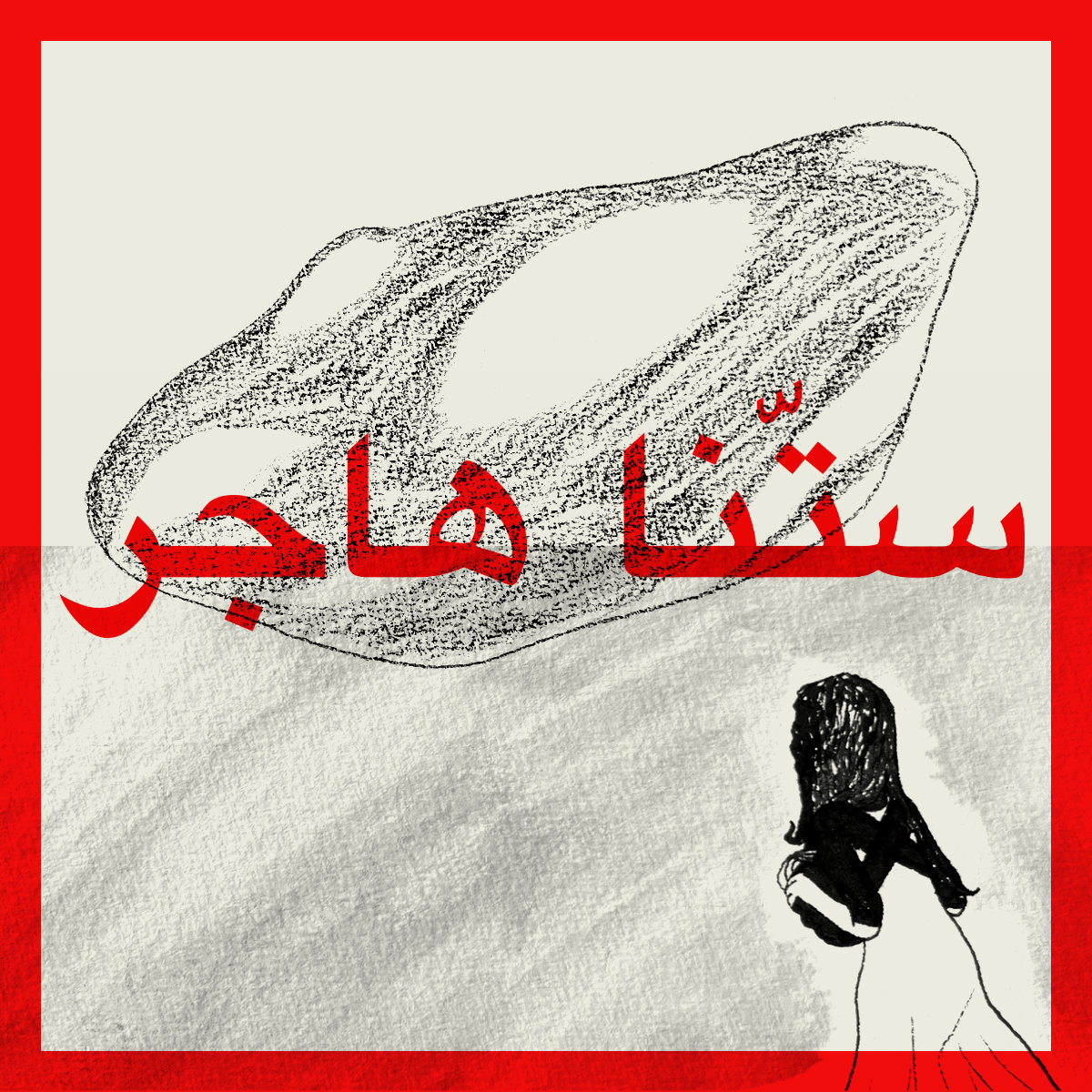
© Karim Ungar
Sittna Hajar and the Sacred House
“Hajar’s sovereignty is not a patriarchal sovereignty that Islamic political thought brings to light through her story. It suggests that people’s worth is measured by their offerings to others.”
Zahiye Kundos
Distillation
Feeling the imminence of death, whether caused by internal forces in one’s body (say, a dysfunction of the placenta, a fatal immune disease), a life threat to a beloved (some mothers believe they carry their children inside them, forever), or externally imposed on a group (say, slavery, genocide), an embodied manual is automatically activated. When death is smelled, tasted, al-rūḥ makes the first move. Seeing al-ʿaql, the mind, in a state of great confusion, unable to grasp or respond to the alerts of acute danger, the spirit withdraws from the body, remaining at a measured distance. Though Prophet Muhammad was advised to answer those curious about it to let it go, “Say, ‘The Spirit is part of my Lord’s domain. You have only been given a little knowledge” (Q, 17:85), it seems that thinkers like Ibn Sina and al-Ghazali have a good basis to speculate that it is made of a subtle vapor that takes the flesh of al-qalb as its seat. Bearing no weight whatsoever, this withdrawal allows the heart to lead on its own, reducing all activities to the minimum necessary circulation of heating and cooling. It is this kind of distillation, to rework a concept used by Audre Lorde in “Poetry Is Not a Luxury”, manifest, once again, through the suspension of the mind, the temporary dislocation of the spirit, and the realization of the heart’s practical knowledge, which prevents the body from initiating an autolysis, or the process of self-dissolving. At the event of survival, little of this experience reaches the tongue, yet its effect is transparent: the shutdown of the I.
On The Monotheist Epic
In the midst of the desert in Mecca’s barren land, at the ruins of the ancient house, Hajar’s skin of water lost weight and sound. Tight to her chest, skin-to-skin, was Ismael, her baby son. Laying the waterskin off her shoulder, Hajar fastened her paces, one-two-three-four-five-six-seven times, circling the two hills that engulfed her, looking for water or people with water. Feeling the heat and sweat of his mother, Ismael has slipped from her chest and settled on her belly; he could still hear the echo of his mother’s whispers, but had become too weak to cling to her dried breasts. With a disturbed mind, Ibrahim was already a few kilometres away, walking beside his donkey on their long, long journey back to the green lands of Can’ān. Sarah, his old companion and the mother of his second son, Ishaq, was sitting at the entrance to their household, waiting for his return; she smelled of fresh bread. In the meantime, a black stone had suddenly shone between the rubble; there stood the angel, a spark in his eyes. Hearing the birds’ excitement, local nomads ran to the place to find the miracle of all miracles: a spring of cold water bursting forth, and a mother and her baby, cooling.
It is easy for all to recognize that the features of these spectacular scenes attest to two traditions at the same time, a mixture of the Muslim and the Judaic, a sequence of events that takes part in the monotheist epic which has been breathing, constantly in motion, ever since, knocking at the gates of each new generation of living Muslims and of ahl al-kitab, the heirs of ‘the people of the Book’, Jews and Christians, demanding from all active re-feeling and relearning.
For Hajar (or Hagar), the valiant woman and nursing mother, her frail, near-death baby, and her exhaustive, insistent circling between the two hills; Ibrahim, the loving, worried father who follows a divine plan, leaving his son and wife at the ruins at the Sacred House of God, the Ka’ba; and the heavenly black stone — uphold essential elements in the story of these ancestors in the Islamic tradition. Abraham’s donkey, the object that Hajar carried with her, khamat mayim or waterskin, Sarah’s strong character, and the household’s rich cuisine are based on the story’s extended version in Genesis. The angel, the revelation of the well, and the birth of Sarah’s son, Ishaq, are approved in both traditions.
The stone that shone, the spark in the angel’s eyes, and the skin-to-skin position are extensions of my imagination. For it seems to me unrealistic that a mother in this acute situation would separate from her baby, as Genesis and the appropriated version in Sahih al-Bukhari suggest. Many centuries stand between Hajar and me, yet I tend to believe that when death was tasted on her dry tongue, she went through a process of distillation; her heart took the lead, not her mind. Staying tight to each other is more likely what most mothers would intuitively do under these extreme circumstances.
Hajar’s part in Genesis marks an exit from the main plot. Her story begins as a slave-girl of Sarah, through whom Sarah chooses to have children, for she was old and had lost hope of bearing children of her own. As argued by Gil Anidjar in his recent book On the Sovereignty of Mothers: The Political as Maternal, Hajar is interesting insofar as she serves, literally and practically, the lives of the main family members, her masters. The Islamic version maintains that Hajar was a slave until she married; however, the point of departure is who she had become after her liberation. And reasonably, where the story begins makes a lot of difference between the two Hajars, defining its repercussions to this day.
In Islam, Hajar is the mother of all mothers. In the year 570 in the Christian calendar, another baby was born, Hajar’s great-grandson, the Prophet Muhammad. Prophet Muhammad was raised and shaped by the environment in which his great-grandmother settled to bring the good news: the renewal of the prophecy of his forefathers, Ismael and Ibrahim, in the center of the Arabian lands, in a Scripture revealed in the Arabic language.
The Qurʾānic exegete Aysha Abd al-Rahman considered Hajar not only as the first female model in Islamic history for her “maternal function,” but also, or mainly, for her “crucial role of leadership” (“Islam and the New Woman”). Sittna Hajar appears warmly in the Hadith, the oral tradition of the Prophet, admirably in the Qurʾān in the contexts of Ibrahim’s stories, and is a vivid role model across diverse Muslim communities. The Revelation of the Qurʾān begins in 610 CE; but the Muslim calendar, the Hijri, begins in 622 CE. This date marks the Hijra, the migration, of the first Muslim community to the city of Yathrib, later named Medina, when they sought refuge from persecution in Mecca. Retrospectively, the meaning of Hajar’s name alludes to her action, her migration from Canaan to Mecca, which, like the migration to Medina, was ordered by God.
Before we demonstrate the literary manifestation of this position by focusing on a single segment of the Qurʾān, it is important not to bypass an enigmatic fact at the outset. “Nearly all the female figures mentioned in the Qur’an appear in conjunction with a family member,” argues Celene Ibrahim in Women and Gender in the Qurʾan, and Sittna Hajar is not one of them. Her name is omitted, and the Qurʾānic references about her are coded. Riffat Hassan finds Sahih al-Bukhari’s account sufficient to reconstruct Hajar’s story and to present her as a heroine (“Islamic Hagar and her Family” in Hagar, Sara, and their Children: Jewish, Christian, and Muslim Perspectives). Hajar’s voice and agency are made clear, as we shall note. Nevertheless, in my opinion, this account fails to grasp the immense potential of this foundational story and is insufficient to counter what Fethi Benslama claims Hajar’s “absence” and “removal from the founding text” (Psychoanalysis and the Challenge of Islam).
Now, if I immediately argue otherwise, for example, that Hajar has “a right to opacity,” lending the poetics of Édouard Glissant, I might risk losing my readers, or worse. I’m afraid I might lose myself by deliberately walking within the confines of the claustrophobic corridor of thought that for the last 200 years or so — meaning since the age of European colonialism or modernity — have held many intelligent Arabs and Muslims, intellectuals and ordinary alike, consciously and unconsciously, captive in the discourse of apologetics, over-celebrating Islam and by doing so ridiculing themselves and Islam, pleading innocence (say, ‘we don’t believe in Islam anymore’), or taking the charge altogether (say, ‘Islam is a misogynist religion’).
But here is what I think: we cannot take this anymore. We are sick of wrestling against the language of ministers of war, we are exhausted of carrying orientalists’ exhaustive paranoias, of looking at ourselves in other people’s mirrors. Such positions have incapacitated us from the need that Asad Q. Ahmed argues for: the need to “reread our traditions in our Eastern languages and within our indigenous systems of thought” (a lecture at Lahore University; my emphasis). Ahmed is right. We have been distracted from ourselves for so long, and from the many things we should be doing: e.g., rebuild the infrastructure of our cities, fix the roads to our destroyed neighbourhoods, reconstruct our demolished houses, draw the plans to our gardens, heal our stuttering tongues, take back all that is ours. For wherever we live, we are homeless. No matter how rich our natural resources are, and how high our towers rise in the deserts, our Islamic past looks exactly like the towers of debris that have been accumulating in Gaza.
Now, bearing in mind the time, energy, and resources we have been investing in resisting stubborn colonial policies, we need to ensure that anything we do serves our agenda. Our attention is especially needed when we pose sensitive, primary questions, such as ‘Where is Sittna Hajar in the Qurʾān?’ If this inquiry serves us, and it certainly does, then we should attend to it without hesitation, without suspicion or dismay, without fear of not finding her in the Qurʾān or of getting lost with her. We shall leave everything else in our hands and summon it with confidence, tranquillity, and curiosity — I mean, positive curiosity.
For even when mothers are apparently absent or quiet, either in their private houses or in the Scriptures, their presence is determined. If you don’t find your mother in the living room, you need to look elsewhere, to follow her wherever she happens to be, whether on the roof or on the terrace, in her desk, in the kitchen, or in your dreams; you should accompany her in whatever activity she thinks is important for her to be doing — reading, cooking, or praying. If it happens and you don’t find her at her house, knock on your neighbours’ houses. It would be best if you just sit attentively and patiently on the stairs at the entrance to her house. Once you recognize her from afar, you must stand and call out loud: ana hon Yamma, ana hon Yamma, so she hears you and knows you are there, waiting for her. Then you must run towards her, release the heavy bags from her swollen fingers, take out each product and place it in its designated place, in the fridge, on the cupboards, on the dining table. You must tidy up exactly as she likes, leave all surfaces clean, and gently close the door before you leave. Just like all houses, all Scriptures bear the portrait of the founding mothers.
On the enigma of Hajar’s omitted name from the Qurʾān
Names and naming are of great value to the Qurʾān’s Teller, who Himself has one hundred names: “Call on God, or on the Lord of Mercy — whatever names you call Him, the best names belong to him” (Q17: 110). A few of the objectives of the Qurʾan is to explain in detail, “We have explained everything in detail” (Q17: 12), to convey what hasn’t been conveyed, “There are the verses of the Scripture that make things clear” (Q12: 1), and tell the best of stories, “We tell you the best of stories in revealing this Qurʾan to you” (Q12: 3). It is then an intelligible Scripture, a revelation that comes to reveal, to say everything about the present, the many pasts and many futures to come. How can one write about Muslim Hajar from her “point of view” as Benslama points out, if she hasn’t been viewed in the first place? Is it really the case that her figure is “intransmissible” in the Qurʾān?
The Qurʾān is very emphatic about the human nature of prophets and their family members, restricting worship to the One God: “There is no God but Me, so serve Me” (Q21:25). For one, it may be that withholding Hajar’s name from the Qurʾān could be to prevent her from becoming what Mariam/Maria has become in Christianity, namely, a worshiped divine figure rather than an honoured woman who received divine guidance. But such a direction isn’t convincing enough since Mariam is comfortably present in the Text.
For another, it may concern the relationships the Islamic Scripture establishes with other Scriptures. Prophet Muhammad is believed to have ended the chain of prophethood among Abraham’s offspring, and the Qurʾān is conceived as a whole and stands on its own. At the same time, it realizes and confirms its precedents:
“So [you believers] say, ‘We believe in God and in what was sent down to us and what was sent down to Abraham, Ismael, Isaac, Jacob, and the Tribes, and what was given to Moses, Jesus, and the prophets by their Lord. We make no distinction between any of them, and we devote ourselves to him” (Q2: 136)
In this sense, Archangel Gabriel’s command to Prophet Muhammad to “read”, known as the first word of revelation, has been extended in practice to read the Bible and the New Testament. In matters of dispute, Muslims’ commitment is, of course, to their Book; nonetheless, to reach a comprehensive understanding of it, they realize they need to consult the other two Books. At any rate, what I am trying to say is that what seems like a “lack” of details and background in the Qurʾān is a decision made by God for theological, hermeneutical, and perhaps also political reasons. In this sense, Muslim Hajar’s story could not be imagined without Jewish Hajar, despite the huge difference in representation.
The eleventh-century renowned literary theorist and scholar of the Qurʾān Abd al-Qaher al-Jurjani argued for the “subtle” and “magical” element in ḥadhf “omission”. According to al-Jurjani, rather than a lack or deficiency, omission enacts the force to pursue meaning:
“It is a path of subtle nuance, gentle in approach, wondrous in effect, and akin to magic; for through it you see that omitting a word is more eloquent than uttering it, and that remaining silent is more instructive than speaking; and you find yourself most articulate when you say nothing, and your meaning is most fully conveyed when you do not make it explicit.” (Dalāʾl al-ʾijaz [The Proofs of Inimitability]).
The Qurʾān forges societal and communal ties as well as speech (“Talk about the blessings of your Lord,” Q 93:11). Yet in certain circumstances, refraining from speech or social contact can be a sign of divine transformation. For example, when Sittna Mariam learned about her soon miraculous pregnancy, she was instructed to withdraw to a far place and not to speak to anyone (Q19:22); Zecharia was also instructed to maintain silence for three days as a sign of having a child at his and his wife’s old age (Q19:10). Like silence, omission may say more, not less.
Given that the general framework of prominent prophets’ stories is already established in earlier Scriptures, the stories narrated in the Qurʾān are not linear but rather circular. This movement intensifies the learning process, prompting recipients to contemplate what hasn’t been said, to notice who is missing from the scene, and to develop their own assumptions. Little by little, they come to understand how Hajar’s suffering explains the life of the Prophet Muhammad, and how Joseph’s hardships explain the life of Moses. Hajar had to gain power in Mecca, and Joseph had to hold high positions in Egypt. Like the spectators of Greek drama, recipients of the Qurʾān know more about the proceedings of the plots than the protagonists themselves. Hajar probably didn’t realize her significant role in the emergence of Islam as a world religion, and Joseph probably did not dream of how his people would fall into slavery and the spectacular miracles God employed to set them free.
Hajar as a symbol of God
In a fragment from Surat al-Baqara, God shares with Prophet Muhammad, the first addressee of the Qurʾān, what his great-grandmother means to Him. Sittna’s name is not mentioned in the Qurʾān, and rocks do not speak (surely not in a human language). Yet, having been ordinary hills until she stood there, the encounter granted al-Safa wa-al-Marwa, and herself, holy status; the three of them are symbols of God Himself:
“We shall certainly test you with a certain degree of fear and hunger, and loss of property, lives, and crops. But [Prophet], give good news to those who are patiently steadfast, those who say, when afflicted with a calamity, ‘we belong to God and to Him we shall return’. These will be given blessings and mercy from their Lord, and it is they who receive My guidance. Behold! Safa and Marwa are among the symbols of God, so for those who make major or minor pilgrimage to the House, it is no offence to circulate between the two. Anyone who does good of his own accord will be rewarded, for God rewards good deeds, and knows everything.” (Q2: 154-157)1
Sincere faith does not spare believers from experiencing “a certain degree” of calamity, and true believers must be able to bear all kinds of genuine losses and dispossession. Certainly, Hajar lived through the test of all tests: a mother losing her child, almost, a mother killing her child, almost. We can feel God’s warmth and admiration towards her, as she genuinely achieved the fine, hard-to-reach theological balance of accepting one’s destiny while making it at the same time. During the Hajj and throughout the year during the minor pilgrimage (the umra), Muslims become Hajar by walking in her footsteps. Hassan is correct, Hajar’s “shadow looms large over the valley where she once stood alone, and her spirit is as inextricably embodied in the Ka’ba as that of her husband Abraham and her son Ismael.”
Ibrahim — the imam of all prophets, the one who enjoyed a “sound heart” (Q37:84) and whose relationship with God is based on friendship (Q 4:125) — was absent from that fearful event. Surat Ibrahim spots his anxiety at the moment he was walking away from his wife and child, confident of salvation, yet so scared to look back:
“O my Lord, I have settled some of my offspring in a barren valley, close to Your Sacred House so that they keep up the prayer. Make people’s hearts turn to them, and provide them with produce, so that they may be thankful.” (Q14:37)
Addressing God, Ibrahim was trying to calm his own distress by reminding himself of the greater cause: to keep up the prayer at the Sacred House. Hajar settles in Mecca, and the hearts indeed turn to the foreign woman in possession of the greatest produce in the desert, an overflowing well of water, supervising its maintenance and fair distribution by herself:
[…] The Prophet added, “Ismael’s mother was sitting near the water. They [the Jurhum people] asked her, ‘Do you allow us to stay with you?’ She replied, “Yes, but you will have no right to possess the water.’ They agreed to do that. The Prophet further said, “Ismael’s mother was pleased with the whole situation as she used to love to enjoy the company of the people.” (Sahih al-Bukhari)
A few years later, the more renowned, successful father-son experience of sacrifice occurs, rewarding Ibrahim and Ismael with the gift of rebuilding the Sacred House. It is important to keep this sequence in mind. Hajar’s esteemed position in Mecca is what enables Ibrahim (who was probably known among the native community as Hajar’s husband) to pursue the reconstruction plan in a foreign land without resistance.
On the age difference of Ismael in Genesis and the Qurān and what that makes us see
In Genesis, the final expulsion of Hajar and Ismael from the family’s household seems especially dramatic. The evening before, they were all busy preparing mishte gadol, a great feast, which Ibrahim initiated to celebrate Ishaq’s weaning (gmila; about 2-3 years old). A few years earlier, on the angels’ way to Lot in Sodom, they stopped by the household to bring the very good news: the soon-to-be conception of Sarah; Sarah’s own miracle, her turn of soft skin, and flowerly, pinky chicks. The distinguished treat offered to the angels at this event inspires us to imagine what was served at Ishaq’s celebration.
Placed under the shadow of the household’s tree, just like where the angels were invited to refresh, the delicious buffet must have had Sarah’s bread and cakes made of choice flour, Ibraham’s specialty, curds and milk, and the main dish, a soft calf, which I imagine Ismael had insisted on sacrificing and cooking by himself for his little beloved brother. This leads me to further assume that the loaf of bread Ibrahim gave Hajar the morning he sent her and his elder son away was leftovers from the party the night before.
Now, considering the timing of that celebration and the 14 years difference between the brothers, Ismael was not a child nor a lad at that time, as alternately described by Genesis’ narrator, but about 16-18 years old. Learning from the characteristics of the family members among whom Ismael was raised, the young man was not only strong-bodied as described, but also stubborn-minded, soft-hearted, and yet hot-tempered, and enjoyed an indispensable degree of self-pride.
This reconstruction suggests a reversal of the events that unfolded for Hajar and Ismael after they were dispossessed of all their belongings. Wandering confused in the wilderness, Hajar must have recalled the radical contrast between the loud, happy evening and the sad, quiet morning, failing to understand how Ibrahim could do this to her, how Sarah could stand there, silent, letting her go after all they had gone through together. We can imagine Ismael, furious, hitting the wind right and left with his stick, cannot believe how his father could do this to him, to him, his right hand, eldest son.
If we go against the narrator’s logic, we see Hajar growing weak, lying down under a bush, and Ismael losing his mind seeing his mother dying from thirst, and not the other way around. All this is still overwhelmingly dramatic. Yet it cancels the basic elements that constitute the Islamic tragedy: No nursing mother, no dying child, no rebuilding of the Ka’ba, no Muhammad, no Islam. There is no bearable age for losing one’s mother, yet it is a kind of loss that goes along with the laws of nature; the young bury the old. It is the killing of children that breaks even hearts made of stone.
Turning to Islamic sources, Sarah is released from any accountability for Hajar’s sufferings or for the split in the household. Just like Moses with Haron, Muslim Ibrahim does not work alone. He shares his revelations and seeks collaboration. According to al-Bukhari, Hajar knew what was at stake. She asked Ibrahim whose decision it was to leave her in the barren valley all alone, his or God’s, and when she understood it was God’s, she fully submitted to her destiny. No surprise her son would do the same a few years later at the event of the sacrifice.
Despite the agency on Hajar’s behalf, I confess that I have some doubts regarding this dialogue. As mentioned in Genesis, Hajar had already begun communicating with the angel of God in Canaan soon after she conceived and ran away from the household the first time. We are told that at this event, when God named her son Ismael “the God who Hears,” she, in turn, named Him El Roi, “The God who sees me.” The moving intimate exchange of names suggests that Hajar may have received direct divine inspiration about her migration, which her husband later may have confirmed.
At any rate, as a woman and mother myself, I am concerned about the duration, of how long things take, because time is all that matters when it comes to our pains, all kinds of pain that only we women know. A rough calculation I made with my friend Gideon shows that it takes about 30-40 days to travel from Canaan to Mecca, either walking or on a donkey. Considering this distance, the long days Hajar and Ibrahim walked together on each side of the donkey, crossing eyes here and there, the many nights they spent observing the stars, she had endless opportunities to withdraw, to change her mind, to plead to Ibrahim to take the baby with him, to tell him to tell Sarah to look after him, to make him promise her to bring him back to her if she survives, or otherwise, return alone, and give her a proper burial, build her a tomb so her son knows he had a mother who loved him.
But she didn’t. Sittna’s story is written in her distillation, in the cracks on her tongue, the scars on her knees. Her story is not read; it is drunk from her overflowing milk, the eternal waters of her well.
*
Each monotheist religion is like a vessel, and “Every vessel drips that which it contains,” as the 12th-century Arabic proverb goes. For you see, it is not the vessel’s mere fullness that makes the difference between life and death, but rather the substance of the liquid each generation pours into it: blood or water, poison or medicine. Hajar’s real power does not stem from ownership over something precious that no one else could have. It is not a patriarchal sovereignty that Islamic political thought brings to light through her story. Her sovereignty suggests that people’s worth is measured by their offerings to others.
- The translation of these verses is a combination of two versions of translations, Ali Yousef, M.A.S Abdel Haleem, and myself.
Distillation
Sentir l’imminence de la mort — qu’elle soit causée par des forces internes au corps (par exemple, un dysfonctionnement du placenta ou une maladie immunitaire mortelle), par une menace pesant sur la vie d’un être aimé (certaines mères croient porter leurs enfants en elles, pour toujours), ou imposée de l’extérieur à un groupe (l’esclavage, le génocide) — active automatiquement un mode d’emploi intégré au corps. Lorsque la mort est humée, goûtée, l’esprit (al-rūḥ) fait le premier geste. Voyant la raison (al-ʿaql), en état de grande confusion, incapable de saisir ou de répondre aux alertes du danger imminent, l’esprit se retire du corps et se tient à une distance mesurée. Bien qu’il ait été ordonné au Prophète Muhammad de répondre à ceux qui l’interrogeaient à ce sujet de ne pas s’en soucier – « Dis : “L’Esprit relève de l’ordre de mon Seigneur. Et il ne vous a été donné que peu de science savoir” » (Coran, 17 : 85) –, il semble que des penseurs tels qu’Ibn Sina et al-Ghazali aient de bonnes raisons de spéculer que l’esprit est fait d’une vapeur subtile qui prend la chair de cœur (’al-qalb) pour siège. Un tel retrait, ne pesant rien, permet au cœur de guider à lui seul, réduisant toutes les activités au minimum nécessaire pour la circulation de la chaleur et du froid. C’est ce type de distillation – pour reprendre un concept employé par Audre Lorde dans « Poetry Is Not a Luxury » –, à nouveau perceptible par la suspension de la raison, la dislocation temporaire de l’esprit et l’actualisation du savoir pratique du cœur, qui empêche le corps d’amorcer une autolyse, c’est-à-dire un processus d’auto-dissolution. Lors de l’événement de la survie, bien peu de cette expérience parvient à la langue, et pourtant son effet est manifeste : l’extinction du Je.
Dans l’épopée monothéiste
Au milieu du désert, sur la terre aride de La Mecque, auprès des ruines de l’antique Maison, l’outre d’eau de Hagar perdit poids et bruit. Contre sa poitrine, peau contre peau, se trouvait Ismaël, son nourrisson. Déposant l’outre de son épaule, Hagar pressa le pas, une-deux-trois-quatre-cinq-six-sept fois, tournant entre les deux collines qui l’engloutissaient, en quête d’eau ou de gens ayant de l’eau. Sentant la chaleur et la sueur de sa mère, Ismaël avait glissé de sa poitrine pour s’établir sur son ventre ; il pouvait encore entendre l’écho de ses murmures, mais s’était trop affaibli pour s’accrocher à ses seins taris. Ibrahim, l’esprit troublé, était déjà à quelques kilomètres, marchant à côté de son âne sur le long, long chemin du retour vers les terres verdoyantes de Canaan. Sarah, sa compagne de longue date et la mère de son second fils, Ishaq, était assise à l’entrée de leur demeure, attendant son retour ; elle sentait le pain frais. Pendant ce temps, une pierre noire s’était soudain mise à luire parmi les décombres ; là se tenait l’ange, une étincelle dans les yeux. Entendant l’émoi des oiseaux, des nomades des environs accoururent et découvrirent le miracle des miracles : une source d’eau froide jaillissant, une mère et son nourrisson se rafraîchissant.
Quiconque peut aisément reconnaître que les caractéristiques de ces scènes spectaculaires témoignent de deux traditions à la fois, un mélange de l’islamique et du judaïque, une séquence d’événements s’inscrivant dans l’épopée monothéiste laquelle respire depuis lors, en mouvement constant, frappant aux portes de chaque nouvelle génération de musulmans vivants et des ahl al-kitāb, les héritiers des « gens du Livre », Juifs et Chrétiens, exigeant de tous un re-sentir actif et un réapprentissage.
Car Hajar (ou Hagar), la femme vaillante et mère allaitante, son nourrisson frêle et presque mort, et son tournoiement épuisant et obstiné entre les deux collines ; Ibrahim, le père aimant et inquiet qui suit un dessein divin, laissant son fils et sa femme aux ruines de la Maison sacrée de Dieu, la Kaʿba ; et la pierre noire céleste — portent des éléments essentiels du récit de ces ancêtres dans la tradition islamique. L’âne d’Abraham, l’objet que Hajar emporta avec elle, khamat mayimou outre d’eau, la forte personnalité de Sarah et la cuisine copieuse de la maisonnée reposent sur la version longue du récit dans la Genèse. L’ange, la révélation du puits et la naissance du fils de Sarah, Ishaq, sont attestés dans les deux traditions.
La pierre qui brilla, l’étincelle dans les yeux de l’ange et la position peau contre peau sont des prolongements de mon imagination. Car il me semble irréaliste qu’une mère dans cette situation critique se sépare de son nourrisson, comme le suggèrent la Genèse et la version reprise dans le Sahih al-Bukhari. Des siècles nous séparent, Hajar et moi, et pourtant j’ai tendance à croire que, lorsque sa langue sèche goûta la mort, elle traversa un processus de distillation ; ce fut son cœur qui guida, et non son esprit. Rester serrés l’un contre l’autre est probablement ce que feraient d’instinct la plupart des mères dans ces circonstances extrêmes.
La place de Hajar dans la Genèse marque une sortie de l’intrigue principale. Son histoire commence en tant que servante de Sarah, choisie pour lui donner des enfants, car cette dernière était âgée et avait perdu l’espoir d’en porter elle-même. Comme l’affirme Gil Anidjar dans son ouvrage récent On the Sovereignty of Mothers: The Political as Maternal, Hagar est intéressante dans la mesure où elle est au service, au sens propre comme dans les faits, de la vie des principaux membres de la famille, ses maîtres. La version islamique maintient que Hajar fut esclave jusqu’à son mariage ; cependant, le point de départ est ce qu’elle devint après son affranchissement. Et, de façon logique, l’endroit où commence le récit représente une différence importante entre les deux Hajar, différence dont les répercussions se prolongent jusqu’à ce jour.
Dans l’islam, Hajar est la mère de toutes les mères. En l’an 570 du calendrier chrétien naquit un autre nourrisson, l’arrière-petit-fils de Hajar, le Prophète Muhammad. Il fut élevé et façonné par l’environnement où s’était établie son arrière-grand-mère pour annoncer la bonne nouvelle : le renouvellement de la prophétie de ses aïeux, Ismaël et Ibrahim, au cœur des terres arabes, dans une Écriture révélée en langue arabe.
Dans son exégète coranique, l’autrice égyptienne, Aysha Abd al-Rahman, considérait Hajar comme le premier modèle féminin de l’histoire islamique non seulement pour sa « fonction maternelle », mais aussi – et surtout – pour son « rôle crucial de leadership » (voir « Islam and the New Woman »). Sittna Hajar est décrite sous un jour chaleureux dans les hadiths, la tradition orale du Prophète ; elle apparaît de façon admirable dans le Coran dans le contexte des récits d’Ibrahim ; et elle est un modèle vivant au sein de diverses communautés musulmanes. La révélation du Coran commence en 610 après J.-C. ; mais le calendrier musulman, hégirien, commence en 622. Cette date marque la Hijra, la migration de la première communauté musulmane vers la ville de Yathrib – plus tard nommée Médine – en quête d’un refuge contre la persécution subie à La Mecque. Rétrospectivement, le sens du nom de Hajar renvoie à son action, à sa migration de Canaan vers La Mecque qui, comme la migration vers Médine, fut ordonnée par Dieu.
Avant de démontrer la manifestation littéraire de ce positionnement en nous concentrant sur un seul passage du Coran, il est important, d’emblée, de ne pas passer outre un fait énigmatique. « Presque toutes les figures féminines mentionnées dans le Coran apparaissent en lien avec un membre de la famille », affirme Celene Ibrahim dans Women and Gender in the Qurʾan, et Sittna Hajar n’est pas de celles-là. Son nom est omis, et les références coraniques à son sujet sont codées. Riffat Hassan estime que le récit du Sahih al-Bukhari suffit à reconstruire l’histoire de Hajar et à la présenter en héroïne (« Islamic Hagar and her Family », dans Hagar, Sarah, and their Children: Jewish, Christian, and Muslim Perspectives). Comme nous le verrons, la voix et l’agentivité de Hajar y sont manifestes. À mon sens néanmoins, ce témoignage ne permet pas de saisir l’immense potentiel de ce récit fondateur et ne suffit pas à infirmer ce que Fethi Benslama nomme l’« absence » de Hajar et son « retrait du texte fondateur » (La psychanalyse à l’épreuve de l’islam).
Si je soutenais aussitôt le contraire, en disant par exemple que Hajar a un « droit à l’opacité », pour emprunter la poétique d’Édouard Glissant, je risquerais de perdre mes lecteurs, ou pire. Je crains de me perdre moi-même en marchant délibérément dans les limites du couloir exigu de la pensée qui, depuis quelque deux cents ans – c’est-à-dire depuis l’âge du colonialisme européen ou de la modernité – , tient captifs dans le discours de l’apologétique bien des Arabes et des musulmans intelligents, intellectuels comme gens ordinaires, consciemment et inconsciemment, célébrant l’islam à l’excès et par-là le – et se – ridiculisant, plaidant l’innocence (« nous ne croyons plus en l’islam », par exemple), ou endossant purement et simplement l’accusation (« l’islam est une religion misogyne »).
Mais voici ce que je pense : nous ne pouvons plus endurer cela. Nous sommes las de lutter contre le langage des ministres de la guerre, épuisés de porter les paranoïas éreintantes des orientalistes et de nous regarder dans le miroir des autres. De telles positions nous ont rendus incapables de répondre au besoin que défend Asad Q. Ahmed : celui de « relire nostraditions dans nos langues orientales et au sein de nos systèmes de pensée indigènes » (conférence à l’Université de Lahore ; je souligne). Ahmed a raison. Nous avons été détournés pendant si longtemps de nous-mêmes et des multiples choses que nous devrions faire : par exemple, reconstruire les infrastructures de nos villes, réparer les routes vers nos quartiers détruits, rebâtir nos maisons démolies, dessiner les plans de nos jardins, guérir nos langues bégayantes, reprendre tout ce qui est à nous. Car où que nous vivions, nous sommes sans abri. Aussi riches que soient nos ressources naturelles, et aussi hautes que s’élèvent nos tours dans les déserts, notre passé ressemble exactement aux tours de gravats qui s’accumulent à Gaza.
À présent, gardant à l’esprit le temps, l’énergie et les ressources que nous ne cessons d’investir pour résister à des politiques coloniales obstinées, nous devons nous assurer que tout ce que nous faisons soit au service de notre agenda. Notre attention est particulièrement requise lorsque nous posons des questions sensibles et primordiales, telles que : « Où est Hajar dans le Coran ? » Si cette interrogation nous sert – et c’est assurément le cas –, alors nous devons nous y consacrer sans hésitation, soupçon ou consternation, sans crainte de ne pas la trouver dans le Coran ou de nous perdre avec elle. Nous laisserons tout ce qui reste entre nos mains et nous l’invoquerons avec confiance, tranquillité et curiosité – une curiosité positive, j’entends.
Car même lorsque les mères paraissent absentes ou silencieuses, dans leurs demeures privées ou dans les Écritures, leur présence est affirmée. Si tu ne trouves pas ta mère au salon, il te faut chercher ailleurs, la suivre où qu’elle soit, sur le toit ou sur la terrasse, à son bureau, dans la cuisine ou dans tes rêves ; tu dois l’accompagner dans toute activité qu’elle estime importante pour elle d’accomplir – lire, cuisiner ou prier. S’il arrive que tu ne la trouves pas chez elle, frappe à la porte des voisins. Le mieux serait que tu t’assoies attentivement et patiemment sur les marches à l’entrée de sa maison. Dès que tu la reconnais de loin, tu dois te lever et appeler à voix haute, ana hon Yamma, ana hon Yamma (je suis là maman, je suis là maman), afin qu’elle t’entende et sache que tu es là et l’attends. Puis tu dois courir vers elle, libérer les lourds sacs de ses doigts gonflés, sortir chaque produit et le ranger à sa place assignée, dans le réfrigérateur, sur les étagères, sur la table à manger, sur le buffet. Tu dois ranger exactement comme elle l’aime, laisser toutes les surfaces propres, et refermer doucement la porte avant de partir. À l’image de toutes les maisons, toutes les Écritures portent le portrait des mères fondatrices.
Sur l’absence énigmatique du nom de Hajar dans le Coran
Les noms et le fait de nommer revêtent une grande importance pour le Locuteur du Coran, qui a Lui-même cent noms : « Invoquez Dieu, ou invoquez le Tout-Miséricordieux ; quel que soit le nom par lequel vous L’invoquez, les plus beaux noms lui appartiennent » (Coran 17 : 110). Parmi les objectifs du Coran, il y a celui d’expliquer en détail – « Et Nous avons exposé toute chose en détail » (17 : 12) –, de transmettre ce qui n’a pas été transmis – « Voici les versets du Livre explicite» (12 : 1) –, et de conter le plus beau des récits – « Nous te racontons le meilleur des récits en te révélant ce Coran » (12 : 3). C’est donc une Écriture intelligible, une révélation qui vient révéler, tout dire du présent, des multiples passés et des multiples futurs à venir. Comment peut-on écrire sur la Hajar musulmane depuis son « point de vue », comme le relève Benslama, si elle n’a pas été vue en premier lieu ? Est-il vrai que sa figure est « intransmissible » dans le Coran ?
Le Coran insiste avec force sur la nature humaine des prophètes et des membres de leur famille, réservant l’adoration au Dieu unique : « Il n’y a d’autre dieu que Moi, adore-Moi donc » (21 : 25). D’une part, il se peut que le fait de ne pas mentionner le nom de Hajar dans le Coran vise à empêcher qu’elle ne devienne ce que Mariam/Marie est devenue dans le christianisme, à savoir une figure divine adorée plutôt qu’une femme honorée ayant reçu une guidance divine. Mais une telle interprétation n’est pas suffisamment convaincante, puisque Mariam est bien présente dans le Texte.
D’autre part, cela peut avoir trait aux relations que l’Écriture islamique établit avec les autres Écritures. Le Prophète Muhammad est réputé avoir clos la chaîne de la prophétie parmi la descendance d’Abraham, et le Coran est conçu comme un tout, se suffisant à lui-même. En même temps, il actualise et confirme ses précédents :
« Dites : “Nous croyons en Dieu et en ce qui nous a été révélé, et en ce qui a été révélé à Abraham, Ismaël, Isaac, Jacob et aux Tribus, et en ce qui a été donné à Moïse, à Jésus et aux prophètes de la part de leur Seigneur ; nous ne faisons de différence entre aucun d’eux, et à Lui nous sommes soumis” » (Coran 2 : 136)
En ce sens, l’ordre de l’archange Gabriel au Prophète Muhammad de « lire », connu comme le premier mot de la révélation, a été étendu en pratique à la lecture de la Bible et du Nouveau Testament. En matière de désaccords, les musulmans sont bien sûr fidèles à leur Livre ; néanmoins, pour atteindre une compréhension exhaustive de celui-ci, ils réalisent avoir besoin de consulter les deux autres Livres. Quoi qu’il en soit, ce que je cherche à dire, c’est que ce qui ressemble à un « manque » de détails et de contexte dans le Coran est une décision prise par Dieu pour des raisons théologiques et herméneutiques. En ce sens, l’histoire de la Hajar musulmane ne pourrait être envisagée sans la Hagar juive, malgré la différence importante de représentation.
Le célèbre théoricien littéraire et savant du Coran du XIème siècle, Abd al-Qāhir al-Jurjānī, a argué de l’élément « subtil » et « magique » du ḥadhf, l’« omission ». Selon al-Jurjānī, plutôt qu’un manque ou une insuffisance, l’omission engendre la force permettant de traquer le sens :
« C’est une voie d’une nuance subtile, douce dans son approche, à l’effet merveilleux, semblable à la magie ; car, par elle, tu comprends que taire un mot est plus éloquent que le dire, que rester silencieux est plus instructif que parler ; tu te trouves le plus éloquent lorsque tu ne dis rien, et le sens de ton propos est le plus pleinement transmis lorsque tu ne l’explicites pas » (Dalāʾil al-iʿjāz, « Le propos sur l’omission », p. 146)
Le Coran tisse des liens sociaux et communautaires comme le fait la parole (« Quant au bienfait de ton Seigneur, proclame-le », 93 : 11). Pourtant, en certaines circonstances, s’abstenir de parler ou d’avoir un contact social peut être le signe d’une transformation divine. Ainsi, lorsque Sittna Mariam apprit sa grossesse miraculeuse à venir, il lui fut prescrit de se retirer en un lieu éloigné et de ne parler à personne (19 : 22) ; Zacharie reçut lui aussi l’ordre d’observer le silence trois jours, comme signe d’un enfant à naître alors que lui et sa femme étaient d’un âge avancé (19 : 10). Comme le silence, l’omission peut dire davantage, non moins.
Étant donné que le cadre général des récits des prophètes éminents est déjà établi dans les Écritures antérieures, les récits narrés dans le Coran ne sont pas linéaires mais plutôt circulaires. Ce mouvement intensifie le processus d’apprentissage, incitant les destinataires à méditer sur ce qui n’a pas été dit, à remarquer qui manque à la scène et à développer leurs propres suppositions. Peu à peu, ils en viennent à comprendre comment la souffrance de Hajar éclaire la vie du Prophète Muhammad, et comment les épreuves de Joseph éclairent la vie de Moïse. Il fallait que Hajar gagnât en puissance à La Mecque, et que Joseph occupât de hautes fonctions en Égypte. Tels les spectateurs de la tragédie grecque, les destinataires du Coran en savent plus sur le déroulement des intrigues que les protagonistes eux-mêmes. Hajar ne mesurait probablement pas son rôle considérable dans l’émergence de l’islam comme religion mondiale, et Joseph ne rêvait probablement pas de la façon dont son peuple tomberait en esclavage, ni des miracles spectaculaires que Dieu emploierait pour le libérer.
Hajar comme symbole de Dieu
Dans un fragment de la sourate al-Baqara, Dieu partage avec le Prophète Muhammad, le premier destinataire du Coran, ce que son arrière-grand-mère représente pour Lui. Le nom de Sittna n’est pas mentionné dans le Coran, et les rochers ne parlent pas (certainement pas dans un langage humain). Pourtant, alors qu’elles n’avaient été que des collines ordinaires jusqu’à ce qu’elle s’y tînt, la rencontre a conféré à al-Safa et al-Marwa, et à elle-même, un statut sacré ; tous trois sont des symboles de Dieu Lui-même :
« Nous vous éprouverons certes par un peu de peur, de faim, et de perte de biens, de personnes et de récoltes. Mais [Prophète], annonce la bonne nouvelle aux endurants, ceux qui, atteints d’un malheur, disent : “Nous appartenons à Dieu et à Lui nous retournons.” Ceux-là reçoivent bénédictions et miséricorde de leur Seigneur, et ceux-là sont les bien-guidés. En vérité, al-Safa et al-Marwa comptent parmi les symboles de Dieu ; quiconque fait le grand ou le petit pèlerinage à la Maison ne commet pas de faute à faire les allées et venues entre elles. Et quiconque fait le bien de son plein gré, Dieu est reconnaissant et savant » (Coran 2 : 155-158)
La foi sincère n’épargne pas les croyants de l’épreuve d’« un certain degré » de calamité, et les vrais croyants doivent être capables de supporter toutes sortes de pertes et de véritables dépossessions. Hajar a assurément vécu l’épreuve de toutes les épreuves : une mère perdant presque son enfant, une mère tuant presque son enfant. Nous pouvons ressentir la chaleur et l’admiration de Dieu à son égard, car elle a véritablement atteint ce subtil équilibre théologique, difficile à réaliser : accepter son destin tout en le façonnant. Durant le Hajj, et tout au long de l’année lors du petit pèlerinage (la ʿumra), les musulmans deviennent Hajar en marchant sur ses pas. Riffat Hassan a raison, « l’ombre de Hajar plane largement sur la vallée où elle se tint jadis seule, et son esprit est aussi inextricablement incarné dans la Kaʿba que celui de son mari Abraham et de son fils Ismaël ».
Ibrahim – l’imam de tous les prophètes, celui qui vint à son Seigneur « d’un cœur sain » (37 : 84) et dont la relation à Dieu repose sur l’amitié (4 : 125) – était absent de cet événement terrifiant. La sourate Ibrahim met en lumière son angoisse au moment où il s’éloignait de son épouse et de son enfant, confiant dans le salut, mais pourtant si effrayé de se retourner :
« Ô mon Seigneur, j’ai établi une partie de ma descendance dans une vallée sans culture, auprès de Ta Maison sacrée, afin, ô notre Seigneur, qu’ils accomplissent la prière. Fais que les cœurs de certains hommes penchent vers eux, et pourvois-les de fruits, afin qu’ils soient reconnaissants » (Coran 14 : 37)
S’adressant à Dieu, Ibrahim tentait d’apaiser sa propre détresse en se rappelant la cause supérieure : accomplir la prière à la Maison sacrée. Hajar s’établit à La Mecque, et les cœurs se tournent effectivement vers la femme étrangère détentrice du plus grand bien du désert, un puits d’eau débordant, dont elle supervise elle-même l’entretien et la juste distribution. Et voici comment le Sahih al-Bukhari commente la scène par un hadith prophétique :
«Le Prophète dit : “[Des gens de la tribu Jurhum] trouvèrent la mère d’Ismaël auprès de l’eau et lui dirent : “Nous permets-tu de nous établir auprès de toi ?” Elle répondit : “Oui, mais vous n’aurez aucun droit sur l’eau.” Ils acceptèrent. Le Prophète dit alors : “La situation convenait à la mère d’Ismaël, qui aimait la compagnie des gens.” »
Quelques années plus tard survient l’expérience du sacrifice, plus célèbre et couronnée de succès, entre le père et le fils, récompensant Ibrahim et Ismaël du don de reconstruire la Maison sacrée. Il importe de garder cette séquence à l’esprit. La position estimée de Hajar à La Mecque est ce qui permet à Ibrahim (qui était probablement connu de la communauté locale comme le mari de Hajar) de poursuivre le projet de reconstruction en terre étrangère sans résistance.
Sur la différence d’âge d’Ismaël dans la Genèse et le Coran, et sur ce qu’elle nous donne à voir
Dans la Genèse, l’expulsion finale de Hajar et d’Ismaël du foyer familial paraît particulièrement dramatique. La veille au soir, tous étaient affairés à préparer un mishte gadol, un grand festin, qu’Ibrahim avait organisé pour célébrer le sevrage d’Ishaq (gmila ; vers deux ou trois ans). Quelques années plus tôt, alors qu’ils étaient en route vers Loth à Sodome, les anges s’étaient arrêtés au foyer pour apporter la très bonne nouvelle : la conception à venir de Sarah ; le miracle de Sarah elle-même, le retour de sa peau douce et de ses joues roses et fleuries. Le mets distingué offert aux anges à cette occasion nous invite à imaginer ce qui fut servi à la célébration d’Ishaq.
Placé sous l’ombre de l’arbre du foyer, là même où les anges avaient été invités à se rafraîchir, le délicieux buffet devait comporter le pain et les gâteaux de Sarah faits de fleur de farine, la spécialité d’Ibrahim, le caillé et le lait, et le plat principal, un veau tendre, qu’Ismaël, j’imagine, avait insisté pour sacrifier et cuisiner lui-même pour son petit frère bien-aimé. Cela me conduit à supposer, en outre, que la miche de pain qu’Ibrahim donna à Hajar le matin où il les renvoya, elle et son fils aîné, était un reste de la fête de la nuit précédente.
À présent, si l’on considère le moment de cette célébration et les quatorze années d’écart entre les frères, Ismaël n’était alors ni un enfant ni un jeune garçon, comme décrit alternativement par le narrateur de la Genèse, mais un jeune homme d’environ seize ou dix-huit ans. Si l’on tire une leçon des caractéristiques des membres de la famille parmi lesquels il fut élevé, le jeune homme n’était pas seulement robuste comme on le décrit, mais aussi têtu, tendre de cœur, et pourtant au tempérament vif, et non sans une part indispensable de fierté.
Cette reconstruction suggère un renversement des événements qu’ont connus Hajar et Ismaël après avoir été dépossédés de tous leurs biens. Errant désemparée dans le désert, Hajar dut se remémorer le contraste saisissant entre la soirée bruyante et joyeuse et la matinée triste et silencieuse, incapable de comprendre comment Ibrahim avait pu lui faire cela, et comment Sarah avait pu se tenir là, silencieuse, la laissant partir après tout ce qu’elles avaient traversé ensemble. On peut imaginer Ismaël, furieux, frappant l’air de son bâton à droite et à gauche, ne pouvant croire que son père ait pu lui faire cela, à lui, son bras droit, son fils aîné.
Et si nous allons à l’encontre de la logique du narrateur, nous voyons Hajar s’affaiblir et s’allonger sous un buisson, et Ismaël perdre la raison en voyant sa mère mourir de soif, non l’inverse. Tout cela demeure profondément dramatique. Mais cela efface les éléments fondamentaux qui constituent la tragédie islamique : pas de mère allaitante, pas d’enfant mourant, pas de reconstruction de la Kaʿba, pas de Muhammad, pas d’islam. Il n’est pas d’âge supportable pour perdre sa mère, et pourtant c’est une perte qui s’inscrit dans les lois de la nature ; les jeunes enterrent les anciens. C’est le meurtre des enfants qui brise jusqu’aux cœurs de pierre.
Si l’on se tourne vers les sources islamiques, Sarah est déchargée de toute responsabilité dans les souffrances de Hajar ou dans la scission du foyer. Car, tout comme Moïse avec Aaron, l’Ibrahim musulman n’œuvre pas seul. Il partage ses révélations et cherche la collaboration. Selon al-Bukhari, Hajar savait ce qui était en jeu. Elle demanda à Ibrahim de qui venait la décision de la laisser seule dans la vallée aride : de lui, ou de Dieu ? Et lorsqu’elle comprit que c’était l’ordre de Dieu, elle se soumit pleinement à son destin. Rien d’étonnant à ce que son fils fît de même quelques années plus tard, lors de l’événement du sacrifice.
Malgré l’agentivité reconnue ici à Hajar, j’avoue nourrir quelques doutes sur ce dialogue. Comme il est rapporté dans la Genèse, Hajar avait déjà commencé à communiquer avec l’ange de Dieu à Canaan, peu après avoir conçu et fui le foyer une première fois. Il nous est dit qu’à cet événement, lorsque Dieu nomma son fils Ismaël, « le Dieu qui entend », elle Le nomma à son tour El Roï, « le Dieu qui me voit ». Cet échange intime et émouvant de noms suggère que Hajar a peut-être reçu une inspiration divine directe au sujet de sa migration, peut-être confirmée par son mari plus tard.
Quoi qu’il en soit, étant moi-même femme et mère, la question de la durée me préoccupe, le temps que prennent les choses, car le temps est tout ce qui compte lorsqu’il s’agit de nos douleurs, de toutes les douleurs que nous seules, femmes, connaissons. Un calcul approximatif que j’ai fait avec mon ami Gideon montre qu’il faut environ trente à quarante jours pour voyager de Canaan à La Mecque, à pied ou à dos d’âne. Compte tenu de cette distance, des longues journées que Hajar et Ibrahim marchèrent ensemble de part et d’autre de l’âne, croisant leurs regards çà et là, des nombreuses nuits passées à observer les étoiles, elle eut d’infinies occasions de reculer, de changer d’avis, de supplier Ibrahim d’emmener le nourrisson avec lui, de lui demander de dire à Sarah de veiller sur lui, de lui faire promettre de le lui ramener si elle survivait, ou, à défaut, de revenir seul et de lui donner une sépulture digne, de lui bâtir une tombe pour que son fils sache qu’il avait eu une mère qui l’aimait.
Mais elle ne le fit pas. L’histoire de Hajar est écrite dans sa distillation, dans les crevasses de sa langue, dans les cicatrices de ses genoux. Son histoire ne se lit pas ; elle se boit dans son lait débordant, dans les eaux éternelles de son puits.
*
Chaque religion monothéiste est semblable à un vase, et « tout vase laisse suinter ce qu’il contient », comme le dit le proverbe arabe du XIIème siècle. Car, voyez-vous, ce n’est pas la simple plénitude du vase qui fait la différence entre la vie et la mort, mais la substance du liquide que chaque génération y verse : sang ou eau, poison ou remède. La véritable puissance de Hajar ne provient pas de la possession de quelque chose de précieux que nul autre ne pourrait détenir. Ce n’est pas une souveraineté patriarcale que la pensée politique islamique met en lumière à travers son histoire. Sa souveraineté suggère que la valeur des êtres se mesure à ce qu’ils offrent aux autres.
זיקוק
כאשר חשים בקִרבת המוות — בין שהוא נגרם על ידי כוחות פנימיים בגוף (למשל, תפקוד לקוי של השִליה, מחלה חיסונית קטלנית), בין שהוא איום על חייו של אדם אהוב (יש אמהות המאמינות שהן נושאות את ילדיהן בתוכן, לנצח), ובין שהוא נכפה מבחוץ על קבוצה שלמה (למשל עבדות, רצח עם) — מופעל אוטומטית מדריך המוטבע בגוף. כאשר מריחים את המוות, מרגישים את טעמו על הלשון, אל-רוח עושה את הצעד הראשון. בראותה את אל-עקל, השֵכל, במצב של מבוכה גדולה, בלתי מסוגל לתפוס את ההתרעות על הסכנה המיָדית או לתת לה מענה, הרוח נסוגה מן הגוף ונותרת במרחק מדוד. אף שהנביא מֻחמד הונחה להשיב לסקרנים אודות טבע הרוח שיניחו לה — “אמור, הרוח היא דבר ריבוני, ואתם קיבלתם אך מעט מן הידע” (הקֻראן, 17:85)1 — נראה שלהוגים כגון אבן סינא ואל-ע’זאלי יש בסיס טוב לשַער כי היא עשויה אֵד דק העושה את לַטִיפַת אל-קאלב, הלב, למקום מושבו. על אף היותה חסרת כל משקל, מאפשרת נסיגה זו ללב להוביל לבדו, ומצמצמת את כל הפעילויות למינימום ההכרחי של מחזור חימום וקירור. אם לחדש מושג שאוֹדרי לורד משתמשת בו ב-“Poetry is not Luxury” —סוג הזיקוק הזה, שמתגלה, שוב, דרך השעיית השֵכל, העתקתה הזמנית של הרוח, ומימוש ידיעתו המעשית של הלב, הוא שמונע מן הגוף לפתוח באוטוליזה, כלומר בתהליך של התפרקות עצמית. ובמקרה של הישרדות, רק מעט מן החוויה הזאת מגיע אל הלשון, אך השפעתה שקופה: כיבוי האני.
על האֶפוס המונותאיסטי
בלב המדבר, על אדמתה הצחיחה של מֶכָּה, לרגלי חורבות הבית העתיק, נאד המים של האג’ר אִבּד את משקלו ואת קולו. צמוד אל חזהּ, עור אל עור, היה יִשמעאל, בנהּ התינוק. בהורידה את הנאד מעל כתפהּ, הֵאיצה האג’ר את צעדיה, אחת-שתיים-שלוש-ארבע-חמש-שש-שבע פעמים, מקיפה את שתי הגבעות שעטפו אותה, מחפשת מים או אנשים עם מים. בהרגישו את חום אמו ואת זֵעתהּ, יִשמעאל החליק מעל חזהּ והתיישב על בטנהּ; הוא עדיין שמע את הֵד לחישותיה, אך נעשה חלש מכדי להיאחז בשדיה היבֵשים. איברהים, טרוד בדעתו, כבר היה במרחק כמה קילומטרים ממכה, פוסע לצד חמורו בדרך הארוכה חזרה אל אדמות כנען המוריקות. שרה, בת לווייתו הזקֵנה ואם בנו השני, יצחק, ישבה בפתח ביתם, ממתינה לשובו; ריח לחם טרי נדף ממנה. בינתיים, אבן שחורה הבזיקה לפתע בין החורבות; שם עמד המלאך, ניצוץ בעיניו. בשומעם את התרגשות הציפורים, נוודים מקומיים מיהרו אל המקום למצוא את פֶלא הפלאים: מעיין של מים קרים מפכה, ואם ותינוקהּ, מצטננים.
קל לזהות שמתאריהם של המחזות המרהיבים הללו מעידים על שתי מסורות בעת ובעונה אחת, תערובת של המוסלמי והיהודי, רצף של אירועים הנוטל חלק באֶפוס המונותאיסטי שנושם, בתנועה מתמדת, מאז ועד היום, ומתדפק על שערי כל דור חדש של מוסלמים חיים ושל אהל אל-כיתאב, יורשי “עם הספר”, יהודים ונוצרים, ותובע מכולם לפעול כדי לחוש מחדש וללמוד מחדש.
כי האג’ר (או הגר), האישה האמיצה והאם המניקה, תינוקהּ השברירי קרוב למוות, וסיבוביה המתישים והעיקשים בין שתי הגבעות; איברהים, האב האוהב והמודאג הממלא את התוכנית האלוהית, מותיר את בנו ואשתו בחורבות הבית המקודש לאל, הכעבּה; והאבן השחורה השמימית — כל אלה הם יסודות מהותיים בסיפור הקדום והמכונן הזה במסורת האסלאמית. חמורו של אברהם, החפץ שהאג’ר נשׂאה עמהּ, חמת המים, או נאד המים, אופייהּ החזק של שרה, ומטבחו העשיר של הבית — מבוססים על הגרסה המורחבת של הסיפור בספר בראשית. המלאך, התגלות הבאר, והולדת בנהּ של שרה, יצחק, מאושרים בשתי המסורות.
ואילו האבן שהבזיקה, הניצוץ בעיני המלאך, ותנוחת העור-אל-עור, הם הרחבות מדמיוני שלי. כי נדמה לי בלתי מציאותי שאם, במצב חמור זה, תיפרד מתינוקהּ, כפי שמשתמע מספר בראשית ומן הגרסה המאומצת בצחיח אל-בוח’ארי. מאות שנים רבות מפרידות בין האג’ר לביני, ובכל זאת אני נוטה להאמין שכאשר עלה טעם המוות על לשונהּ היבֵשה, היא עברה תהליך של זיקוק; לבהּ נטל את ההגה, לא שכלה. בנסיבות קיצוניות כאלו, רוב האמהות היו קרוב לוודאי ובאופן אינסטינקטיבי מצמידות את ילדן לחזיהן.
חֶלקהּ של האג’ר בספר בראשית מסמן יציאה מן העלילה המרכזית. סיפורהּ מתחיל כשפחה של שרה, אשר שרה בוחרת להביא ילדים דרכהּ, כי הזקינה ואיבדה תקווה ללדת בעצמהּ. כפי שטוען גיל אנידג’אר בספרו On the Sovereignty of Mothers: The Political as Maternal, דמותה של האג’ר מעניינת כל עוד שהיא משרתת, מילולית ומעשית, את חיי בני המשפחה המרכזיים, אדוניה. הגרסה האסלאמית משמרת את העובדה שהאג’ר הייתה שפחה עד שנישאה. אולם נקודת המוצא בגרסה זו היא מי שהאג׳ר נהייתה לאחר שחרורהּ. לכן סביר להניח שהמקום שבו הסיפור מתחיל יוצר הבדל גדול בין שתי ההאג’רות, ומגדיר את השלכותיו של סיפור זה עד עצם היום הזה.
באסלאם, האג’ר היא אם כל האמהות. בשנת 570 ללוח הנוצרי נולד תינוק אחר, נִינהּ של האג’ר, הנביא מֻחמד. הנביא מֻחמד, עליו השלום, גדל ואישיותו התעצבה בסביבה שבה השתקעה סבתא רבא שלו כדי להביא את הבשׂורה הטובה: חידוש נבואת אבותיו, יִשמעאל ואיברהים, בלב ארצות ערב, בכתב קודש שהתגלה בשפה הערבית.
פרשנית הקֻראן עאישה עבּד אל-רחמן ראתה בהאג’ר את המודל הנשי הראשון בהיסטוריה האסלאמית לא רק בזכות “תפקידהּ האימהי”, אלא גם, ובעיקר, בזכות “תפקידה המכריע כמנהיגה” (“Islam and the New Woman”). סִתּנא האג’ר מופיעה בחום בחדית’, מסורת הנביא שבעל פה, ובאורח מעורר הערצה בקֻראן בהקשר של סיפורי איברהים, והיא מופת חי בקרב קהילות מוסלמיות מגוונות מסביב לעולם. התגלות הקֻראן מתחילה בשנת 610 לספירה, אך הלוח המוסלמי, ההיג’רי, מתחיל בשנת 622. תאריך זה מסמן את ההיג’רה, הגירתה של הקהילה המוסלמית הראשונה אל העיר יַת’ריב, שלימים תקרא מַדִינה, כאשר חבריה ביקשו מקלט מפני רדיפתם במכה. בדיעבד, משמעות שמהּ של האג’ר רומזת אל פועלה, אל הגירתהּ מכנען אל מכה, אשר, כמו ההגירה למדינה, צוותה בידי האל ולא מרצון אנושי.
לפני שנדגים את ההתגלמות הספרותית של עמדה זו תוך התמקדות בקטע אחד מן הקֻראן, חשוב שלא לפספס עובדה מסתורית כבר בתחילת הדברים. “כמעט כל הדמויות הנשיות המוזכרות בקֻראן מופיעות בזיקה לבן משפחה”, טוענת סֶלין אִבּראהים בספרה Women and Gender in the Qurʾan, אך סִתּנא האג’ר אינה אחת מהן. שמהּ חסר, וההתייחסויות הקֻראניות אליה מוצפנות. רִפעת חסן מוצאת בדברי צחיח אל-בוח’ארי בסיס מספק כדי לשחזר את סיפורהּ של האג’ר ולהציגהּ כ”גיבורה” (»Islamic Hagar and her Family« בתוך Hagar, Sarah, and their Children: Jewish, Christian, and Muslim Perspectives). קולהּ ופועלה של האג’ר גלויים, כפי שנראה בהמשך הדברים. אף על פי כן, לדעתי, דברים אלו אינם מצליחים לתפוס את הפוטנציאל העצום של הסיפור המכונן הזה, ואין בהם די כדי להתמודד עם מה שפתחי בֶּנסלאמה מכנה “היעדרותהּ” של האג’ר ו”הרחקתהּ מן הטקסט המכונן” (Psychoanalysis and the Challenge of Islam).
ואולם, אם אטען מיד את ההפך — אם אומַר, למשל, שלהאג’ר יש “זכות לאי-שקיפות”, בהשאילי את הפואטיקה של אֶדוארד גליסאן [Glissant] — אסתכן באובדן קוראַיי, או גרוע מכך. אני חוששת לאבד את עצמי בצעדי במכוון בגבולות פרוזדור המחשבה הקלסטרופובי אשר, מזה כמאתיים שנה — כלומר מאז עידן הקולוניאליזם האירופי או המודרנה — מחזיק ערבים ומוסלמים נבונים רבים, אינטלקטואלים כפשוטי העם, במודע ושלא במודע, בשבי שׂיח האפולוגטיקה: אם בחוגגם את האסלאם יתר על המידה תוך הגחכת עצמם והאסלאם, אם בטענם לחפוּת (למשל, “איננו מאמינים עוד באסלאם”), ואם בקבלת מלוא האשמה (למשל, “האסלאם הוא דת מיזוגינית”).
אבל זה מה שאני חושבת: איננו יכולים עוד לשׂאת זאת. נמאס לנו להיאבק נגד שפתם של שרי המלחמה, מותשים אנו מנשׂיאת הפראנויות האוריינטליסטיות, מהתבוננות בעצמנו במַראותיהם של אחרים. עמדות כאלה הן ששיתקו את יכולתנו להתמודד עם הצורך שבשמו מדבר אסד ק’ אחמד: הצורך “לקרוא מחדש את מסורותינו שלנו בשפותינו המזרחיות שלנו ובתוך מערכות המחשבה הילידיות שלנו” (הרצאה באוניברסיטת לאהור; ההדגשה שלי). אחמד צודק. דעתנו הוסחה מעצמנו זמן כה רב, ומן הדברים הרבים שמוטל עלינו לעשות. בין היתר, הצורך לבנות מחדש את תשתיות ערינו, לתקן את הדרכים אל שכונותינו ההרוסות, לשקם את בתינו ששוטחו, לשרטט את תוכניות גינותינו, לרפא את לשונותינו המגמגמות, ליטול בחזרה את כל אשר לנו. כי היכן שלא נחיה, אנו חסרי בית. יהיו משאבינו הטבעיים עשירים ככל שיהיו, ויתנשׂאו מגדלינו במדבריות גבוהים ככל שיתנשׂאו, עברֵנו האסלאמי נראה בדיוק כמגדלי ההריסות המצטברים בעזה.
כעת, אם ניקח בחשבון את הזמן, האנרגיה והמשאבים שהשקענו בהתנגדות למדיניות קולוניאלית עקשנית, עלינו להבטיח שכל מעשינו ישרתו את סדר יומנו. תשומת לבנו נדרשת במיוחד כאשר אנו מציבים שאלות רגישות וראשוניות, כגון: “היכן סִתּנא האג’ר בקֻראן?” אם חקירה זו משרתת אותנו, ואין בכך כל ספק, אז עלינו לגשת אליה ללא היסוס, ללא חשד או מבוכה, ללא פחד שלא נמצא אותה בקֻראן או שנלך לאיבוד ביחד איתה. עלינו לזמן את השאלה הזו בביטחון, בשלווה ובסקרנות, כלומר סקרנות חיובית.
כי אף כאשר נראה שהאמהות נעדרות או שותקות, בבתיהן הפרטיים או בכתבי הקודש, נוכחותן וודאית. אם אינכם מוצאים את אמכם בסלון, עליכם לחפש במקום אחר, ללכת אחריה לכל אשר תלך, על הגג או על המרפסת, אל שולחן העבודה שלה, במטבח, או בחלומותיכם; עליכם ללוותהּ בכל פעילות שחשוב לה לעשות — קריאה, בישול, או תפילה. ואם קרה שלא מצאתם אותה בביתהּ, דפקו על דלתות השכנים. אך מוטב שתשבו, קשובים וסבלנים, על המדרגות בפתח ביתהּ. ברגע שתזהו אותה מרחוק, עליכם לקום ולקרוא בקול, אנא הון יאמא, אנא הון יאמא, כדי שתשמע אותכם ותדע שאתם שם, מחכים לה. אז עליכם לרוץ לקראתה, לשחרר את השקיות הכבֵדות מאצבעותיה הנפוחות ממרכולת השוק, להוציא כל מוצר ולהניחו במקומו המיועד, במקרר, על המדפים, על שולחן האוכל. עליכם לסדר בדיוק כפי שהיא אוהבת, להשאיר את כל המשטחים נקיים, ולסגור את הדלת בעדינות בטרם תצאו. בדיוק כמו כל הבתים, כל כתבי הקודש נושׂאים את דיוקנן של האמהות המייסדות. כי אין ספרי קודש ללא סבתות, ואין סבתות ללא בית משלהן.
על חידת שמהּ של האג’ר שנעדר מן הקֻראן
שמות ופעולת השיוּם הם בעלי ערך רב עבור אללה, מחבר הקֻראן, אשר לו עצמו מאה שמות: “הברירה בידכם לקרוא לאלוהים או לרחמן – אחת היא לו באיזה שם תקראו, כי לו יאים כל השמות הנאים” (17:110). בין מטרות הקֻראן: להסביר בפירוט, “הצגנו דבר דבור על אופניו” (17:12), להבהיר את שלא ברור, “אלה אותותיו של הספר הברור” (12:1), ולספר את מיטב הסיפורים, “בגלותנו לך את הקוראן הזה, אנו מספרים לך את הנאה שבסיפורים” (12:3). זהו אפוא כתב מבואר, התגלות הבאה לגַלות, לומַר הכל על ההווה, על העברים הרבים שחלפו ועל העתידים הרבים לבוא. כיצד ניתן לכתוב על האג’ר המוסלמית מ”נקודת מבטהּ”, כפי שמעיר בֶּנסלאמה, אם היא לא נראתה מלכתחילה? האומנם דמותהּ “אינה ניתנת להעברה” בקֻראן?
הקוראן מדגיש את טבעם האנושי של הנביאים ובני משפחתם, ומגביל את הפולחן לאל האחד: “אין אלוה מבלעדַי, לכן עבדוני” (21:25). מצד אחד, ייתכן שהרחקת שמהּ של האג’ר מן הקֻראן נועדה למנוע ממנה להפוך למה שסִתּנא מַרים/מריה הפכה להיות בנצרות, כלומר דמות אלוהית נערצת במקום אישה מכובדת שקיבלה הדרכה אלוהית. אך כיוון שכזה אינו משכנע דיו, שכן מַרים נוכחת בטקסט הקֻראני בנוחות. מצד אחר, ייתכן שהדבר נוגע ליחסים שהקֻראן מכונן עם כתבי הקודש שקדמו לו. לפי האמונה, הנביא מֻחמד חתם את שרשרת הנבואה בקרב צאצאי איברהים. הקֻראן נתפס כספר קדוש שהושלם ועומד בפני עצמו. אך באותה עת, הוא מאשר את ספרי הקודש שהופיעו לפניו:
“אִמרו, מאמינים אנו באלוהים ובאשר הורד אלינו ממרומים, ובכל אשר הוּרד ממרומים אל אברהם ויִשמעאל ויצחק ויעקב והשבטים, ובאשר ניתן למשה ולישוע ובאשר ניתן לנביאים מעם ריבונם. לא נפלה איש מהם, ומתמסרים אנו לו” (2:136).
במובן זה, ציוויו של המלאך גבריאל אל הנביא מֻחמד “קרא” — הידוע כמילה הראשונה של ההתגלות — התרחב הלכה למעשה אל החובה לקרוא את התנ”ך והברית החדשה בקרב קהילת הפרשנים לאורך הדורות השונים. בעניינים שבמחלוקת, המוסלמים מחוייבים כמובן לספרם; ואף על פי כן, כדי להבינו כהלכה, הם מכירים בצורך לעיין בשני הספרים הקודמים. על כל פנים, מה שאני מנסה לומר הוא שמה שנראה כ”מחסור” בפרטים וברקע בקֻראן הוא החלטה שקיבל האל מטעמים תיאולוגיים והרמנויטיים, ואולי אפילו פוליטיים. במובן זה, לא ניתן להעלות על הדעת את סיפורהּ של האג’ר המוסלמית ללא הגר במסורת היהודית, על אף ההבדל העצום בין שתי ההאג’ריות.
תיאורטיקן הספרות ומלומד הקֻראן הנודע במאה האחת עשרה, עבּד אל-קאהִר אל-ג’ֻרג’אני, טען כי יש אלמנט “מעודן” ו”קסום” בפעולת החד’פ, “ההשמטה”. לפי אל-ג’ֻרג’אני, ההשמטה אינה מעידה דווקא על מחסור או פגם בטקסט. כוחה מתגלם בעידוד הקוראים לבחינה מדוקדקת של הטקסט ולהמשך החתירה לדלות משמעויות חדשות שקצרה ידם של דורות קדמונים להשיגן:
“זהו נתיב שגונו דק, הגישה אליו עדינה, השפעתו מופלאה, בדומה מאוד להשפעתו של קסם. כך תווכח לדעת כי הבחירה לא לציין דבר רהוטה יותר מציונו, וכי השתיקה מועילה יותר מהדיבור. וכך תמצא את עצמך מוטעם ביותר כשאינך אומר דבר, וכוונתך בהירה יותר כשאינך מבהיר.” (דלאאִל אל-אִעג’אז, הוכחות אי-אפשרות החיקוי).
הקֻראן טווה קשרים חברתיים וקהילתיים וכן מעודד דיבור (“ואשר לחסד ריבונך, עליו ספר”, 93:11). אולם בנסיבות מסוימות, הימנעות מתקשורת חברתית ודיבור עשויים להיות סימנים לטרנספורמציה אנושית בעקבות התערבות אלוהית. כך למשל, כאשר נודע לסִתּנא מַרים על הריונהּ המופלא הקָרֵב, היא נצטוותה לסגת אל מקום נידח ולא לדבר עם איש (19:26); זכריה נצטווה אף הוא לשמור על שתיקה שלושה ימים, כאות ללידת ילד בגיל המופלג שלו ושל אשתו (19:10). כמו שתיקה, העדרות או השמטה עשויים לומר יותר, לא פחות, מאשר נוכחות ודיבור.
לכן, והואיל והמסגרת הכללית של סיפורי הנביאים הבולטים בקֻראן מנוסחת כבר בכתבים הקודמים, הסיפורים בקֻראן אינם לינאריים אלא מעגליים. תנועה זו מעצימה את תהליך הלמידה, ומעוררת את הנמענים להרהר במה שלא נאמר, להבחין מי נעדר מן הסצנה, ולפתח את הנחותיהם באופן עצמאי. כך, לאט לאט, הם מבינים כיצד סבלהּ של האג’ר מבאר את חיי הנביא מֻחמד, וכיצד תלאותיו של הנביא יוסף מבארות את חיי הנביא משה. נדרש היה שהאג’ר תרכוש כוח במכה, ונדרש היה שיוסף יתפוס עמדות רמות במצרים. כצופים בדרמה היוונית, נמעני הקֻראן לרוב יודעים על מהלכי העלילות יותר מן הגיבורים עצמם. האג’ר קרוב לוודאי לא הבינה את תפקידהּ המכונן בהיווצרות העתידית של האסלאם כדת עולמית, ויוסף קרוב לוודאי לא חלם על כך שעמו ייפול לעבדות ועל הנִסים המרהיבים שיעשה האל כדי לשחררם.
סִתּנא האג’ר כסמל של האל
בקטע מסוּרת אל-בַּקַרה, האל מספר לנביא מֻחמד, הנמען הראשון של הקֻראן, על הכבוד הרב שהוא רוכש לסבתא-רבא שלו. שמהּ של סִתּנא אינו מוזכר בקֻראן, והסלעים אינם מדברים (בוודאי לא בשפה אנושית). ואף על פי כן, מי שהיו גבעות רגילות עד שעמדה שם, המפגש העניק לאלצפא ואלמרוה, ולה עצמהּ, מעמד קדוש; שלושתן מהוות סמלים לאל:
“עוד נעמידכם במבחנם של סכנות ורעב ואבדות ברכוש ובנפש וביבול. בשר טובות לעומדים בעוז רוח, אשר בפקוד אותם אסון, יגידו, אנו ביד אלוהים ואליו סופנו לשוב. כל אלה, יישא ריבונם את תפילותיו עליהם ואת רחמיו, והם המישירים לכת. אלצפא ואלמרוה הן מטקסי אלוהים, על כן כל העולה לרגל אל הבית בחג’ או בעמרה, לא יהיה עליו עוון אם יקיף את שתיהן. וכל המתנדב לעשות טוב, הנה אלוהים מכיר טובה ויודע” (2:154-157)
האמונה הכֵּנה לא חוסכת מן המאמינים לחוות מידה של סבל. ועל המאמינים האמיתיים להיות מסוגלים לשׂאת סוגים שונים של אובדן. אכן, האג’ר חוותה את מבחן כל המבחנים: אם שכמעט איבדה את ילדהּ, אם שכמעט והרגה את ילדהּ, ללא כוונה. אפשר לחוש את חומו והערצתו של האל כלפיה, בשל כך שהשׂיגה את האיזון התיאולוגי העדין והנדיר מאוד, בין קבלה שלמה של גזרת הגורל ועיצוב מהלך החיים בעת ובעונה אחת. בעת החַג’, ולאורך השנה במהלך העֻמרה, המוסלמים הופכים להאג’ר בהולכם בעקבותיה. רפעת חסן צודקת: “צלהּ של האג’ר מוטל עצום על העמק שבו עמדה פעם לבדהּ, ורוחהּ מגולמת בכעבּה, כרוחם של בעלהּ אברהם ובנהּ יִשמעאל”.
ואילו איברהים — אִמאם כל הנביאים, בעל “לבב שלם” (37:84), אשר יחסו עם האל מושתת על ידידות (4:125) — נעדר מן האירוע המבעית ההוא. סוּרת איבּרהים מזהה את חרדתו ברגע שהתרחק מאשתו ומילדו, בטוח בישועה, אך מלא פחד להביט לאחור: “הושבתי חלק מצאצאי בעמק בלתי פורה זה על יד ביתך הקדוש, למען יקיימו את התפילות. לכן הטה, ריבוננו, את לבות האנשים אליך ואל ביתך הקדוש ופרנסם, למען יהיו אסירי תודה” (14:37). בפנותו אל האל, ניסה איברהים להרגיע את מצוקתו שלו בהזכירו לעצמו את המטרה העליונה: לקיים את התפילה בכעבה.
האג’ר משתקעת במכה, ואכן הלבבות נוטים אל האישה הזרה שברשותה המַשאב הגדול ביותר במדבר, באר מים שופעת, אשר היא עצמהּ מפקחת על תחזוקתהּ ועל חלוקתהּ ההוגנת:
“[…] הנביא הוסיף, ‘אם יִשמעאל ישבה ליד המים. הם [אנשי דורהום] שאלו אותה, ‘התרשי לנו לחנות אצלך?’ ענתה, ‘כן, אך לא תהא לכם כל זכות במים.’ הם הסכימו לכך. עוד אמר הנביא, “המצב כולו היה לרצונה של אם ישמעאל, שאהבה את חברת האנשים.” (צחיח אל-בוח’ארי)
כמה שנים מאוחר יותר מתרחש אירוע הקורבן המפורסם בין האב לבן, המתגמל את איברהים ואת יִשמעאל במתנת בנייתו מחדש של הבית המקודש. חשוב לזכור את רצף האירועים. מעמדהּ הנכבד של האג’ר במכה הוא שמאפשר לאיברהים (שהיה ידוע קרוב לוודאי בקהילה המקומית כבעלהּ של האג’ר) לבצע את תוכנית הבנייה מחדש בארץ זרה ללא התנגדות.
על ההבדל בגיל יִשמעאל בין ספר בראשית לקֻראן, ומה שזה מאפשר לנו לראות
בספר בראשית, הגירוש של האג’ר ויִשמעאל מבית המשפחה ומארץ כנען נראה דרמטי במיוחד. בערב הקודם, המשפחה היתה עסוקה בהכנת משתה גדול שאברהם ערך כדי לחגוג את גמילת יצחק (בגיל שנתיים-שלוש בערך). כמה שנים קודם לכן, בדרכם אל לוט בסדום, עצרו המלאכים בבית המשפחה להביא את הבשׂורה על הריונהּ הקָרֵב של שרה; נִסהּ של שרה עצמהּ, שיבת עורהּ הרך ולחייה הפורחות, הוורודות. הכיבוד שהוגש למלאכים באירוע ההוא מעוררנו לדמיין מה הוגש בחגיגת יצחק.
בצל עץ הבית, בדיוק במקום שאליו הוזמנו המלאכים להתרענן, מזנון המעדנים כלל ודאי את לחמהּ ועוגותיה של שרה אפויים מקמח מובחר, את הגבינה והחלב שאברהם הכין, ואת המנה העיקרית, עגל רך, אשר בדמיוני התעקש יִשמעאל לשחוט ולבשל בעצמו עבור אחיו הקטן והאהוב. הדבר מוליך אותי להנחה נוספת: שכיכר הלחם שנתן אברהם להגר בבוקר שבו שילח אותה ואת בנו הבכור הייתה שאריות ממסיבת הלילה הקודם.
כעת, בהביאנו בחשבון את מועד החגיגה ההיא ואת הפרש ארבע עשרה השנים בין האחים, יִשמעאל לא היה אז ילד ולא נער, כפי שמתאר אותו לסירוגין מסַפר בראשית, אלא צעיר כבן שש עשרה עד שמונה עשרה. ואם נלמד ממאפייני בני המשפחה שבקירבם גדל, הצעיר לא היה רק חסון-גוף כמתואר, אלא גם רך בלבו, ועם זאת עקשן בדעתו, חם-מזג, וניחן במידה רבה של גאווה.
שחזור דמיוני זה מציע היפוך במהלך האירועים שאירעו להאג’ר וליִשמעאל לאחר שגורשו ונושלו מכל רכושם. בשוטטה מבולבלת במדבר, האג’ר ודאי נזכרה בניגוד הקיצוני בין הערב הרועש והשׂמח ובין הבוקר העצוב והשקט, אינה מסוגלת להבין כיצד יכול היה אברהם לעשות לה את זה, וכיצד יכלה שרה לעמוד שם, שותקת, ולתת לה ללכת אחרי כל מה שעברו יחד. אפשר לדמיין את יִשמעאל, זועם, מכה את הרוח ימין ושמאל במקלו, לא יכול להאמין כיצד יכול אביו לעשות לו את זה, לו, יד ימינו, בנו בכורו.
ואם נלך עוד נגד הגיונו של המסַפר, נראה את הגר נחלשת, שוכבת תחת שׂיח, ואת יִשמעאל מאבד את עשתונותיו בראותו את אמו גוֹוַעת מצמא, ולא להפך. כל זה עדיין דרמטי עד מאוד. אך זה מבטל את היסודות המהווים את הבסיס לטרגדיה האסלאמית: אין אם מניקה, אין ילד גוֹוֵע, אין בנייה מחדש של הכעבּה, אין מֻחמד, אין אסלאם. אין גיל נסבל לאובדן האם, ובכל זאת זהו אובדן התואם את חוקי הטבע; הצעירים קוברים את הזקנים. הריגת ילדים היא ששוברת אף לבבות אבן.
בפנותנו אל המקורות האסלאמיים, שרה משוחררת מכל אחריות לסבלהּ של האג’ר או לפילוג בבית המשפחה. שכן, בדיוק כמו משה עם אהרון, איברהים המוסלמי אינו פועל לבדו. הוא חולק את התגלויותיו ומחפש שיתוף פעולה. לפי אל-בוח’ארי, האג’ר ידעה מה עומד על הכף. היא שאלה את איברהים של מי היתה ההחלטה להותירהּ בעמק הצחיח לבדהּ, שלו או של האל; וכאשר הבינה שזה ציווי האל, היא קיבלה בלב שלם את גזרת גורלהּ. אין פלא שבנהּ יעשה כמותהּ כמה שנים אחר כך באירוע הקורבן.
על אף הסוכנות המיוחסת כאן להאג’ר, אני מודָה שיש לי ספקות לגבי התזמון של הדיאלוג הזה בינה לבין בעלה. שכן, כמסופר בספר בראשית, הגר כבר החלה לתקשר עם מלאך האל בכנען, זמן קצר לאחר שהרתה וברחה מן הבית בפעם הראשונה בעקבות יחס עוין מצד שרה. נאמר לנו שבאירוע ההוא, כאשר האל קרא לבנהּ יִשמעאל, כלומר האל השומע, קראה היא בתורהּ לאל “אל רואי”, האל הרואה אותי. החלפת השמות האינטימית והמרגשת הזו מרמזת שהאג’ר אולי קיבלה השראה אלוהית ישירה בדבר הגירתהּ, אשר בעלהּ אישר מאוחר יותר.
על כל פנים, כאישה ואם בעצמי, מטרידה אותי שאלת משך הזמן, כי הזמן הוא כל מה שחשוב כשמדובר בכאֵבֵינו, בכל מיני סוגים של כאב שרק אנו הנשים מכירות. חישוב גס שערכתי עם ידידי גדעון מראה שנדרשים כשלושים עד ארבעים יום למסע מכנען אל מכה, ברגל או על גב חמור. אם חושבים על המרחק הזה, על הימים הארוכים שהאג’ר ואיברהים צעדו יחד משני צדי החמור, מבטיהם מצטלבים פה ושם, על הלילות הרבים שבּילו בשתיקה בהתבוננות בכוכבים — היו לה הזדמנויות אינספור לסגת, לשנות את דעתהּ, להתחנן לאיברהים שייקח את התינוק עמו ויתן לה לעבור את מבחן האמונה לבדה, לומר לו שיאמַר לשרה לשמור עליו, להשביעו שיחזירֵהו אליה אם תשׂרוד, ואם לא, שישוב לבדו ויקבור אותה כראוי, יבנה לה קבר כדי שבנהּ ידע שהייתה לו אם שאהבה אותו.
אך היא לא עשׂתה זאת. סיפורהּ של סִתּנא האג’ר כתוב בזיקוקהּ, בחריצי לשונהּ, בצלקות שעל ברכיה. שמה אינו מוזכר וסיפורהּ אינו נקרא. הוא נגמע מחלבהּ השופע, ממימי בְּאֵרהּ הנצחיים.
*
כל דת מונותאיסטית היא כמו כלי, ו”כל כלי מטפטף מה שהוא מכיל”, כמאמר הפתגם הערבי הקדום. שכן, ראו, אין זו מלאות הכלי כשלעצמהּ שמבדילה בין חיים למוות, אלא מהות הנוזל שכל דור יוצק בו: דם או מים, רעל או תרופה. כוחהּ האמיתי של האג’ר לא נובע מבעלוּת על דבר יקר-ערך שאינו נתון לאיש מלבדה. אין זו ריבונות פטריארכלית שהמחשבה הפוליטית האסלאמית מאירה דרך סיפורהּ. ריבונותהּ מסמלת שערכם של בני האדם נמדד במה שהם מעניקים לזולתם.
- הערת מתרגם: דברי הקוראן לפי תרגומו של אורי רובין, הוצאת אוניברסיטת תל אביב, 2005.
تقطير
عند استشعار دنوّ الموت — سواء كان ذلك ناتجاً عن قوى عضوية باطنية (لنقل لأجل خلل في المشيمة، أو مرض مناعي قاتل)، أو بسبب تهديد حياة شخص عزيز (إذ تعتقد بعض الأمهات أنهن يحملن أطفالهن في أحشائهن إلى الأبد)، أو خطراً مفروضاً من الخارج على مجموع إنساني ما (لنقل عبودية أو إبادة جماعية) — ينشط تلقائياً دليلٌ كامنٌ داخل الجسد. فحين تُشمُّ رائحة الموت ويُتَذَوَّقُ طعمه، تبادر الروح بالتحرك أولاً. فعلى مرآى تواجد العقل في حالة من الارتباك الشديد، عاجزاً عن استيعاب إشارات الخطر الداهم والرد عليه، تنسحب الروح من الجسد وتظل على مسافة قريبة منه. رغم أن النبي محمدًا أُمِرَ بأن يكتفي بردٍّ مقتضبٍ على الفضوليين حول ماهية الروح، “قُلِ الرُّوحُ مِنْ أَمْرِ رَبِّي وَمَا أُوتِيتُم مِّنَ الْعِلْمِ إِلَّا قَلِيلًا” (سورة الإسراء: 85)، إلا أن هناك بعض الأسس الوجيهة التي جعلت مفكرين مثل ابن سينا والغزالي افتراض أن الروح تتكون من بخار لطيف يتخذ من لطيفة القلب مستقراً لها. ورغم أن موطن الروح داخل الجسد لا يثقل عليه بأي وزن، ففي الانسحاب ما يتيح للقلب أن يقود بمفرده، مختزلاً كافة الأنشطة للحد الأدنى الضروري لتفعيل الدورة الدموية والتركيز على عملية التدفئة والتبريد. إن هذا النوع من “التقطير”، إن شئنا إعادة توظيف مفهوم استخدمته أودري لورد في مقالها “الشعر ليس ترفاً”، والذي يتجلى كما ذكر سلفاً من خلال تعليق عمل العقل، والانسحاب المؤقت للروح، وتحقُّق المعرفة العملية للقلب – هي الصيرورة التي تحول دون شروع الجسد في التحلل الذاتي أو الـ autolysis. وفي حالة النجاة، يصل القليل جداً من هذه التجربة إلى اللسان، ومع ذلك يتجلى أثرها في تحوّل جذري لمفهوم “الأنا”.
عن الملحمة التوحيدية
في قلب الصحراء، وسط أرض مكة القاحلة وعند أطلال البيت العتيق، خفَّ وزنُ قِربة الماء التي كانت تحملها هاجر وانقطع صوتُ تلاطمِ ما فيها؛ كان إسماعيل، طفلها الرضيع، ملتصقاً بصدرها في تلامسٍ مباشرٍ للجسدين. ألقت هاجر قربة الماء عن كتفها، وأسرعت خطواتها، واحدة اثنتان ثلاث أربع خمس ست سبع مرات، ودارت حول التلتين اللتين أحاطتا بها، باحثة عن الماء أو عن أناس يحملون الماء. شعر إسماعيل بحرارة جسد أمه وعرقها، فانزلق عن صدرها ليستقر فوق بطنها؛ كان لا يزال يسمع صدى همساتها، لكنه أضحى أضعف من أن يتشبث بثدييها الجافين. وفي تلك الأثناء، كان إبراهيم، مضطرب البال، قد ابتعد بضعة كيلومترات عن البيت العتيق، سائراً بجوار حماره في رحلة العودة الطويلة إلى أراضي كنعان الخضراء. هناك كانت سارة، رفيقة عمره وأم ابنه الثاني إسحاق، تجلس عند مدخل البيت بانتظار عودته، وقد فاحت منها رائحة الخبز الطازج. وفي غضون ذلك، لمع فجأة حجرٌ أسود وسط الركام، وظهر الملاكُ، متألقاً ببريقٍ في عينيه. وحين سمع البدوُ في الجوار صخب الطيور، هرعوا إلى المكان ليجدوا معجزة المعجزات: نبعاً من الماء يتفجر، وأماً وطفلها يرتويان ويبردان.
من السهل على الجميع إدراك أن سمات هذه المشاهد المهيبة هي مزيج من الميراث الأدبي للديانتين الإسلامية واليهودية، البداية الدرامية لملحمة التوحيد التي تواصل نبضها وحركتها عبر العصور، حيث تقرع أبواب كل جيل جديد من المسلمين وأهل الكتاب، أي اليهود والمسيحيين، مطالبةً الجميع باستشعار مجدد لأحداثها وبيان العبر في دراستها.
تبرز في هذه القصة عناصر جوهرية تتعلق بالشخصيات المركزية لهؤلاء الأسلاف في التراث الإسلامي، متمثلةً في شخصية هاجر، المرأة الشجاعة والأم المرضعة وتجربة سعيها الدؤوب والمضني بين التلّتين من أجل إنقاذ رضيعها الواهن الذي أشرف على الهلاك؛ كما وهناك شخصية إبراهيم، الأب المحب والمضطرب الذي يمتثل لأمر إلهي ويترك زوجته وابنه عند أطلال بيت الله الحرام (الكعبة)، بالإضافة إلى الحجر الأسود السماوي. أما حمار إبراهيم، والقربة (أو وعاء الماء) التي حملتها هاجر، وشخصية سارة القوية، وتفاصيل المائدة الغنية للأسرة، فهي عناصر تستند إلى الصيغة الموسّعة للقصة كما وردت في سفر التكوين (جينيسيس).
تفاصيل أخرى، مثل ظهور الملاك، وانبثاق نبع الماء، وميلاد إسحاق ابن سارة، فهي جميعها معتمدة ومقررة في التاريخ القصصي لكلا الديانتين. أما صورة تلألئ الحجر، والبريق في عيني الملاك، ووضعية التلامس الجسدي المباشر بين هاجر وابنها، فهي امتدادات لخيالي؛ إذ يبدو لي أمراً غير واقعي أن تنفصل أمٌ عن رضيعها في موقف حرج كهذا، خلافاً لما يوحي به سفر التكوين والرواية المستندة عليه في صحيح البخاري. ورغم القرون العديدة التي تفصل بيني وبين هاجر، إلا أنني أميل إلى الاعتقاد بأنها حين ذاقت طعم الموت على لسانها الجاف، كانت قد خضعت لعملية “تقطير” جوهرية، حيث تولى قلبها زمام الأمور بدلاً من عقلها. ففي ظل هذه الظروف القاسية، الالتصاق الوثيق هو التصرف الذي يُرجح أن تقدم عليه معظم الأمهات بدافع الفطرة.
يمثل حضور هاجر في سفر التكوين خروجاً عن مسار الحبكة الرئيسية؛ إذ تبدأ قصتها بصفتها جارية لسارة، التي اختارتها كوسيلةً للإنجاب بعد أن تقدم بها العمر وفقدت الأمل في أن تلد بنفسها. وكما يجادل جيل أنيدجار في كتابه الصادر مؤخراً عن سيادة الأمهات On the Sovereignty of Mothers: The Political as Maternal ، فإن شخصية هاجر مهمة طالما قامت بدور خدمة حياة أفراد الأسرة الرئيسية، أي سادتها. تُبقي الرواية الإسلامية على حقيقة أن هاجر كانت جارية حتى زواجها، غير أن نقطة الانطلاق تكمن فيما آلت إليه بعد تحررها. ومن المنطقي القول إن نقطة بداية القصة تُحدث فارقاً جوهرياً بين صورتي الهاجرتين، محددة تداعيات قصتها حتى يومنا هذا.
في الإسلام، تُعد هاجر أم الأمهات جميعاً. ففي عام 570 ميلادي، وُلد حفيدها: النبي محمد. لقد نشأ النبي محمد، صلوات ربي وسلامه عليه، وتشكّلت شخصيته في البيئة التي استقرت فيها جدته الكبرى ليحمل بشرى تجديد نبوة آبائه إسماعيل وإبراهيم في قلب الأراضي العربية، وعبر كتاب مُنزَّل باللغة العربية. اعتبرت المفسرة القرآنية عائشة عبد الرحمن أن هاجر لم تكن مجرد نموذج نسائي أول في التاريخ الإسلامي بفضل “دورها الأمومي” فحسب، بل أيضاً، أو بالأحرى في المقام الأول، بفضل “دورها القيادي” (“Islam and the New Woman”). تتألق ستنا هاجر بصورة دافئة جداً في الأحاديث النبوية وفي القرآن الكريم ضمن سياق قصص إبراهيم، كما أنها تشكل نموذجاً حياً يُحتذى به في مختلف المجتمعات الإسلامية على مر العصور. بدأ نزول الوحي القرآني عام 610 ميلادي، إلا أن التقويم الإسلامي (الهجري) يبدأ من عام 622 ميلادي؛ وهو التاريخ الذي يوافق “الهجرة”، أي انتقال الجماعة المسلمة الأولى من مكة إلى مدينة يثرب (التي عُرفت لاحقاً باسم “المدينة المنورة”)، طلباً للأمان من الاضطهاد الذي واجهوه في مكة، مبعث الديانة الإسلامية. وبهذا الشكل يمكننا أن نجد في معنى اسم هاجر ما يشير إلى عملها المتمثل في هجرتها من كنعان إلى مكة. وعلى غرار الهجرة من مكة إلى المدينة، هجرة هاجر من كنعان الى مكة تمت أيضاً بأمر من الله، لا بقرار انساني.
قبل أن نستعرض التجلي الأدبي لصورة هاجر الإسلامية من خلال التركيز على بعض الآيات القرآنية، من المهم ألا نغفل عن حقيقةً غامضةً في مستهل حديثنا. تشير سيلين إبراهيم في كتابها عن المرأة والجندر في القرآن (Women and Gender in the Qurʾan) أن “تقريباً جميع الشخصيات النسائية المذكورة في القرآن تظهر مقترنةً بأحد أفراد الأسرة”؛ غير أن ستنا هاجر ليست واحدة منهن. اسمها غير مذكور بشكل بيّن في القرآن والإشارات المتعلقة بها نجدها مبهمة أو مشفرة. ورغم ذلك، ترى رفعت حسن في دراستها عن هاجر أن الرواية الواردة في صحيح البخاري كافية لإعادة بناء قصتها وتقديمها في صورة”البطلة” ( (“Islamic Hagar and her Family” in Hagar, Sara, and their Children, Jewish, Christian, and Muslim Perspectives)). وكما سنرى، فإن صوت هاجر ودورها الفاعل يتضحان جلياً في هذه الرواية؛ ومع ذلك، فإنني أرى أن هذه الرواية تفشل في تقديم الإمكانات الهائلة الكامنة في هذه القصة التأسيسية، كما أنها لا تكفي لدحض ما يصفه فتحي بن سلامة “غياب” هاجر و”إقصاؤها من النص التأسيسي”، أي من القرآن (Psychoanalysis and the Challenge of Islam).
إذا بادرتُ للتو بطرح وجهة نظر مغايرة، كأن أقول إن لهاجر “حقاً في الغموض”، مستعيرةً لغة إدوارد غليسانت (Édouard Glissant)، فقد أخاطر بفقدان ثقة قرّائي، أو ما هو أسوأ من ذلك، أخشى أن أفقد ذاتي إن تعمّدتُ السير داخل ذلك الممر الفكري الخانق الذي ظلّ، على مدى القرنين الماضيين تقريباً – أي منذ عصر الحداثة الاوروبية الاستعمارية – يقيّد الكثير من العرب والمسلمين الأذكياء، سواء كانوا من طبقة المثقفين أو من عامة الناس، يُبقيهم أسرى -بوعي أو دون وعي-لخطاب التبرير والدفاع. هو ذاته الخطاب الذي يبالغ في تمجيد الإسلام فيُعرّض أصحابه والإسلامَ للسخرية، أو يجبرهم على التنصل من الدين (بقولهم: “لم نعد نؤمن بالإسلام أصلاً”)، أو تبني التهمة الموجهة إلى الإسلام بالكامل (بقولهم: “الإسلام دين يكره النساء”).
ولكن إليكم رأيي: لقد سئمنا مصارعة لغة وزراء الحرب، وأنهكتنا أعباء هواجس المستشرقين، وأرهقتنا رؤية أنفسنا في مرايا الآخرين. لقد أعاقتنا هذه المواقف عن تلبية الحاجة التي يشدد عليها أسد قدري أحمد، الحاجة إلى “العودة لقراءة ميراثنا العلمي بلغاتنا الشرقية وضمن منظوماتنا الفكرية الأصلية” (محاضرة في جامعة لاهور). وأحمد محق في ذلك؛ فقد انشغلنا عن أنفسنا طويلاً، وعن أمور كثيرة كان ينبغي علينا القيام بها، كإعادة بناء البنية التحتية لمدننا، وإصلاح الطرق المؤدية إلى أحيائنا المدمرة، وإعادة تشييد منازلنا المهدومة، وتخطيط حدائقنا، وشفاء ألسنتنا المتعثرة، واستعادة كل ما هو حق لنا. ذلك أننا، وأينما عشنا، نعيش بلا وطن؛ ومهما بلغت ثرواتنا الطبيعية من وفرة، وارتفعت أبراجنا في قلب الصحارى، فإن ماضينا الإسلامي يبدو تماماً كأكوام الركام المرتفعة في مدن قطاع غزة.
وإذا أخذنا في الحسبان ما بذلناه من وقت وجهد وموارد استثمرناها في مقاومة السياسات الاستعمارية المتعنتة، يتعين علينا أن نضمن أن كل ما نقوم به اليوم يخدم أجندتنا ومصالحنا. تتطلب المسألة اهتماماً خاصاً قبل القيام بطرح تساؤلات جوهرية وحساسة، مثل: “أين نجد ستنا هاجر في القرآن؟”. فإذا كان هذا السؤال يخدم قضيتنا، وهو بلا شك يخدمها، فعلينا تناوله دون تردد ودون الريبة من عدم العثور على ستنا هاجر في القرآن أو من الضياع معها في دروب البحث عنها. بل ينبغي علينا أن نتناول الأمر بثقة وسكينة وفضول إيجابي.
فحتى عندما تبدو الأمهات غائبات أو صامتات، سواء في بيوتهن أو في النصوص المقدسة، فإن حضورهن يظل أمراً محتوماً. في حال لم نجد أمُّنا في غرفة المعيشة، علينا أن نبحث عنها في مكان آخر، وأن نتتبع خطاها أينما كانت: فوق سطح البيت، أو عند مكتبها، أو في المطبخ، أو حتى في أحلامنا. علينا أن نرافقها في أي نشاط تجده مهماً بالنسبة لها، سواء كان القراءة أو الطهي أو الصلاة. في حال لم نجدها في بيتها، يمكننا أن نطرق أبواب الجيران عسانا نجدها هناك، لكن الأفضل أن نترقب عودتها بصبر جالسين على درج مدخل بيتها. وما إن نلمحها قادمة من بعيد، يتوجب علينا الوقوف والنداء بصوت عالٍ: “انا هون يمّا، انا هون يمّا”، كي تسمعنا وتدرك أننا بانتظارها. حينها، علينا أن نركض نحوها، وأن نخلص أصابعها المتورمة من ثقل الأكياس التي تحملها معها من السوق، ونخرج كل غرض ونضعه في مكانه المخصص: في الثلاجة، أو على الأرفف، أو على مائدة الطعام. علينا ترتيب المكان تماماً كما تحب هي، وترك الأسطح نظيفة، وإغلاق الباب برفق قبل المغادرة.
فتماماً كحال البيوت، تحمل النصوص المقدسة صورة الجدّات المؤسِّسات. فليس هناك كتب سماوية بدون الجدّات، ومن غير الممكن تخيل جدّة بدون بيت.
حول لغز حذف اسم “هاجر” من القرآن
تحظى الأسماء وعملية التسمية بقيمة عظيمة في القرآن، فلله ذاته مائة اسم، “ادْعُوا اللَّهَ أَوِ ادْعُوَ الرَّحْمَنَ ۖ أَيًّا مَّا تَدْعُوا فَلَهُ الْأَسْمَاءُ الْحُسْنَىٰ” (سورة الإسراء: 110). ومن بين مقاصد القرآن التفصيل، “وَكُلَّ شَيْءٍ فَصَّلْنَاهُ تَفْصِيلًا” (سورة الإسراء: 12)، كما والبيان (“تِلْكَ آيَاتُ الْكِتَابِ الْمُبِينِ” (سورة يوسف: 1)، وسرد أحسن القصص (“نَحْنُ نَقُصُّ عَلَيْكَ أَحْسَنَ الْقَصَصِ بِمَا أَوْحَيْنَا إِلَيْكَ هَٰذَا الْقُرْآنَ” (سورة يوسف:3). إنه إذن وحيٌ سماوي جاء ليكشف الباطن والمجهول وليقول كل شيء عن الحاضر وعن الماضي والمستقبل. فكيف يتسنى لنا اذن الكتابة عن هاجر المسلمة من “وجهة نظرها”، كما يشير بن سلامة، إذا لم تكن هي نفسها موضعَ نظرٍ في المقام الأول؟ وهل صحيحٌ حقاً أن شخصيتها تُعدّ “غير قابلة للنقل” أو التجسيد في القرآن؟
يؤكد القرآن وبشدة على الطبيعة البشرية للأنبياء وأفراد عائلاتهم ويحصر العبادة في الإله الواحد: “لا إله إلا أنا فاعبدونِ” (سورة الأنبياء: 25). فمن ناحية، قد يُعزى عدم ذكر اسم ستنا هاجر في القرآن للحيلولة دون أن تكتسب مكانةً شبيهة بتلك التي حظيت بها ستنا مريم في المسيحية، أي أن تتحول إلى شخصية إلهية تُعبد بدلاً من كونها امرأة مُكرَّمة حظيت بالهداية الإلهية. غير أن هذا التفسير لا يبدو مقنعاً بما يكفي، نظراً لأن شخصية ستنا مريم حاضرة بوضوح في النص القرآني.
ومن ناحية أخرى، فقد يتعلق الأمر بطبيعة العلاقة التي يُقيمها النص القرآني مع النصوص المقدسة السابقة لنزوله. إذ يُعتقد أن النبي محمداً قد ختم سلسلة النبوة في نسل إبراهيم، كما ويُنظر إلى القرآن باعتباره كلاً متكاملاً قائماً بذاته. وفي الوقت ذاته، يقرّ القرآن بالكتب المنزّلة السابقة له: “قولوا آمنا بالله وما أنزل إلينا وما أنزل إلى إبراهيمَ وإسماعيلَ وإسحاق ويعقوب والأسباط، وما أوتي موسى وعيسى وما أوتي النبيون من ربهم، لا نفرق بين أحد منهم ونحن له مسلمون” (سورة البقرة: 136).
ومن هذا المنظور، فإن أمر الملاك جبريل للنبي محمد بأن “إقرأ”، التي هي أولى كلمات الوحي، قد امتد عملياً من واجب قراءة القرآن ليشمل واجب قراءة التوراة والانجيل. وبطبيعة الحال، ففي المسائل الخلافية يظل التزام المسلمين بكتابهم. ومع ذلك، فهم يدركون أن التوصل إلى فهم شامل لكتابهم يتطلب الرجوع إلى الكتابين السابقين. وعليه، فما قد يبدو “نقصاً” في التفاصيل والخلفيات في القرآن الكريم، هو على الأرجح قرار إلهي متعّمد يعود لأسباب لاهوتية وتفسيرية، وربما أيضاً سياسية. وبهذا المعنى، لا يمكن تصور قصة ستنا هاجر في المنظور الإسلامي بمعزل عن قصتها في المنظور اليهودي، رغم التباين الكبير في تصوير الهاجرتين.
يجادل عبد القاهر الجرجاني -وهو عالم بارز في علوم القرآن ومنظّر أدبي مرموق عاش في القرن الحادي عشر- بوجود عنصر “دقيق” و”ساحر” في عملية “الحذف”. فبدلاً من أن يكون الحذف نقصاً أو قصوراً، قوته في دفع المتلقي للتحقيق في بواطن النص والسعي الدائم لتحقيق معاني جديدة قصرت أجيال سابقة على كشفها، “[الحذف] هو بابً دقيقُ المسلك، لطيفُ المأخذ، عجيبُ الأمر، شبيٌه بالسحر؛ فإنك ترى به تركَ الذكر أفصحَ من الذكر، والصمتَ عن الإفادة أزيد للإفادة، وتجدُك أنطقَ ما تكون إذا لم تنطق، وأتمَّ ما تكون بياناً إذا لم تُبنِ (تبَيّن)”.
يُرسّخ القرآن الروابط الاجتماعية بين المسلمين ومن هم غير مسلمين كما ويحث المسلمين على الحديث “وَأَمَّا بِنِعْمَةِ رَبِّكَ فَحَدِّثْ” (سورة الضحى: 11). ومع ذلك، ففي ظروف معينة يكون الامتناع عن التواصل الاجتماعي وعن الكلام علامات سماوية تشير إلى تحوّلٍ كبير في حياة الانسان. فعلى سبيل المثال، حين علمت ستنا مريم بحملها المعجِزيّ الوشيك، أُمِرت بالانعزال في مكانٍ قصيّ وألا تُكلّم أحداً “فَكُلِي وَاشْرَبِي وَقَرِّي عَيْنًا فَإِمَّا تَرَيِنَّ مِنَ الْبَشَرِ أَحَدًا فَقُولِي إِنِّي نَذَرْتُ لِلرَّحْمَٰنِ صَوْمًا فَلَنْ أُكَلِّمَ الْيَوْمَ إِنْسِيًّا” (سورة مريم: 26). وكذلك أُمِر زكريا بالتزام الصمت لثلاثة أيام كعلامةٍ على رزقه بمولودٍ رغم تقدمه وزوجته في العمر”قَالَ رَبِّ اجْعَلْ لِي آيَةً قَالَ آيَتُكَ أَلَّا تُكَلِّمَ النَّاسَ ثَلَاثَ لَيَالٍ سَوِيًّا” (سورة مريم: 10). وكما هو الحال مع الصمت، ففي الحذف أو الغياب عن النص ما يُفصح عن معانٍ أعمق وأكثر دلالة من الذكر والحضور. ونظراً إلى أن الإطار العام لقصص الأنبياء البارزين مُرسَّخ بالفعل في الكتب المقدسة السابقة، فالقصص التي يرويها القرآن لا تسير في خط مستقيم، بل تتخذ مساراً دائرياً. تُعزِّز هذه الديناميكية عملية التعلُّم، إذ تحفِّز المتلقين على التأمل فيما لم يُقَل، وملاحظة من يغيب عن المشهد، وتكوين استنتاجاتهم الخاصة. وبهذا الشكل، ورويداً رويداً، يدركون كيف تفسِّر معاناةُ هاجر حياةَ النبي محمد، وكيف تفسِّر محنُ يوسف حياةَ موسى، وكيف كان لزاماً على هاجر أن تكتسب نفوذاً في مكة، وعلى يوسف أن يتبوأ مناصب رفيعة في مصر.وكحال جمهور المسرح اليوناني، يمتلك متلقو القرآن معرفةً بتفاصيل الأحداث تفوق أحياناً ما يدركه أبطال القصص أنفسهم؛ فمن المرجح أن هاجر لم تكن تدرك دورها المحوري في البزوغ المستقبلي للإسلام كديانة عالمية، كما أن يوسف لم يكن يتصور كيف سيقع قومه في براثن العبودية، ولا المعجزات المذهلة التي سيُجريها الله لتحريرهم.
ستنا هاجر وشعائر الله
في مقطعٍ من سورة البقرة، يُطلع اللهُ النبيَّ محمداً، وهو المخاطَب الأول في القرآن، على مكانة جدته الكبرى لديه. فيما يلي، لا يُذكر اسم هاجر صراحةً، كما أن الصخور لا تنطق (على الأقل لا بلغة البشر). ومع ذلك، فبعد أن كانت مجرد تلالٍ عادية قبل وقوف ستنا هاجر هناك، أضفى ذلك اللقاءُ على كلٍّ من الصفا والمروة، وعليها أيضاً، صبغةً مقدسة، إذ أصبحوا ثلاثتهم من شعائر الله:
ولَنَبْلُوَنَّكُم بِشَيْءٍ مِّنَ الْخَوْفِ وَالْجُوعِ وَنَقْصٍ مِّنَ الْأَمْوَالِ وَالْأَنفُسِ وَالثَّمَرَاتِ ۗ وَبَشِّرِ الصَّابِرِينَ. الَّذِينَ إِذَا أَصَابَتْهُم مُّصِيبَةٌ قَالُوا إِنَّا لِلَّـهِ وَإِنَّا إِلَيْهِ رَاجِعُونَ. أُولَـٰئِكَ عَلَيْهِمْ صَلَوَاتٌ مِّن رَّبِّهِمْ وَرَحْمَةٌ ۖ وَأُولَـٰئِكَ هُمُ الْمُهْتَدُون. إِنَّ الصَّفَا وَالْمَرْوَةَ مِن شَعَائِرِ اللَّـهِ ۖ فَمَنْ حَجَّ الْبَيْتَ أَوِ اعْتَمَرَ فَلَا جُنَاحَ عَلَيْهِ أَن يَطَّوَّفَ بِهِمَا ۚ وَمَن تَطَوَّعَ خَيْرًا فَإِنَّ اللَّـهَ شَاكِرٌ عَلِيم. (سورة البقرة:154-157)
بكلمات أخرى، فإن الإيمان الصادق لا يعفي المؤمنين والمؤمنات من التعرض لـ “شيء” من المحن والشدائد، بل يتحتم عليهم خاصة أن يكونوا قادرين على تحمل شتى أنواع المصائب، بما في ذلك الخسائر في الأرواح والتجرد مما يملكون. ولا شك أن ستنا هاجر قد خاضت الاختبار الأعظم على الإطلاق: تجربة أمٍ توشك أن تفقد وليدها، وأمٍ توشك أن تقتل طفلها بيديها لقرار خاطئ اتخذته. في الآيات السابقة، يمكننا أن نلمس دفء مشاعر الله اتجاهها والتقدير الفريد نحوها؛ إذ نجحت بصدق في تحقيق ذلك التوازن الدقيق -والصعب المنال- المتمثل في تقبّل القضاء والقدر والكسب وصناعة الحياة في آنٍ واحد. ففي موسم الحج، وطوال العام أثناء أداء العمرة، يتقمص المسلمون شخصية ستنا هاجر حين يسيرون على خطاها. رفعت حسن محقة حين قالت إن “ظل هاجر يمتد مهيباً فوق الوادي الذي وقفت فيه يوماً وحيدة، وإن روحها حاضرة ومتجذرة في الكعبة، تماماً كروح زوجها إبراهيم وابنها إسماعيل”.
النبي إبراهيم -إمام الأنبياء جميعاً- وصاحب القلب السليم، “إِذْ جَاءَ رَبَّهُ بِقَلْبٍ سَلِيمٍ” (الصافات: 84)، والذي قامت علاقته بالله على أسس الخُلّة والصحبة، “وَمَنْ أَحْسَنُ دِينًا مِّمَّنْ أَسْلَمَ وَجْهَهُ لِلَّهِ وَهُوَ مُحْسِنٌ وَاتَّبَعَ مِلَّةَ إِبْرَاهِيمَ حَنِيفًا ۗ وَاتَّخَذَ اللَّهُ إِبْرَاهِيمَ خَلِيلًا” (النساء: 125)، غاب عن ذلك الحدث الرهيب في صحراء مكة. مع ذلك، تُبرز سورة إبراهيم مشاعر القلق التي انتابته لحظة ابتعاده عن زوجته وطفله؛ إذ كان واثقاً من النجاة، لكنه كان يخشى بشدة أن يلتفت إلى الوراء: “ربنا إني أسكنت من ذريتي بواد غير ذي زرع عند بيتك المحرم، ربنا ليقيموا الصلاة فاجعل افئدة من الناس تهوي إليهم وارزقهم من الثمرات لعلهم يشكرون.”(سورة ابراهيم: 37). في مناجاته لربه، كان إبراهيم يسعى لتهدئة ما يجول في نفسه من اضطراب عبر تذكير ذاته بالغاية الأسمى، وهي إقامة الصلاة في البيت الحرام.
استقرت هاجر في مكة، وتوجهت القلوبُ كما دعا ابراهيم نحو تلك المرأة الغريبة التي حازت على أعظم ثروة في الصحراء، بئر ماءٍ فائض، بئر زمزم، حيث تولت بنفسها الإشراف على صيانته وتوزيع مائه بالعدل:
[…] وأضاف النبي: “كانت أم إسماعيل (هاجر) جالسةً عند الماء، فسألوها [أي قوم جُرهم]: ‘أتأذنين لنا أن ننزل عندكِ؟’فأجابت: ‘نعم، ولكن لا حقَّ لكم في ملكية الماء’. فوافقوا على ذلك. ومضى النبي قائلاً: ‘لقد سُرَّت أم إسماعيل بذلك الوضع، إذ كانت تحبُّ أُنسَ الناسِ وصحبتهم’”. (صحيح البخاري)
وفقط بعد بضع سنوات، تتجلى قصة التضحية التي جمعت بين الأب وابنه لتُثمر عن منح إبراهيم وإسماعيل شرف إعادة بناء البيت الحرام. من المهم مراعاة هذا التسلسل للأحداث. المكانة المرموقة التي حظيت بها ستنا هاجر في مكة هي التي مكّنت إبراهيم (الذي على الارجح كان يُعرف في أوساط القوم بكونه زوج هاجر) من المضي قدماً في خطة إعادة بناء البيت العتيق في أرضٍ غريبة دون أن يواجه أي معارضة.
حول فارق السن لإسماعيل في سفر التكوين والقرآن، وما يتيح لنا ذلك أن نرى
في سفر التكوين (جنسيس)، تبدو حادثة الطرد النهائي لهاجر وإسماعيل من بيت العائلة مشهداً درامياً بامتياز. ففي الليلة التي سبقت الطرد، كان الجميع منشغلين بالتحضير لـ “مِشتي غادول”، أي وليمة عظيمة باللغة العبرية، أقامها إبراهيم احتفالاً بفطام إسحاق (والذي كان يبلغ حينها عامين أو ثلاثة). قبل ذلك ببضع سنوات، وأثناء توجه الملائكة لزيارة لوط في سدوم، توقفوا عند بيت العائلة ليزفوا إليهم بشارة سارّة: حمل سارة الوشيك؛ تلك المعجزة التي استعادت بها سارة نضارة بشرتها وتورّد وجنتيها.
تدفعنا الضيافة المميزة التي قُدّمت للملائكة في تلك المناسبة إلى تخيّل ما قدّم في احتفال فطام إسحاق. فكما هو مذكور، لقد ضمت تلك المائدة الشهية والتي أُقيمت في ظل شجرة الدار والتي دُعيت إليه الملائكة للاستراحة، خبز سارة وكعكها المصنوع من أجود أنواع الدقيق، وما كان يشتهر به إبراهيم من ألبان وحليب، بالإضافة إلى الطبق الرئيسي: لحم عجل طري.وهو طبق أتخيل أن إسماعيل أصرّ بنفسه على ذبحه وطهيه لأجل أخيه الصغير والحبيب. وهذا يقودني إلى افتراض آخر وهو أن رغيف الخبز الذي أعطاه إبراهيم لهاجر في الصباح الذي طردها فيه هي وابنها هو من بقايا تلك الوليمة التي أقيمت في الليلة السابقة. وعند النظر في توقيت ذلك الاحتفال، وفارق السن البالغ أربعة عشر عاماً بين الأخوين، نجد أن إسماعيل لم يكن طفلاً ولا صبياً صغيراً آنذاك، كما يصفه الراوي تارةً بهذا وتارةً بذاك، بل كان شاباً يافعاً يتراوح عمره بين السادسة عشرة والثامنة عشرة. وبالنظر إلى سمات أفراد الأسرة التي نشأ في كنفها، لم يكن هذا الشاب قوي البنية فحسب، بل كان عنيداً، رقيق القلب وسريع الغضب في آن واحد، كما كان يتمتع بقدرٍ لافتٍ من الاعتزاز بالنفس.
يشير هذا التخيل لتطور الأحداث إلى انقلابٍ جذريٍ لما حصل مع هاجر وإسماعيل في جنوب صحراء أرض كنعان عقب تجريدهما من كافة ممتلكاتهما. نستطيع أن نتصور، أنه بينما كانت هاجر تهيم على وجهها في البرية حائرةً ومضطربة، لا بد أنها استحضرت ذلك التباين الصارخ بين الأمسية المفعمة بالبهجة وبين الصباح الكئيب الهادئ؛ عاجزة عن استيعاب كيف أقدم إبراهيم على فعلته تلك، وكيف وقفت سارة صامتةً تتركها لترحل بعد كل ما تقاسمتاه معاً من تجارب الحياة. يمكننا أيضاً تصور إسماعيل وهو في ثورة غضبه يضرب الهواء بعصاه يميناً وشمالاً، عاجزاً عن أن يصدق ما فعله والده به وهو ابنه البكر ويده اليمنى.
وإذا خالفنا منطق الراوي، فسوف نجد أن هاجر هي من ستضعف وتستلقي تحت شجيرة، وإسماعيل هو من سوف يفقد صوابه على مرآى أمه تحتضر عطشاً، وليس العكس كما هو مذكور. ورغم أن هذا المشهد يظل مشحوناً بقدر هائل من التراجيديا، إلا أنه يلغي العناصر الأساسية التي تشكّل المأساة الإسلامية: فلا أمّ مُرضِع، ولا طفل يحتضر، ولا إعادة لبناء الكعبة، ولا محمد، ولا إسلام. لا يوجد عمر يمكن فيه تحمّل البنات والأبناء فقدان الأم، ومع ذلك يظل هذا النوع من الفقدان متماشياً مع قوانين الطبيعة؛ حيث على الصغار دفن الكبار، أما مقتل الصغار فهو الأمر الذي يفتت حتى أقسى القلوب.
بالعودة إلى المصادر الإسلامية، نجد أن سارة مُعفاة من أي مسؤولية عما عانته هاجر أو عن الانقسام الذي حلّ بالأسرة. فكما كان الحال مع موسى وأخيه هارون، فبالمنظور الإسلامي لم يكن إبراهيم يعمل بمفرده؛ بل كان يشارك ما يتلقاه من وحي ويسعى للتعاون. ووفقاً لما ورد عن البخاري عن النبي محمد، كانت هاجر تدرك تماماً طبيعة الموقف؛ فقد سألت إبراهيم عمن اتخذ قرار تركها وحيدة في ذلك الوادي القفر: أهو قراره الشخصي أم أمرٌ من الله؟ وحين أدركت أنه أمرٌ إلهي، سلّمت لقدرها بقلب مطمئن. ولا عجب أن يسير ابنها على النهج ذاته بعد بضع سنوات في واقعة التضحية مع والده.
ورغم هذا التأكيد في الميراث الاسلامي على حرية هاجر في اتخاذ قرارات بشكل مستقل وواعي، إلا أنني أعترف أن لدي بعض الشكوك حول توقيت ذلك الحوار بينها وبين زوجها ابراهيم. فكما هو مذكور في سفر التكوين، كانت هاجر قد بدأت بالفعل في التواصل مع ملاك الله في كنعان عقب هروبها من منزل العائلة بسبب قساوة سارة معها بعد فترة وجيزة من الحمل.يُقال لنا أنه في هذا الحدث، عندما أطلق الله اسم إسماعيل على جنينها، أي الإله الذي يسمع، أطلقت هاجر على الله اسم “إل روئي”، أي الإله الذي يراني. وعليه، فإنني أرى في هذا التبادل الحميم والمتقدم للأسماء بين الله والجدة الكبرى للمسلمين على أرض كنعان إشارة محتملة لتلقيها إلهامًا إلهيًا مباشرًا وبدون وسيط بخصوص هجرتها المرتقبة، وهو الأمر الذي ربما أكده زوجها لاحقًا.
وبصفتي امرأة وأماً، يساورني القلق بشأن المدة الزمنية التي تستغرقها الأمور؛ فالوقت هو كل ما يهم حين يتعلق الأمر بآلامنا – تلك الآلام بشتى أنواعها التي لا يدركها إلا نحن النساء. لقد أجريتُ حساباً تقريبياً مع صديقي جدعون، وتبيّن لنا أن الرحلة من كنعان إلى مكة تستغرق ما بين ثلاثين وأربعين يوماً، سواءً قُطعت سيراً على الأقدام أو على ظهر حمار. وبالنظر إلى هذه المسافة، إلى تلك الأيام الطويلة التي سارا فيها هاجر وإبراهيم جنباً إلى جنب، هي على جانب الحمار وهو على الجانب الآخر، متبادلين النظرات بين الحين والآخر، وتلك الليالي العديدة التي قضياها في تأمل النجوم دون الحاجة للكلام، فقد أتيحت لستنا هاجر فرص لا حصر لها لكي تتراجع عن قرارها، لتتوسل مثلاً إلى إبراهيم كي يأخذ اسماعيل معه ويتركها تمر بتجربة الايمان وحدها، أو لتطلب منه أن يوصي سارة برعايته، أو لتنتزع منه وعداً بأن يعيد طفلها إليها إن كُتب لها النجاة، وفي حال موتها، أن يعود بمفرده ويوارى جثمانها الثرى ويقيم لها قبراً، لكي يعلم ابنها حين يكبر أن كانت له أمٌ أحبته.
لكنها لم تتراجع. إن قصة ستّنا هاجر مكتوبة في جوهرها المُقطَّر. وفي التشققات التي تعلو لسانها. والندوب التي تكسو ركبتيها إلى الأبد. اسمها غير مذكور في القرآن، وقصتها لا تُقرأ فيه بما فيه الكفاية، لكنها تُرتشف من حليبها الفائض، تلك المياه الأبدية النابعة من بئرها.
*
تشبه كل ديانة توحيدية وعاءً، و”كل وعاء يَنضح بما فيه”، كما يقول المثل العربي القديم. فالعبرة ليست بمجرد امتلاء الوعاء لتحديد الفارق بين الحياة والموت. بل هي في ماهية السائل الذي يسكبه كل جيل في الوعاء: أهو دم أم ماء، سُمٌّ أم دواء.قوة ستنا هاجر لا ترتكز على امتلاك شيءٍ نفيسٍ يستحيل على الآخرين نيله. إن السيادة التي يبرزها الفكر السياسي الإسلامي من خلال قصتها ليست سيادةً ذكوريةً تسلطية. بل هي نموذج آخر، فيه ما يؤكد على أن قيمة أي مجموع إنساني تُقاس بما يقدموه للآخرين.
تقطیر
احساسِ مرگ قریبالوقوع ــ خواه ناشی از نیروهایی درونی در بدنِ باشد (مثلاً اختلال جفت جنین، یا یک بیماری خودایمنیِ کشنده)، خواه تهدیدی جانی برای عزیزان باشد (برخی مادران باور دارند که فرزندانشان را برای همیشه در درونِ خود حمل میکنند)، و خواه از بیرون بر گروهی تحمیل شود (مانند بردگی یا نسلکشی) ــ بهطور خودکار دستورالعملی گنجاندهشده در بدن را فعال میکند. آنگاه که مرگ بوییده و حس میشود، روح گام نخست را برمیدارد. روح، وقتی عقل، یا ذهن، را که ناتوان از دریافت و پاسخ به هشدارهای خطرِ قریب است، سخت آشفته مییابد، از بدن جدا میشود و در فاصلهای مناسب قرار میگیرد. هرچند به پیغمبر اسلام محمد توصیه شده که در پاسخ به پرسندگان کنجکاو بگوید این مقوله را رها کنند ــ «بگو روح از امرِ پروردگارِ من است، و به شما از دانش جز اندکی داده نشده است» (اسراء: آیهی ۸۵) ــ چنین به نظر میرسد که اندیشمندانی چون ابنسینا و غزالی دلایلی داشتهاند برای این ایده که روح از بخاری لطیف ساخته شده که در گوشتِ قلب خانه کرده است. جداشدن روح، که بی وزن است، به قلب امکان میدهد که خود بهتنهایی امور را به دست گیرد و همهی فعالیتهای بدن را به حداقل میزان لازم برای گردشِ گرمایش و سرمایش فرو کاهد. با تعلیقِ ذهن، جابهجاییِ موقت روح، و دانشِ عملیِ قلب، چنین تقطیری است ــ تقطیر به معنای بازپرداختشدهی مفهومی که آدری لورد در «شعر تجمل نیست» به کار میبرد ــ، که دوباره به کار میافتد و مانع ورود بدن به خودهضمی، یا فرایندِ خودناپدیدگری، میشود. در صورت زنده ماندن، اندک چیزی از این تجربه را میتوان به زبان آورد، چراکه اثر آن مشخص است:خاموشیِ «من».
در باب حماسهی توحیدی
در میانهی بیابان سوزانِ مکه، کنار ویرانههای خانهی کهن، مشک آب هاجر وزن و صدای خود را از دست داد. اسماعیل، پسرِ شیرخوارش، سینهبهسینه به او چسبیده بود. هاجر مشک را از دوش خود فرو نهاد و گامهایاش را تند کرد، یکدوسهچهارپنجششهفت بار، میانِ دو تپهای که او را احاطه کرده بودند چرخید، در جستوجوی آب یا مردمانی که آب داشته باشند. اسماعیل که گرما و عرق مادرش را حس کرد، از سینهی او سُرید و بر شکماش آرام گرفت؛ هنوز پژواک نجواهای مادرش را میشنید، اما چنان ناتوان شده بود که نمیتوانست به پستانهای خشکیدهی او بیاویزد. ابراهیم، با ذهنی پریشان، چند کیلومتر دورتر بود و در کنار الاغاش، در راه دراز بازگشت به سرزمینهای سرسبز کنعان گام برمیداشت. سارا، همدمِ سالخوردهی او و مادرِ پسرِ دوماش، اسحاق، بر آستانهی خانهشان نشسته و چشمبهراه بازگشتِ او بود.از او بوی نان تازه میآمد. در همین اثناء، سنگی سیاه ناگهان در میانِ آوارها درخشید؛ فرشتهای در آن میان ایستاده بود، با چشمانی که برق میزدند. چادرنشینانِ محلی که هیاهوی پرندگان را شنیدند، به آنجا شتافتند تا شاهد معجزهای بزرگ باشند: چشمهای از آبِ سرد که فوران میکرد، و مادری و کودک شیرخوارش که خنک میشدند.
همه بهراحتی میتوانند دریابند که این صحنههای شگفتانگیز همزمان به دو سنت اشاره میکنند، به آمیزهای از سنت اسلامی و یهودی، و رشته رخدادهایی که به حماسهی توحیدی تعلق دارند؛ حماسهای که از آن هنگام تاکنون همواره زنده بوده و نفس کشیده است و به سراغ هر نسلِ تازهای از مسلمانانِ و وارثانِ «اهلِ کتاب»، یهودیان و مسیحیان، رفته و آنها را به تجربهی دوباره و بازآموزی فراخوانده است.
هاجر، آن زنِ دلاور و مادرِ شیرده، کودک شیرخوارِ نحیف و در حال احتضارش، و رفتوآمد فرساینده و سرسختانهاش میانِ دو تپه؛ ابراهیم، آن پدرِ مهربان و نگرانی که از دستور الاهی پیروی میکند و پسر و همسرش را بر ویرانههای خانهی مقدس خدا، کعبه، وامیگذارد؛ و سنگ سیاه آسمانی ــ همهی اینها عناصر بنیادین داستان این نیاکان را در سنت اسلامی میسازند. الاغ ابراهیم، و شیئای که هاجر با خود حمل میکند، خَمَت مائیم یا مشک آب، شخصیت نیرومند سارا، و غذاهای ارزشمند در خانه، بر روایت مبسوطترِ این داستان در سِفر پیدایش استوار اند. ظهور فرشته، آشکار شدن چاه، و تولد پسر سارا، اسحاق، مورد تأیید هر دو سنت اند.
سنگی که درخشید، برق چشمانِ فرشته، و حالت سینهبهسینهی مادر و فرزند، اینها زادهی خیال من اند. زیرا غیرواقعی بهنظرم میآید که مادری در چنین وضعیتِ بحرانیای از کودک شیرخوارش جدا شود، چنانکه از سِفرِ پیدایش و روایتِ برگرفته در «صحیحِ بخاری» برمیآید. میانِ هاجر و من سدهها فاصله است، بااینهمه فکر میکنم که وقتی او مرگ را در زیر زبانِ خشکیدهاش چشیده، وارد فرایندِ تقطیر شده؛ قلباش فرمان امور را به دست گرفته، نه ذهناش. در چنین شرایط دشواری بهاحتمالِ زیاد بیشتر مادران بهطور غریزی به طفلشان میچسبند.
در سِفرِ پیدایش بخش مربوط به هاجر از پیرنگ اصلی فاصله میگیرد. داستان او بهعنوان کنیز سارا آغاز میشود، کنیزی که سارا از طریقِ او میخواهد فرزندی بیاورد، چرا که پیر شده و امید باروریاش را از دست داده است. چنانکه گیل آنیجار در کتاب اخیرش در باب حاکمیت مادران :امر سیاسی همچون امری مادرانه استدلال میکند، هاجر از آن رو درخور توجه است که بهمعنای واقعی و عملی به زندگیِ اعضای اصلیِ خانوادهای که ارباباناش هستند، خدمت میکند. روایت اسلامی بر آن است که هاجر تا هنگامِ ازدواج کنیز بود؛ اما نقطهی عزیمت داستاناش سرنوشتی است که او پس از آزادیاش پیدا میکند. و طبیعتاً جایی که داستان از آنجا آغاز میشود، تفاوت بزرگی میانِ دو هاجر ایجاد میکند و پیآمدهای آن تا به امروز ادامه دارند.
در اسلام، هاجر مادرِ همهی مادران است. در سالِ ۵۷۰ میلادی کودک دیگری زاده شد، نبیرهی هاجر، محمد پیغمبر. محمد در همان محیطی پرورش یافت و شکل گرفت که جدهی بزرگاش در آن رحل اقامت افکنده بود تا بشارت را برساند: تجدید نبوت نیاکاناش، اسماعیل و ابراهیم، در دلِ سرزمینهای عرب، و در قالب کتابی که به زبانِ عربی نازل شد.
عایشه عبدالرحمان، مفسرِ قرآن، هاجر را نهتنها بهخاطر «کارکرد مادرانه»اش بلکه خصوصاً بهخاطر «نقشِ سرنوشتسازش در رهبریِ » («اسلام و زن نو»)، نخستین الگوی زنانه در تاریخ اسلام قلمداد میکند. در حدیث، سنت شفاهیِ پیغمبر، و در قرآن، در بافت داستانهای مربوط به ابراهیم، از بانویمان هاجر بهنیکی و بهگونهای ستودنی یاد شده، و او در جوامع گوناگون مسلمان همچنان الگویی زنده است. نزولِ قرآن در سالِ ۶۱۰ میلادی آغاز میشود، اما تقویمِ مسلمانان، تقویم هجری، از سالِ ۶۲۲ شروع میشود. این تاریخ نشانگرِ هجرت نخستین جامعهی مسلمانان به شهرِ یثرب ــ که بعدها مدینه نام گرفت ــ است، هنگامی که از آزار در مکه به آنجا پناه بردند. با نگاهی پسینی میتوان گفت که معنای نام هاجر به کنش او اشاره دارد، به هجرتاش از کنعان به مکه، که مانند هجرت مسلمانان به مدینه، به فرمان خدا انجام شد.
قبل از آن که با تمرکز بر بخش خاصی از قرآن به وجههی ادبیِ این موضع بپردازیم، پیش از هر چیز مهم است که واقعیتی معماگون را در از نظر دور نداشته باشیم. همچنانکه سلین ابراهیم در زن و جنسیت در قرآن استدلال میکند، «تقریباً تمام چهرههای زنانهای که در قرآن ذکر شدهاند، در پیوند با یکی از اعضای خانواده پدیدار میشوند»، اما بانویمان هاجر از آنها نیست. ناماش حذف شده، و اشارههای قرآنی به او رمزگذاریشده اند. رِفعت حسن روایتِ «صحیحِ بخاری» را برای بازسازیِ داستانِ هاجر و معرفیِ او همچون قهرمان کافی میداند («هاجرِ اسلامی و خانوادهاش»، در: هاجر، سارا، و فرزندانشان: دیدگاه یهودی، مسیحی، و اسلامی). صدا و عاملیتِ هاجر، چنانکه خواهیم دید، در این روایت آشکار بیان شدهاند. با اینهمه، بهنظرِ من، این روایت از دریافت ظرفیت عظیم این داستانِ برسازنده بازمیماند و برای درک آنچه فتحی بنسلامه «غیاب» هاجر و «برکناریاش از متنِ بنیانگذار» میخواند بسنده نیست (روانکاوی در بوتهی اسلام).
حال، اگر بیدرنگ خلاف آن را طرح کنم ــ مثلاً، با وامگیری از دید شاعرانهی ادوار گلیسان، بگویم که هاجر «حقی بر ابهام» دارد ــ ممکن است خوانندگانام را از دست بدهم، یا بدتر. میترسم که با گام نهادنِ عامدانه در محدودههای دالانِ خفقانآورِ اندیشه، خودم را گم کنم؛ دالانی که نزدیک به دویست سال است ــ یعنی از عصرِ استعمارِ اروپایی یا مدرنیته ــ بسیاری از عربها و مسلمانانِ متفکر را، روشنفکر و عوام، آگاهانه و ناآگاهانه، اسیر گفتمانِ اعتذار نگاه داشته است: یا با ستایشِ افراطیِ اسلام، که در نهایت منجر به سخره گرفتن خود و اسلام میشود، یا با ادعای بیگناهی (مثلاً: «ما دیگر به اسلام اعتقاد نداریم»)، یا با قبول یکسرهی اتهام (مثلاً: «اسلام دینی زنستیز است»).
اما من چنین فکر میکنم: ما دیگر تاب این حرفها را نداریم. ما از سرشاخ شدن با زبان وزیران جنگ خسته ایم، از به دوش کشیدن پارانویاهای فرسایندهی شرقشناسان، از نگریستن به خود در آینهی دیگران، فرسوده ایم. چنین مواضعی ما را در برابر ضرورتی که اسد ق. احمد بر آن پای میفشارد ناتوان کردهاند: ضرورت اینکه «سنتهامان را به زبانهای شرقی خودمان و در چارچوب نظامهای فکری بومی خودمان بازخوانی کنیم» (سخنرانی در دانشگاهِ لاهور؛ تأکید از من است). حق با احمد است. ما مدتهاست که از خودمان، و از کارهای بسیاری که باید انجام دهیم، دور شدهایم: مثلاً بازسازیِ زیرساخت شهرهامان، ترمیم راهها به سوی محلههای ویرانشدهمان، بازسازی خانههای تخریبشدهمان، کشیدنِ نقشهی باغهامان، درمانِ زبانهای لکنتگرفتهمان، و بازپسگیری هر آنچه که از آن ماست. زیرا هرجا که زندگی کنیم، بیخانمان ایم. هرچقدر هم منابع طبیعیمان غنی و هرچقدر هم برجهامان در بیابانها سرافراشته باشند، گذشتهمان درست مانند برجهای آواری است که در غزه انباشته شدهاند.
اکنون، با در نظر داشتنِ زمان و انرژی و منابعی که صرف مقاومت در برابرِ سیاستهای استعماریِ سرسخت کردهایم، باید مطمئن شویم که هر کاری که میکنیم در خدمت اهدافمان است. خصوصاً باید توجهِ کنیم که وقتی پرسشهایی حساس و بنیادین مطرح میکنیم، مانند اینکه «هاجر در قرآن کجاست؟»، اگر این پرسش به ما کمک میکند ــ که بیگمان چنین است ــ پس باید بیدرنگ به آن بپردازیم، بیهیچ بدگمانی یا دلهره، بی ترس از اینکه او را در قرآن پیدا نکنیم یا اینکه با او گم شویم. باید هر آنچه که در دست داریم کنار بگذاریم و با اطمینان، آرامش، و کنجکاوی ــ منظورم کنجکاویِ مثبت است ــ به دنبال این پرسش رویم.
زیرا حتا آنگاه که مادران غایب یا خاموش به نظر میرسند، در کنج خانهشان یا در کتابهای مقدس، حضورشان قطعی است. اگر مادرت را در اتاق پذیرایی نیافتی، باید جایِ دیگری را بجویی، باید هرجایی که ممکن است او باشد جستوجویاش کنی، بر بام یا بر تراس خانه، پشت میز کارش، در آشپزخانه، یا در رؤیاهایات؛ باید در هر کاری که او آن را مهم میداند همراهیاش کنی ــ خواندن، پختن، یا عبادت. و اگر پیش آمد که او را در خانهاش نیافتی، درِ همسایگان را بزن. بهترین کار آن است که با دقت و شکیبایی بر پلههای ورودیِ خانهاش بنشینی. همینکه او را از دور بازشناختی، باید برخیزی و بلند صدا بزنی، «مادر من اینجام، مادر من اینجام»، تا بشنودت و بداند که آنجایی و در انتظارش هستی. سپس باید بهسویاش بدوی، کیسههای سنگین را از انگشتان ورمکردهاش بگیری، هر آنچه در آنهاست را بیرون بیاوری و در جایِ تعیینشدهاش بگذاری، در یخچال، بر قفسهها، بر میزِ غذا، داخل بوفه. باید همه چیز را درست همانگونه که او میپسندد مرتب کنی، همهی سطوح را تمیز واگذاری، و پیش از رفتن در را بهنرمی ببندی. درست مثل همهی خانهها، تمام کتابهای مقدس نیز نگارهای از مادران بنیانگذار را در خود دارند.
در معمای حذف نام هاجر از قرآن
نامها و نامگذاری نزد گویندهی قرآن، که خود صد نام دارد، اهمیت بسیاری دارند: «بگو خدا را بخوانید یا رحمان را بخوانید؛ هر کدام را بخوانید، نیکوترین نامها از آنِ اوست» (اسراء: آیهی ۱۱۰). یکی از اهداف قرآن این است که بهتفصیل شرح دهد ــ «و هر چیزی را بهروشنی تفصیل دادهایم» (اسراء: آیهی ۱۲)ــ که آنچه را که بیان نشده انتقال دهد ــ «اینها آیاتِ کتابِ روشنگر اند» (یوسف: آیهی ۱) ــ و بهترین داستانها را بازگوید ــ «ما با وحیِ این قرآن به تو، بهترینِ داستانها را بر تو باز میگوییم» (یوسف: آیهی ۳). پس این کتابی روشنگر است، وحیای که میآید تا پرده بردارد، تا همهچیز را دربارهی اکنون، گذشتههای بسیار و آیندههای بسیار بگوید. حال چگونه میتوان دربارهی هاجرِ مسلمان از «چشماندازِ او»، چنانکه بنسلامه میگوید، نوشت، اگر او از ابتدا دیده نشده باشد؟ آیا بهراستی شخصیت او در قرآن «انتقالناپذیر» است؟
قرآن بر سرشت انسانیِ پیامبران و اعضای خانوادهشان سخت تأکید میورزد و پرستش را به خدای یگانه محدود میکند: «معبودی جز من نیست، پس مرا بپرستید»(انبیاء: آیهی ۲۵). از یک سو، شاید عدم اشاره به نامِ هاجر در قرآن به این دلیل باشد که مبادا او به سرنوشت مریم در مسیحیت تبدیل شود، یعنی چهرهای الاهی و مورد پرستش، بهجای زنی گرامیداشته که هدایت الاهی یافته است. اما چنین دیدگاهی چندان متقاعدکننده نیست، چرا که مریم بیهیچ مشکلی در متن قرآن حاضر است.
از سویی دیگر، این مسئله میتواند به پیوندهایی مربوط باشد که کتاب مقدس اسلام با دیگر کتب مقدس برقرار میکند. باور بر این است که محمد پیغمبر ختم زنجیرهی نبوت در نسلِ ابراهیم است، و قرآن همچون کلی قائمبهذات تصور میشود. وانگهی، قرآن پیشینیانِ خود را تکمیل و تأیید میکند:
قُولُوا آمَنَّا بِاللَّهِ وَمَا أُنزِلَ إِلَيْنَا وَمَا أُنزِلَ إِلَىٰ إِبْرَاهِيمَ وَ إِسْمَاعِيلَ وَإِسْحَاقَ وَيَعْقُوبَ وَالْأَسْبَاطِ وَمَا أُوتِيَ مُوسَىٰ وَعِيسَىٰ وَمَا أُوتِيَ النَّبِيُّونَ مِن رَّبِّهِمْ لَا نُفَرِّقُ بَيْنَ أَحَدٍ مِّنْهُمْ وَنَحْنُ لَهُ مُسْلِمُونَ (بقره: آیهی ۱۳۶).
«بگویید ما به خدا و به آنچه بر ما نازل شد و به آنچه بر ابراهیم و اسماعیل و اسحاق و یعقوب و اسباط نازل آمده، و به آنچه به موسی و عیسی داده شده و به آنچه به پیامبران از سویِ پروردگارشان داده شده ایمان آوردهایم، میانِ هیچیک از ایشان فرق نمیگذاریم و در برابر او تسلیمِ هستیم.»
از این منظر، فرمان جبرئیل به محمد پیغمبر که «بخوان» ــ که نخستین کلمهی وحی دانسته میشود ــ در عمل به خواندن تورات و انجیل نیز گسترش یافت. در مسائل مورد اختلاف، مسلمانان طبعاً به کتاب خودشان متعهد اند؛ با این همه، برای رسیدن به فهمی جامع از قرآن، مسلمانان درمییابند که باید به دو کتابِ دیگر نیز رجوع کنند. در مجموع، چیزی که سعی میکنم توضیح دهم این است که آنچه که در قرآن «کمبود» جزئیات و پیشزمینه به نظر میرسد، در واقع تصمیمی است که خدا به دلایلِ کلامی و هرمنوتیکی گرفته است. از این نظر، بهرغم تفاوت عظیمی که در بازنمایی وجود دارد، داستانِ هاجرِ مسلمان را نمیشود فارغ از هاجرِ یهودی تصور کرد.
عبدالقاهرِ جرجانی، نظریهپردازِ ادبی و قرآنپژوه نامدارِ سدهی یازدهم، استدلال میکند که در «حذف» عنصرِی «ظریف» و «سحرآمیز» وجود دارد. بهگفتهی جرجانی، حذف بیش از آنکه نشان کمبود یا نقص باشد، نیروی پیگیریِ معنا را به کار میاندازد:
هو بابٌ دقيقُ المسلك، لطيفُ المأخذ، عجيبُ الأمر، شبيهٌ بالسحر؛ فإنك ترى به تركَ الذكر أفصحَ من الذكر، والصمتَ عن الإفادة أزيدَ للإفادة، وتجدُك أنطقَ ما تكون إذا لم تنطق، وأتمَّ ما تكون بيانًا إذا لم تُبِن (دلائل الإعجاز، «القول في الحذف»، ص ۱۴۶)
«این بابی است باریکرَه، لطیفرو، شگفتکار، همانندِ سحر؛ زیرا از این طریق میبینی که حذف ذکر یک کلمه رساتر از ذکر آن است، و خاموش ماندن افزونتر بر افاده؛ و خود را گویاترین مییابی آنگاه که سخن نمیگویی، و رساترین در بیان آنگاه که تبیین نمیکنی»
قرآن پیوندهای اجتماعی و همبستگی را همچون سخن در هم میتند: «و از نعمات پروردگارت سخن بگو» (ضحی: آیهی ۱۱). بااینهمه، در شرایطی خاص، خودداری از سخن یا از تماس اجتماعی میتواند نشانهی تحولی الاهی باشد. برای مثال، آنگاه که بانویمان مریم از بارداریِ معجزهآسای قریبالوقوعاش آگاه شد، فرمان یافت که به مکانی دور کناره گیرد و با هیچکس سخن نگوید (مریم: آیات ۲۶-۲۰)؛ زکریا نیز فرمان یافت که سه روز سکوت پیشه کند، بهنشانهی فرزندی که در کهنسالیِ او و همسرش زاده میشد (مریم: آیهی ۱۰). همچون سکوت، حذف نیز میتواند بیشتر بگوید، نه کمتر.
از آنجا که چارچوب کلیِ داستانهای پیامبران برجسته پیشتر در کتابهای مقدس پیشین بیان شده، داستانهایی که در قرآن روایت میشوند خطی نیستند، بلکه دایرهوار اند. این کار فرایند آموختن را تعمیق میبخشد و مخاطبان را برمیانگیزد که به آنچه گفته نشده بیاندیشند، دقت کنند که چه کسی از صحنه غایب است، و فرضیات خود را بپرورند. اندکاندک درمییابند که چگونه رنج هاجر زندگی محمد پیغمبر را روشن میکند، و چگونه سختیهای یوسف زندگیِ موسی را. هاجر میبایست در مکه قدرت مییافت، و یوسف میبایست در مصر به جایگاهی بالا میرسید.مخاطبانِ قرآن، همچون تماشاگرانِ درامِ یونانی، از سیرِ پیرنگها بیش از خودِ شخصیتها آگاه اند. هاجر احتمالاً نقشِ سترگ خود در پیدایشِ اسلام همچون دینی جهانی را نمیدانست، و یوسف احتمالاً در خواب هم نمیدید که قوماش چگونه به بردگی خواهند افتاد و خدا چه معجزههای شگفتی برای رهاییِ آنان به کار خواهد بست.
هاجر همچون نماد خدا
در قطعهای از سورهی بقره، خدا با محمد پیغمبر، نخستین مخاطب قرآن، جایگاه و معنایی که جدهی بزرگاش نزد او دارد را در میان مینهد. نامِ بانویمان هاجر در قرآن ذکر نشده، و صخرهها سخن نمیگویند (قطعاً نه به زبانِ انسان). با اینهمه، تپههایی که پیش از آن عادی بودند همینکه هاجر بر آنها ایستاد، این تلاقی به صفا و مروه و به خود او مقامی مقدس بخشید؛ این هر سه از نشانههای خود خدای اند:
وَلَنَبْلُوَنَّكُم بِشَيْءٍ مِّنَ الْخَوْفِ وَالْجُوعِ وَنَقْصٍ مِّنَ الْأَمْوَالِ وَالْأَنفُسِ وَالثَّمَرَاتِ ۗ وَبَشِّرِ الصَّابِرِينَ. الَّذِينَ إِذَا أَصَابَتْهُم مُّصِيبَةٌ قَالُوا إِنَّا لِلَّهِ وَإِنَّا إِلَيْهِ رَاجِعُونَ. أُولَٰئِكَ عَلَيْهِمْ صَلَوَاتٌ مِّن رَّبِّهِمْ وَرَحْمَةٌ ۖ وَأُولَٰئِكَ هُمُ الْمُهْتَدُونَ.إِنَّ الصَّفَا وَالْمَرْوَةَ مِن شَعَائِرِ اللَّهِ ۖ فَمَنْ حَجَّ الْبَيْتَ أَوِ اعْتَمَرَ فَلَا جُنَاحَ عَلَيْهِ أَن يَطَّوَّفَ بِهِمَا ۚ وَمَن تَطَوَّعَ خَيْرًا فَإِنَّ اللَّهَ شَاكِرٌ عَلِيمٌ (بقره: آیات ۱۵۸ـ۱۵۵)
«و بیگمان شما را به چیزهای از قیبل ترس و گرسنگی و کاهشی در اموال و جانها و محصولات میآزماییم و مژده ده شکیبایان را. آنان که چون مصیبتی به ایشان رسد میگویند: ما از آنِ خدای ایم و بهسویِ او بازمیگردیم. بر ایشان درودها و رحمتی از پروردگارشان باد، و آنان راهیافتگان اند. همانا صفا و مروه از نشانههای خدای اند، پس هر کس که خانهی [خدا] را حج گزارد یا عمره کند بر او گناهی نیست که میانِ آن دو طواف کند و هر کس که افزون بر فریضه کارِ نیکی کند، خدا سپاسگزار و داناست»
ایمانِ صادق مؤمنان را از تجربهی «میزانی» از بلا معاف نمیدارد، و مؤمنانِ راستین باید بتوانند هر گونه فقدان و ازدستدادنِ راستین را تاب آورند. بیگمان هاجر آزمونِی دشوار را از سر گذراند: مادری که، به نوعی، فرزندش را از دست میدهد، مادری که، به نوعی، فرزندش را میکُشد.میتوان لطف و ستایشِ خدا را نسبت به او حس کرد، چرا که او بهراستی به آن توازن ظریف و سختیاب الاهی، یعنی پذیرش سرنوشت خود و در عین حال ساختن آن، دست یافت. در طی حج، و در سرتاسرِ سال در طول حج عمره، مسلمانان با گام نهادن بر رد پاهای هاجر، به هاجر تبدیلمیشوند. حق با رفعت حسن است: «سایهی هاجر بر درهای که او زمانی در آن تنها ایستاد گسترده است، و روح او همانقدر در کعبه رسوخ کرده که روح شوهرش ابراهیم و پسرش اسماعیل».
ابراهیم ــ امامِ تمام پیامبران، کسی با «قلبی سلیم» (صافات: آیهی ۸۴) بهسویِ پروردگارش آمد و رابطهاش با خدا بر دوستی (خُلّت) (نساء: آیهی ۱۲۵) استوار است ــ در آن رخداد هراسانگیز غایب بود. سورهی ابراهیم اضطراب او را هنگامی که، مطمئن از نجات اما هراسان از نگاه به پشت سر، از همسر و فرزندش دور میشد بهخوبی نشان میدهد:
رَبَّنَا إِنِّي أَسْكَنتُ مِن ذُرِّيَّتِي بِوَادٍ غَيْرِ ذِي زَرْعٍ عِندَ بَيْتِكَ الْمُحَرَّمِ رَبَّنَا لِيُقِيمُوا الصَّلَاةَ فَاجْعَلْ أَفْئِدَةً مِّنَ النَّاسِ تَهْوِي إِلَيْهِمْ وَارْزُقْهُم مِّنَ الثَّمَرَاتِ لَعَلَّهُمْ يَشْكُرُونَ (ابراهیم: آیهی ۳۷)
«پروردگارا، من [یکی] از فرزندانم را در درهای بیکِشت، نزد خانهی محترمِ تو سکونت دادم، پروردگارا باشد که نماز برپا دارند، پس دلهایی از مردمان را بهسویِ آنان گرایش و از محصولات روزیشان ده، باشد که سپاسگزاری کنند.»
ابراهیم، در خطاب به خدا، میکوشید پریشانی خود را با یادآوری آرمانی بزرگتر آرام کند: برپاداشتنِ نماز در خانهی مقدس. هاجر در مکه اقامت میگزیند، و دلها بهراستی بهسوی آن زن بیگانه که بزرگترین محصول بیابان، چاهی سرشار از آب، را در اختیار داشت میگرایند، زنی که خود بر نگهداری و توزیع عادلانهی این محصول نظارت میکند:
«[…] پیغمبر چنین اضافهمیکند که « مادرِ اسماعیل کنار چشمهی آب نشسته بود. [مردمان جرهم] از او پرسیدند: آیا اجازه میدهی نزدِ تو سکنا گزینیم؟ گفت: آری، اما شما را بر آب حقی نیست. ایشان پذیرفتند». پیغمبر سپس فرمود: «مادرِ اسماعیل که مصاحبت مردم را دوست میداشت از این شرایط راضی شد».»
چند سال بعد، اتفاق مشهورتر و ثمربخشتر قربانی کردن میانِ پدر و پسر رخ میدهد، اتفاقی که ابراهیم و اسماعیل بهواسطهی آن با موهبت بازسازیِ خانهی مقدس پاداش مییابند. مهم است که این توالی را در نظر داشته باشیم. جایگاه ارجمند هاجر در مکه همان چیزی است که به ابراهیم (که احتمالاً نزد جامعهی محلی بهعنوان شوهر هاجر شناخته میشد) امکان میدهد که طرح بازسازی خانه را در سرزمینی بیگانه بیهیچ مقاومتی پی گیرد.
در باب تفاوت سنِ اسماعیل در سِفرِ پیدایش و قرآن، و آنچه این تفاوت به ما مینمایاند
در سِفرِ پیدایش، اخراج نهاییِ هاجر و اسماعیل از خانهی خانوادگی بهنحوی بسیار دراماتیک توصیف شده است. شامگاه روز پیش، همه سرگرمِ آمادهکردن «میشته گَدول» (ضیافت بزرگ) بودند که ابراهیم آن را برای جشنِ ازشیرگرفتنِ اسحاق (جشن گمیلا حدودِ دو تا سهسالگی) برپا کرده بود. چند سال پیشتر، فرشتگان در راه خود بهسویِ لوط در سودوم، نزد این خانه توقف کرده بودند تا خبرِی بسیار خوش را برسانند: بارداریِ قریبالوقوع سارا؛ معجزهی خاص سارا، بازگشت نرمی پوست و گونههای شکوفا و صورتیاش. پذیراییِ خاصی که در آن مناسبت از فرشتگان شد، کمک میکند که تصور کنیم چه چیزهایی در جشن مربوط به اسحاق سرو شده.
در سایهی درخت خانه، درست همانجا که فرشتگان به آسودن دعوت شده بودند، بوفهای لذیذ نهاده شده، بیگمان شامل نان و شیرینیِ سارا پختهشده با آردی مرغوب، که تخصصِ ابراهیم بود، ماست و شیر، و خوراک اصلی، گوشت نرم گوساله، که به گمان من به اصرار اسماعیل او خود آن را برای برادرِ کوچک محبوباش قربانی کرده و پخته بود. این مرا به فرضی دیگر میکشاند: آن گرده نانی که ابراهیم بامداد روزِ روانهکردنِ هاجر و پسرِ ارشدش به آنها داد، تهماندهی ضیافت شب پیش بوده است.
حال، با در نظر گرفتنِ زمان آن جشن و تفاوت چهاردهسالهی میان دو برادر، اسماعیل در آن هنگام نه کودک بود و نه پسرکی خردسال ــ چنانکه راویِ سِفرِ پیدایش گاه چنین و گاه چنان توصیفاش میکند ــ بلکه جوانی حدوداً شانزده تا هجدهساله بوده است. و اگر به ویژگیهای اعضای خانوادهای که او در میانشان پرورش یافته توجه کنیم، آن جوان نهتنها، چنانکه توصیف شده، واجد اندامی نیرومند، بلکه سرسختنظر، نرمدل، و با اینهمه تندخو و دارای میزان زیادی از غرورِ نفس بوده است.
بازسازی این روایت، وارونگی اتفاقاتی را که هاجر و اسماعیل پس از ازدستدادن همهی داراییشان از سر گذراندند روشن میکند. سرگردان و گمگشته در بیابان، هاجر بیگمان تضاد شدید میانِ آن ضیافت شام پرهیاهو و شاد و آن بامداد اندوهناک و خاموش را به یاد آورده، و نتوانسته درک کند که ابراهیم چگونه توانسته با او چنین کند، و سارا چگونه توانسته خاموش بایستد و او را پس از تمام آنچه با هم از سر گذرانده بودند، رها کند که برود. میتوان تصور کرد اسماعیل ، خشمگین، با چوبدستاش چپ و راست به باد میزند، ناتوان از درک اینکه پدرش چگونه توانسته با او چنین کند، با او، دست راست پدرش و پسرِ ارشدش.
اگر خلاف منطقِ راوی پیش رویم، میتوان هاجر را تصور کرد که ناتوان شده و زیرِ بوتهای دراز کشیده، و این اسماعیل است که با دیدنِ مادرش که از تشنگی در حال مردن است عقل از کف داده، نه برعکس. همهی اینها بهطرز تکاندهندهای دراماتیک است. بااینحال عناصرِ بنیادینی که سازندهی تراژدیِ اسلامی اند را از میان میبرد: نه مادر شیرده، نه کودک در حال مرگ، نه بازسازیِ کعبه، نه محمد، و نه اسلام در میان نیست.هیچ سنی ازدستدادنِ مادر را تحملپذیر نمیکند، وانگهی این فقدانی است که از دل قوانینِ طبیعت میآید: جوانان پیران را به خاک میسپارند.این کشتنِ کودکان است که حتا دلهای سنگی را نیز میشکند.
با رجوع به منابع اسلامی، سارا از هر مسئولیتی در قبالِ رنجهای هاجر یا شکاف در خانواده بری میشود. درست مانند موسی در کنار هارون، ابراهیمِ مسلمان تنها عمل نمیکند. او مکاشفاتاش را به اشتراک میگذارد و طلب همکاری میکند. به زعم صحیح بخاری، هاجر میدانست قضیه از چه قرار است. او از ابراهیم میپرسد که تصمیمِ تنها رهاکردنِ او در آن درهی خشک از آنِ کیست، از او یا از خدا. و وقتی در مییابد که فرمانِ خداست، یکسره به سرنوشت خود تسلیم میشود. جای شگفتی نیست که پسرش نیز چند سال بعد موقع رخداد قربانی کردن همچون او واکنش نشان میدهد.
با وجودِ عاملیتی که به هاجر داده میشود، اعتراف میکنم که دربارهی این گفتوگو تردید دارم. زیرا، چنانکه در سِفرِ پیدایش آمده، هاجر پیشتر در کنعان، اندکی پس از باردارشدن و گریختناش از خانه برای نخستین بار، با فرشتهی خدا شروع به گفتوگو کرده بود. به ما گفته میشود که در آن مقطع، آنگاه که خدا پسرش را اسماعیل، به معنای «خدایی که میشنود»، نامید، او در عوض اسماعیل را El Roï، «خدایی که مرا میبیند »، نامید. این جابهجایی صمیمی و تکاندهندهی نامها نشان میدهد که هاجر احتمالاً الهامی الاهی و مستقیم دربارهی هجرتاش دریافت کرده، امری که شوهرش بعدها بر آن صحه گذاشته است.
بههر روی، من نیز که خود زن و مادرم، به مسئلهی مدت زمان امور، اینکه چیزها چهقدر طول میکشند، فکر میکنم، زیرا آنگاه که پایِ دردهامان در میان است، تمام دردهایی که تنها ما زنان میشناسیم، زمان تنها چیزی است که اهمیت دارد. برطبق محاسبهای تقریبی که با دوستام گیدئون کردم، سفر از کنعان به مکه، پیاده یا بر پشت الاغ، حدود سی تا چهل روز طول میکشد. با در نظر گرفتنِ این مسافت، و روزهای درازی که هاجر و ابراهیم در دو سویِ الاغ با هم گام زدند و نگاههایی که از نقطهای تا نقطهی دیگر با هم تلاقی کرده، و شبهای بسیاری که آنها به تماشای ستارگان گذراندهاند، او فرصتهای بیشماری داشته که پا پس کشد، نظرش را عوض کند، به ابراهیم التماس کند که کودک را با خود بِبَرد، به او بگوید که از سارا بخواهد به سراغاش بیاید، از او عهد بگیرد که اگر او زنده ماند کودک را به او بازگرداند، و اگر مُرد تنها بازگردد و او را چنانکه شایسته است به خاک بسپارد و برایاش گوری بسازد تا پسرش بداند که مادری داشته که او را دوست میداشت.
اما او چنین نکرد. داستان بانویمان هاجر هنگامی نوشته شده که او به مرحلهی تقطیرِ رسیده بود، آنگاه که زباناش شکاف، و زانواناش زخم، برداشتهاند. داستانِ او خوانده نمیشود؛ از شیرِ سرشارش، و از آبهای جاویدان چاهاش، نوشیده میشود.
*
هر دینِ توحیدی همچون یک ظرف است، و چنانکه مثل عربی سدهی دوازدهم میگوید، «از ظرف همان تراود که در اوست». زیرا، همانگونه که میبینید، این تنها پُریِ ظرف نیست که فرقِ میانِ مرگ و زندگی را رقم میزند، بلکه جوهرِ مایعی است که هر نسل در آن میریزد: خون یا آب، زهر یا درمان. قدرت راستین هاجر از مالکیت چیزی گرانبها که هیچکسِ دیگر نمیتواند داشته باشد ناشی نمیشود. قدرت او همچون حاکمیت پدرسالارانهای نیست که اندیشهی سیاسیِ اسلامی از طریق داستانِ او به صحنه میآورد. حاکمیت او نشانگر آن است که ارزشِ آدمیان با آنچه به دیگران میبخشند سنجیده میشود.
Responses
“Just like all houses, all scriptures bear the portrait of the founding mothers,” writes Zahiye Kundos in “Sittna Hajar and the Sacred House.” Let us thus treat these scriptures as houses, she urges, and examine what our mothers have left behind. What can the traces of Hajar in the Qu’ran and Torah reveal about the relationship between Judaism and Islam? Kundos asks. Through her tangible attention to the materiality of Hagar, to her parched lips and dried breasts, to the pain of helplessness in the face of the suffering of those we love, Kundos poses the question of what it might mean to reimagine politics, not as a combat of competing claims of patriarchal sovereignty, but on the model of Hagar, who, through her own motherly love, demonstrates how a “people’s worth” ought to be “measured by their offerings to others.” In what follows I want to respond to this generous and generative provocation by adding to Kundos’s meditations on the traces of our founding mothers some thoughts about Sarah.
I am her namesake, one of millions of women who have borne the name Sarah and thus her equivocal legacy: mother of the Jewish people, Abram/Abraham’s half-sister, an object of exchange between her husband and Pharoah. She is a woman who scoffs at God and then denies it. In her dealings with Hagar, Sarah displays envy and desperation, competition and regret.
In Genesis 16, Sarah instructs Abram to take Hagar as his wife. It is partially an act of generosity, a desire to give to Abram what she cannot provide. But she also assumes that it is not Hagar but herself who will be “built up” through Hagar’s motherhood, as though Hagar could be merely a vessel (Genesis 16:2). When Hagar’s new status and her pleasure therein reveal Sarah’s error, Sarah is spurred into anger and abuses Hagar. When Hagar flees, it is not to Sarah that God first speaks, but to Hagar, making a divine promise that she will be mother of a great nation. It is then Hagar who demonstrates trust in God, calling him a “God of seeing” (Genesis 16:13). Sarah, in contrast, learns of her own maternal destiny by eavesdropping. She then laughs at the unrealistic prophecy that she, an old and barren woman, would bear a child. God does not address Sarah even then, turning instead to Abraham to ask, “Why did Sarah laugh? Doesn’t she know nothing is too hard for the lord” (Genesis 18:14). In response, Sarah does the unthinkable before God: she dissimulates and denies: “I did not laugh, לא כי צחקתי, tzahaqti.” “But you did,” God replies, his first words directly to her (18:15). Scripture preserves this exchange in Isaac’s name: Yitzhaq. Perhaps, this laughter is also a fundamental element of Sarah’s legacy and our inheritance — her penchant and ours for laughing at ourselves and our fate.
Kundos’s essay guides us through the remainder of this story. Sarah casts Hagar out into the wilderness with her child, and Hagar and Ishmael survive only through the Lord’s miracle. Kundos focuses in her retelling on the pain and sacrifice of motherhood on how this suffering haunts the scriptures, even in the Quran’s omissions. “It is her [Hajar’s] heart that took the lead, not her mind,” Kundos writes, guiding us to meditate on how this passion might change our relation to sovereignty and politics. In response, I ask, must we not also consider Sarah’s heart? Its jealous nature, its skepticism, humor and duplicity. On the face of it, it might seem that this is exactly the maternal haunting we want to resist. It might seem that we would want to retell this story with a better, more noble Sarah, one as self-sacrificing as Kundos’s Hajar or indeed Christianity’s Mary.
Sarah is in so many ways the negative image of Christianity’s matriarch. Where Mary is virginal, Sarah is both promiscuous and crone-like. Where Mary is a figure of love and sacrifice, Sarah reveals desires, resentments and shame. Genesis describes Sarah as denying her laughter out of yirah, usually translated as awe or reverence. Isn’t this odd? She dissimulates out of awe?
I want to resist here the enticing move to purify, to hold as political model only those who are better than we are, purer and more noble, models that deny humanity’s mercurial and ambivalent nature. I want to follow Kundos and ask not only about what is suppressed in the scriptures, but what they preserve, and why.
Let me take it one step further by conjuring another Sarah. Like Kafka’s Abraham, this Sarah is no moral hero, yet more worthy of our consideration for it. What if Sarah knows that God knows that she laughed? In denying her laughter, she is at the same time admitting it. I think of the moments when my husband has asked whether I ate the last cookie and I, still covered in cookie crumbs, still holding the bag, declare, “no, I didn’t,” knowing full well that I bear the evidence in my hands and on my face. What if Sarah’s denial could be read similarly, as an ironic honesty in the performance of a lie? This lie professes the crime and the desire to escape or hide, knowing full well that escape is impossible. It includes the acknowledgment that both parties know both these things, that they share in the knowledge and the laughter. Yitzhaq would then be God’s and Sarah’s inside joke.
Can we follow Kundos and construct a politics that takes one of Scripture’s mothers as its subjective starting point? Can we begin also with Sarah’s humanity, her flawed nature, her duplicity, indeed even her penchant for pettiness? Here too I think Kundos has something to teach us. For it would not be a politics based on the subject as patriarchal sovereign, one predicated on power and autonomy, nor would it be one that claims the moral high ground out of a sense of self-righteousness. Instead, it would have to be one whose subject acknowledges what it is to be a person often lacking foresight or capacity, one for whom even the denial is accompanied by an expression of self-mockery, an acknowledgment of our own vulnerability, our proclivity to fail. In the wake of the Gaza war, Kundos asks us to reread Hagar’s story and Sarah’s with it. In this light, I want to suggest that it is Sarah’s flawed humanity, her and our penchant for saying, “no I didn’t,” that might help us to be political subjects who can also find the humility to say, “yes, I did.”
Sarah Hammerschlag is professor for Religion and Literature at the University of Chicago.
“A man stands disarmed and naked with a weapon pointed at him; this person becomes a corpse before anybody or anything touches him.” So writes Simone Weil in her commentary on the Iliad, making the case that the poem’s genuine protagonist is force – “force employed by man, force that enslaves man.” In our world, according to Weil, force turns humans into the living dead. “What is impossible in logic becomes true in life, and the contradiction lodged within the soul tears it to shreds.”
For Weil, this paradox, this condition of the slave, is the condition of humanity in a world of force, the condition of humanity unmystified: disarmed and naked, a sword’s blade to our necks. For Kundos, too, this is where to begin, “feeling the imminence of death,” the self shattered but not dissolved – instead it is distilled, enspirited.
The paradox at the heart of Weil’s thought, perhaps of religious thought writ large, is the dual figure of enslavement. First, we must acknowledge that we are enslaved by the world (by force), and our hollow humanity is taken away; then, we must choose enslavement through faith, we must make ourselves slaves to God, and genuine humanity will be ours. Here, too, is the privilege of the oppressed: it is they who are primed to acknowledge their enslavement because it is they who feel it acutely, the sword at their neck approaches literality, and so they are primed for faith.
Kundos invites us into a method of reading that takes the paradox, this doubling with difference, as its guiding light: we might call it faithful reading. She reads the two Hagars, and she reads the absent Hagar who is at the center of everything. She reads Hagar as mother, as paradigm of motherhood and as paradigm of faith.
In this invitation, the claims Kundos makes are both startling and self-evident. What better figure of the double, of repetition with difference, is there than the mother and child, the mother-child? What better figure of vulnerability is there – disarmed, naked, and threatened – than mother-child, babe helpless against the world but for mother, mother made defenseless by devotion to babe? What better figure of enslavement is there, mother commanded by babe, babe commanded by mother? And so: what better figure for the ambivalence of faith, at once shattering and loving, requiring obedience and offering fulfillment?
Doubling is the magic of one become two. It exceeds, it overflows: milk from blood, water from desert well. Ismail, swept up in the law of the father and the phallus, strikes out in vain, “hitting the wind right and left with his stick.” Hagar stands in silence and faith, and she reaps a great bounty.
Yet it cannot be quite right to identify the logic of faith with the logic of the mother, of the double – anymore than it can be right to identify it with the logic of the father, the phallus, and the law.
Doubles deceive. They promise immediacy, the fulfilment of all needs and desires, and they inevitably disappoint. The object of pure devotion turns out to be an idol, offering devotees a sugar rush and then a crash (the tragedy of motherhood: milk will not satisfy forever, turning infant from mother and mother from infant with a lifetime’s resentment).
The question, then, is how to insist on the utter uniqueness of God – Kundos quotes the Qurʾān, “There is no God but Me, so serve Me” – and to also work with the logic of doubling that is so entwined with the life of faith. Perhaps the answer has something to do with the angel that Kundos envisions “between the rubble,” “with a spark in his eyes.” The angel appears when the double fails, when it seems that mother Hagar is not enough, when Ismail “has slipped from her chest and settled on her belly,” almost a return to oneness, “too weak to cling to her dried breasts.” What sparks from the rubble is neither mother nor father but entirely other, sent from the divine to remind both maternal and paternal instincts that they are human, all too human.
Vincent Lloyd is a professor of theology and religious studies, and the director of the Center for Political Theology at Villanova University.
Thinking Hearts, Speaking Stones: Breaking into Tradition
A response to Zahiye Kundos
“Poetry is the way we help give name to the nameless so it can be thought,” Audre Lorde writes in her Poetry is Not a Luxury manifesto (1984). Set against the “sterile wordplay” and aestheticized imagination of “the white fathers,” she considers poetry a source of insight, distilling lived — silenced, marginalized, suppressed, racialized — experience into vital knowledge.
In Sittna Hajar and the Sacred House, Zahiye Kundos takes Lorde’s notion of distillation somewhere unexpected. It first names a state of acute human vulnerability, where the imminence of thirst, loss, and death suspends analytical reason, allowing (or forcing) the heart to lead. Then, what has begun as a phenomenology of survival gradually extends into literary reflection, imagination, and exegesis, wherein distillation becomes a principle of hermeneutics. The heart (re)assumes the work of knowing, carrying analytical reason beyond its limits. Existential emergency becomes a critical epistemology of affect.
Convention has taught us to distinguish sharply between cognition and affect, analysis and imagination, history and poetry. Kundos demonstrates how the story of Hajar — or more accurately, the story behind the story of Hajar — troubles such separations. Reading across Jewish and Islamic traditions while grounded in human experience, she widens the horizon of both creed and narrative, expanding the scope of literary memory, sacred geography, and ritual significance. Kundos recovers not only Hajar but embodied experience itself as a source of insight, unsettling the boundaries between history, literature, theology, poetry, and affect.
Importantly, Kundos shows that the readiness to make the nameless thinkable, so central to Lorde’s poetics, is present already within Islamic intellectual tradition, as epitomised in al-Jurjani’s discussion of omission (hadhf). Qur’anic silences are not voids but hermeneutical openings, implicitly connecting to extra-Qur’anic legacies preserved in Hebrew-Judaic tradition. Readers are invited to move beyond what is written, recited, and preached; to enter the story themselves. In this sense, al-Jurjani’s hermeneutics converge with Lorde’s poetics, refusing to reduce meaning to textual surface or passive reception, whether literary or theological.
The notion of distillation thus invites other approaches to narrative, memory, and scripture — alternative ways of knowing, to draw on Susan Greenwood’s (2000) work on magic. It resonates with critical discussions of religion and modernity that challenge the assumption that mystery, imagination, and affect belong outside the production of knowledge, as Jason Josephson Storm (2017) argues in his critique of “the myth of mythless modernity”.
Yet the intervention does more than advocating an epistemology otherwise. Through its movement between imagination, memory, and exegesis, Kundos offers a tangible demonstration of how lived experience, affect, and imagination are productive instruments of analysis rather than methodological liabilities, as positivist traditions have assumed. The author repeatedly allows herself to imagine what is not narrated: Sarah’s bread, Hajar carrying Ishmael skin-to-skin, Ibrahim’s anxiety, the slow journey across the desert. Dismissing such moments as speculative or fabular would miss the point. Kundos does not ask us to replace scholarship. She shows how imagination enhances hermeneutical criticality, by scrutinizing and pushing beyond convention.
In other words, rather than reconstructing “what actually happened,” Kundos prompts us to probe what becomes readable once we inhabit Hajar’s experience as mother, exile, survivor. It strikes me less as a departure from tradition than as a way of entering tradition differently — not breaking with tradition but breaking into it. It is no correction of scripture but an expansion of its human intelligibility. Beyond a symbolic ancestor of Islam, Hajar becomes a figure readers are invited to think with rather than merely remember and ritually revere.
The breaking into tradition takes place not only through imagination grounded in human experience but through terminology itself. Throughout the essay Kundos describes Hajar’s movement between Safa and Marwa as a circulation. In Islamic ritual vocabulary, circulation immediately evokes ṭawaf, the circumambulation of the Kaʿba, the singular centre of divine unity. In Islamic orthopraxy this is carefully distinguished from saʿy, the ritual run/walk between Ṣafa and Marwa performed during the pilgrimage. Yet the distinction is sharper in orthopraxy than in early tradition. As Ibn Kathir notes in his Qur’an commentary (tafsir), citing Aisha, the verse discussed by Kundos (Q 2:158) itself speaks of performing ṭawaf between the two hills, before ritual terminology came to reserve ṭawaf for circumambulating the Kaʿba.
By allowing Hajar’s search for water to resonate with the circumambulation of the Sacred House and its Black Stone, Kundos quietly (re)connects the mother’s struggle for survival with the symbolic grammar of Islam itself. Her essay itself, it seems to me, follows a similar circular logic, returning to earlier revelations, memory, and omission. As readers, we too begin to circulate. Not around a single authoritative interpretation, but between Genesis and the Qur’an, presence and omission, history and imagination, memory and futurity, mother, father, and child. Attending to the human experience beneath the written record, forgotten relations emerge. What scholarship often dismisses as ‘circuitous’ becomes a hermeneutical virtue. Meaning is distilled from the seemingly barren rocks of Safa and Marwa, from the Black Stone itself.
Kundos laconically remarks that “rocks do not speak (surely not in a human language).” By the end of her essay, I am no longer so sure. The inaudibility of Hajar’s name and motherly experience are effects of conventions of scripturalisation and exegesis. But we may listen otherwise. This strikes me as the core of Kundos’ intervention. She invites us to think and listen with Hajar, with the heart, and with the rocks of Mecca. Poetic imagination enlarges the field of historical, literary, and scholarly vision, allowing us to venture beyond scriptural description, to immerse in wider landscapes of memory. If humans do not understand what stones have to say, that is a limitation of humans — not of stones.
References
- Greenwood, Susan. 2000. Magic, Witchcraft and the Otherworld. Berg.
- Ibn Kathir. Tafsir al-Qur’an al-ʿAzim. https://quran.com/al-baqarah/158/tafsirs/en-tafisr-ibn-kathir (Accessed 2026-07-06).
- Josephson Storm, Jason. 2017. The Myth of Disenchantment. University of Chicago Press.
- Lorde, Audre. 1984. “Poetry Is Not a Luxury.” In Sister Outsider, 36–39. Freedom, CA: Crossing Press.
Torsten Janson is a senior lecturer in Islamic studies at Lund University.