
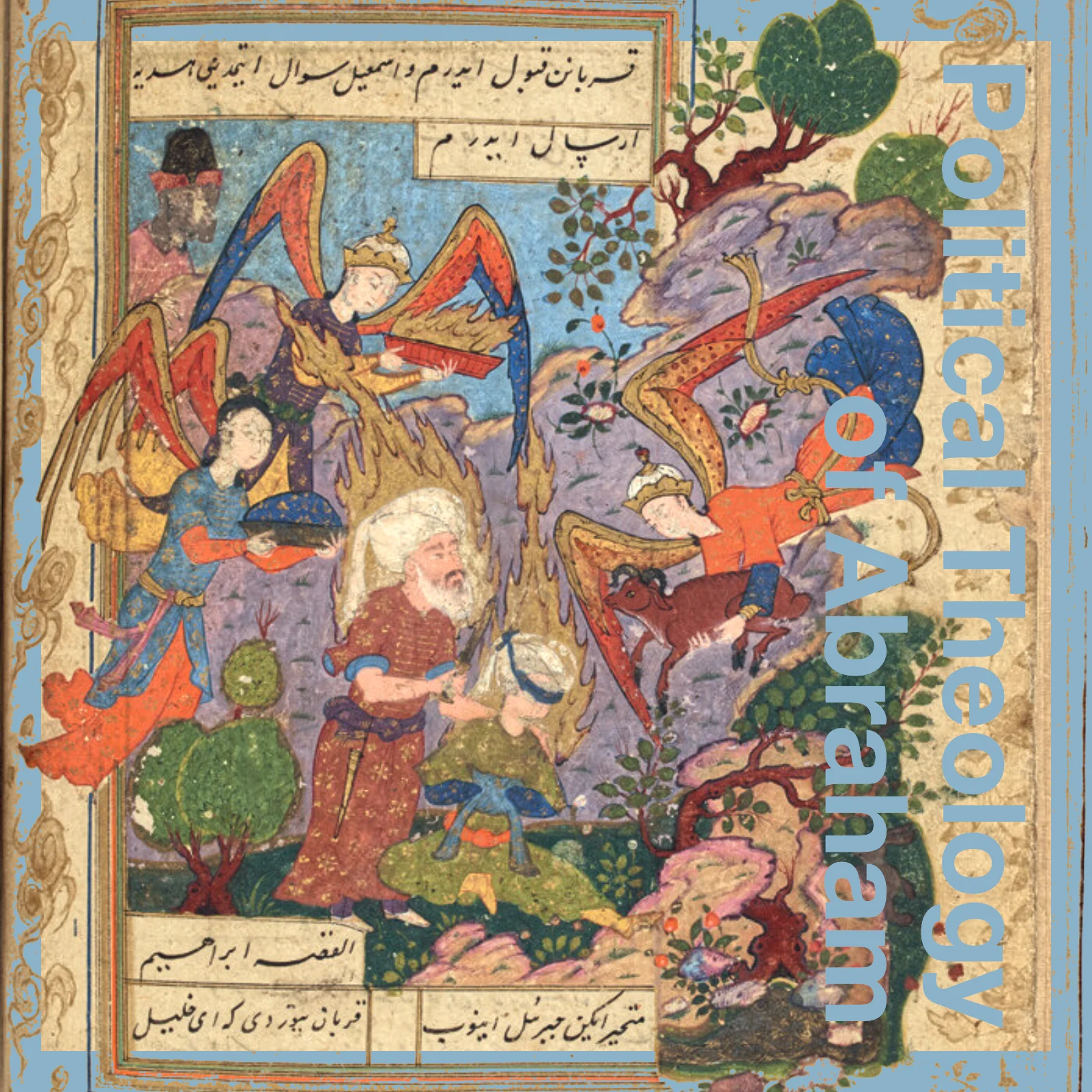
The Offer of Ibrahims son, Image from the book Hadikat as-Suada via Wikimedia
Reflections on Bad Cousins: On the Political Theology of Abraham
“As the Abrahamic story is already a drama of exclusion, how can a peace agreement be grounded on it?”
Yael Attia
Can theology offer a perspective for thinking about the current political situation in the Middle East? This situation has been the object of countless diagnoses and proposed solutions, but what might be gained by approaching its politics through the lens of theology rather than through policy alone? Should theology and cultural criticism have anything to say about the region’s ongoing wars and conflicts, and, further, could these worlds of thought offer us ways of moving beyond them?
One attempt to think through the theology underlying contemporary Middle East politics is the podcast Bad Cousins, hosted by Matan Kaminer and Ben Schuman-Stoler and produced by Kollo Media in collaboration with the online magazine The Diasporist. Kaminer is an anthropologist at Queen Mary University of London, and a member of Academia for Equality, an organization that works to promote justice and equality in Israel/Palestine, specifically by opposing the complicity of Israeli academia and the silencing of critical voices in Israel and the wider academic world. Schuman-Stoler is a publisher based in Berlin, and the founder of Kollo Media. The team also includes Guli Dolev-Hashiloni, a writer and activist based in Berlin.
Having known Kaminer as a longtime activist in anti-militarist and migrant solidarity groups in Israel and as an active member in various socialist and Marxist frameworks in Jaffa, I found it notable that, rather than pursuing a structural and material analysis, he turns in this project to theology, to understand why this symbolic register mobilizes people. Together with Schuman-Stoler, he has gathered, over a series of podcast episodes, a group of intellectuals, mostly Jewish and Muslim, though not only, to think about how the biblical story of Abraham is figured in the politics of the Middle East. What interests the hosts, then, is not only understanding the theological narratives built around Abraham, but also why they move people politically, why they hold such a grip on people’s political imagination.1
Bad Cousins was launched in 2025 to discuss and problematize the theological underpinnings of the Abraham Accords, the 2020 diplomatic agreements normalizing relations between Israel and several Arab states, including the United Arab Emirates, Bahrain, Morocco, and Sudan. Kaminer and Schuman-Stoler begin from the hypothesis that the Accords were not coincidentally named after the biblical figure Abraham. Specifically, they argue that the conservative right has developed a political-theological model grounded in the figure of Abraham as the foundation for a new political vision in the Middle East. In their view, this model draws on two aspects of the figure of Abraham. The first is the genealogical Abraham, the figure of kinship: father of both Ishmael and Isaac, of Jews and Arabs, of the two peoples. In this reading, the Accords rest on an idea of cousinage. The second is the theological Abraham, the father of monotheism, a unifying figure across the three Abrahamic religions and, therefore, a figure of reconciliation.
Through these two aspects, the figure of Abraham becomes the symbol of the Abraham Accords, a set of agreements designed to bring stability and cohesion across the region. However, it is not merely that the situation has worsened since the Accords were signed in 2020; rather, it is precisely the signing of the Accords, the hosts claim, that set the escalation in motion. For decades, it was assumed, including among Palestinian factions such as Fatah and Hamas, that Arab states would not normalize relations with Israel until the Palestinian question was resolved. The Accords decoupled normalization from the Palestinian question, as the Arab states involved decided to sacrifice the Palestinian cause in favor of economic gain by normalizing relations with Israel.2 By 2023 the Accords appeared to be the first stage of a broader process of regional normalization, with talks continuing toward an agreement between Israel and Saudi Arabia that could have further marginalized the Palestinian cause. This is why many analysts, including the podcast hosts, read the Hamas attack of October 7, 2023, as timed partly to derail that momentum, an attack that subsequently led to Israel’s destruction of Gaza.
Their analysis of how the Accords relate to the current violence leads the hosts to two questions. The first is whether the theological framework on which the Accords rest, the figure of Abraham, is connected to the fact that the Accords, ostensibly meant to bring peace, have coincided with an escalation of violence. The second starts from the possibility that the problem lies not in the Abrahamic narrative itself but in the model the conservative right has built from it, in the concrete form of the Accords. If so, they ask their interlocutors, can the biblical Abrahamic story, read within an alternative political project, serve as a positive basis for a political program, one that might be valorized and mobilized for progressive, leftist ends? The answers range widely. Some see a theology at work behind the Accords that reaches well beyond them and argue that the conflict itself should be understood in theological terms. Others hold that the theological framework is merely a cover for a political and colonial struggle over land and self-determination, and that the Accords are one more mechanism for obscuring it.
Dana El Kurd, from the University of Richmond, for instance, who appears in the first episode, regards the Abraham Accords as a political disaster for Palestinians, and more broadly, for ordinary people across the Arab world. She argues that the Accords formalize a set of shared political and economic interests across the region—interests that run counter both to Palestinian demands for self-determination and to the broader popular desire across the region for democratic self-rule. Against this backdrop, El Kurd reads the theological component of the Accords, and the choice to name them after Abraham, as part of an effort to recast the conflict as one between Muslims and Jews. Once the conflict is traced back to Abraham, on the one hand, its political element, the fight over land and sovereignty, is neutralized. On the other hand, an eternal enmity is invoked, which, in her account, contributes to the narrative that portrays Palestinians today as harboring antisemitic views. In El Kurd’s view, this obscures what the conflict is actually about: land, self-determination, and sovereignty.
Substitution and Sacrifice
When the hosts approached me to contribute to the project by speaking alongside the Berlin-based Palestinian writer Muhammad Jabali at their launch event in Berlin in November 2025, I took up the task with skepticism. I wished to debunk the assumption underlying their hypothesis: that the story of Abraham could offer a progressive theological-political model. However, unlike El Kurd, who rejects the theological framework altogether, I pursued my skepticism through the story of Abraham itself. I aimed to show why the Abrahamic narrative cannot provide a model for a progressive political program because it is irreconcilable with the biblical text itself. I will briefly explain why.
The narrative of Abraham, like his life trajectory, is marked by entangled kinship and familial tensions. These tensions are produced in such a way that the figures who inhabit the story, Sarah and Hagar and, later, their respective sons Isaac and Ishmael, serve through the story as replacements and substitutes for one another. To understand this dynamic, let us turn to Genesis.
The story begins with Sarai/Sarah, who is unable to bear children and gives her maid Hagar to Abraham so that Hagar might bear a child in her place. In a form of self-sacrifice, she tells him, “Consort with my maid,” and states her motive: “perhaps I shall have a child through her” (Genesis 16:2).3 Once Hagar conceives, her attitude toward Sarah changes. Sarah, we are told, “was lowered in her esteem” (Genesis 16:4), as Hagar looks on her with contempt, since Sarah cannot bear children. The arrangement thus contains its own reversal: Sarah wants to live through Hagar, and Hagar, once she can provide what Sarah lacks, cannot hide her sense of superiority. Sarah complains to Abraham and then changes her conduct toward Hagar: she “treated her harshly, and she [Hagar] ran away from her” (Genesis 16:6). Hagar flees into the wilderness, where a messenger of God finds her and tells her to “go back to your mistress and submit to her harsh treatment” (Genesis 16:9). Yet the command comes with a promise that makes the self-submission possible: “I will greatly increase your offspring, and they shall be too many to count” (Genesis 16:10). For in this story, the suffering is always rewarded through children and their prosperity.
Years later, Sarah herself bears a son, Isaac. This does not settle the dynamic between Hagar and Sarah. Rather, it is now projected onto Isaac and Ishmael, for with Isaac’s birth comes a demand from Sarah: Hagar and Ishmael must go, “for the son of that slave woman shall not share in the inheritance with my son Isaac” (Genesis 21:10). The text tells us that “the matter distressed Abraham greatly, for it concerned a son of his” (Genesis 21:11). God responds by instructing Abraham: “Do not be distressed over the boy or your slave; whatever Sarah tells you, do as she says, for it is through Isaac that offspring shall be continued for you” (Genesis 21:12). Abraham complies, and the expulsion follows: “Early next morning Abraham took some bread and a skin of water and gave them to Hagar. He placed them over her shoulder, together with the child, and sent her away” (Genesis 21:14). Hagar wanders with Ishmael in the wilderness and falls into despair.
Following the expulsion of Hagar and Ishmael comes the story that casts another shadow: the binding of Isaac. God asks Abraham to “take your son, your favored one, Isaac, whom you love, and go to the land of Moriah, and offer him there as a burnt offering on one of the heights that I will point out to you” (Genesis 22:2). Abraham agrees, no questions asked. He binds his son, raises the knife, and only then does a messenger of God intervene. “When Abraham looked up, his eye fell upon a ram, caught in the thicket by its horns. So Abraham went and took the ram and offered it up as a burnt offering in place of his son” (Genesis 22:13). The particular perversity of the binding, or the Akedah, is that the “reward” for suffering, the child, is itself placed on the altar.
Thus, in the biblical narrative of Abraham’s genealogy, the two mothers, Sarah and Hagar, and the two sons, Ishmael and Isaac, live in a relation of substitution and sacrifice to one another. Within this family constellation, each can exist only at the expense of the other. As shown, this produces numerous moments of inclusion and exclusion. It is not merely the figure of Abraham himself but the narrative of his entangled kinship, including the very story of cousinage, that reveals a structure imbued with this sacrificial logic: Hagar replaces Sarah and Sarah Hagar, the birth of Isaac necessitates the expulsion of Ishmael, and the ram is sacrificed in Isaac’s place.
As the Abrahamic story is already a drama of exclusion, it seems hard to ground a narrative of inclusion on it. More than that, the specter of exclusion actually haunts the Abraham Accords. For how to ground a peace agreement on a story of cousinage that was never peaceful to begin with? Is it surprising, then, that an agreement named after Abraham and rooted in the Abrahamic theological model can be read as one that, in normalizing relations with Israel, excluded the Palestinians or, in harsher terms, sacrificed their cause?
Nonetheless, having listened to the podcast and taken its offering seriously, I present in what follows two political-theological models it proposes. Each asks which elements of the story could be probed, fleshed out, or amplified in order to produce alternative narratives.
The State of Abraham
One recurring theme across almost all the episodes is the connection between Abraham and hospitality, often called “the hospitality of Abraham,” a motif originating in Genesis 18. As the story goes, Abraham is sitting “by the oaks of Mamre” when he sees three men approaching. He immediately runs to greet them, bows, and offers water to wash their feet, food to eat, and shade to rest, without yet knowing who they are. Only later does he realize that these visitors are divine messengers, bringing the announcement that Sarah will bear a son, Isaac. This story becomes emblematic across Jewish traditions of the ethical duty to welcome the stranger. The rabbis, in the Babylonian Talmud, Tractate Shabbat 127a, teach that “greater is hospitality than receiving the Divine Presence,” since Abraham attends to the strangers before he turns to speak with God. Emmanuel Levinas’s account of Abraham offers a further register for thinking through this figure. For him, Abraham represents the human subject who responds to the call of the Other before even knowing or understanding it. Thus, Abraham becomes a figure of ethical obedience, not in the sense of blind submission, but as one called into responsibility by the infinite demand of the Other.
In this way, hospitality becomes central and inherently bound up with the story of Abraham, together with the commandment that: “You shall not oppress a stranger, for you know the feelings of the stranger, having yourselves been strangers in the land of Egypt” (Exodus 23:9). One attempt to work through the political implications of the figure of Abraham and the concept of hospitality is explored in an episode featuring the historian Avi-ram Tzoreff, also a member of Academia for Equality. The conversation revolves around a political-theological pamphlet written after October 2023 by Rabbi Joseph Kaminer (no relation to Kaminer the host). Rabbi Kaminer belongs to the “ultra-Orthodox,” or Haredi, movement, which has historically opposed the assertion of Jewish sovereignty in the land. As head of the Hokhmat HaTorah Institute, he leads an organization that seeks to bridge the divide between the modern secular world and the ultra-Orthodox community, through texts, educational events, and programming aimed at reconciling the two.
In the pamphlet, entitled “As for Ishmael, I Have Heeded You,”4 Rabbi Kaminer argues for replacing the model of the State of Israel with the State of Abraham, in which “the Sovereign of the land is none other than the Holy One, blessed be He.” However, rather than the “binational” ancestor of Isaac and Ishmael invoked by the Abraham Accords, the figurehead of Rabbi Kaminer’s envisioned state is a humble servant of God who recognizes himself as a ger toshav, “a stranger and resident” in the land (Genesis 23:4). In this state of Abraham, citizenship is not conditioned on national belonging, because all residents of the land, including Jews, are migrants and strangers. “The children of Sarah and the children of Hagar, the children of Isaac and the children of Ishmael, will return to dwell together in the land, as was Sarah’s intention before Hagar became a rival to her, and as was Abraham’s original intention—that Israel and Ishmael would serve God together.”
Avi-ram Tzoreff sees Rabbi Kaminer’s intervention as contradicting, in a sense, the common association of the Accords with Abraham as a genealogical ancestor. According to Tzoreff, Rabbi Kaminer instead returns to a Talmudic notion that identifies Abraham with giyur, the act of conversion, and with being a megayer, or converter, rather than merely a genealogical forebear. This challenges the emphasis on particular forms of familial kinship and ancestry and touches on a central element of the pamphlet, which attributes the atrocities taking place in the land to the fact that “we saw the Holy Land as a national place, where a particular nation has the right to be its master and dwell in it as the sole owner, while the other nations dwelling in the land submit to it and are its guests.” This perception, together with the “attitude of dominion over the land and sovereignty over it” produced an “attitude of superiority toward all the other inhabitants of the land.” Instead, Rabbi Kaminer argues for the need to reject nationalism and sovereignty and to think in more hospitable and universal terms. Within his political-theological model, the very phenomenon of nationalism becomes a form of idolatry, insofar as both the nation and the state become divine.
For Kaminer the host, Rabbi Kaminer’s critique of nationalism strikes at the heart of hospitality while simultaneously exposing its inherent contradiction: hospitality presupposes a distinction between host and guest, thereby establishing a limit to hospitality itself. Thinking about hospitality as an ethical or political imperative in fact reasserts that Jews are the masters of the house, and with it reaffirms the categorical difference between “host” and “guest.” This problematic equation, Kaminer suggests, could be resolved by Rabbi Kaminer’s idea of the State of Abraham as a state of strangers, where everyone is a ger and therefore a stranger. This model does not suggest that if the citizen is a ger, and all citizens are gerim, that everyone exists as strangers to one another, but rather that all citizens in the land exist in a relation of non-sovereignty. Thus, the State of Abraham carries an even more universalist message, one that extends beyond Abraham’s sons to encompass all people.
Tzoreff, though, cautions against a danger here. As a Jewish Israeli, he asks: from what position can those who currently hold power speak of non-ownership? When people have been expelled and killed, can the rejection of nationalism and sovereignty be disentangled from the privilege of ownership? And does suggesting that “no one is the owner” not risk reproducing a colonial logic by negating Palestinians’ own claims to the land? How, then, are we to understand the claim to non-ownership when it is articulated by those who possess the land, while the oppressed struggle to maintain their relationship to it? This is the tension Tzoreff asks us to reckon with. How, then, might we think with the story of Abraham beyond the logic of ownership altogether?
The State of Hagar
Kaminer the host proposes an alternative model of his own. In his view, the subversive potential lies not in the figure of Abraham but in the figure of Hagar. Therefore, the desired state is not the State of Abraham but the State of Hagar. Having long been interested in questions of migration and having studied Thai migrant workers in Israel in the research that became his book, Capitalist Colonial: Thai Migrant Workers in Israeli Agriculture5, Kaminer sketches a model of a state whose approach to migration draws on both Islamic and Jewish traditions. To this end, he mobilizes the figure of Hagar, or Hajar—the Egyptian concubine of Abraham and, through her son Ishmael, the ancestor of the Arabs and the Prophet Muhammad—who, according to him, and precisely unlike Abraham, plays a subaltern role in a narrative shared by both traditions. Both traditions, moreover, “recognize her unique relationship with God, founded on His care for her and her child at their darkest hour of abandonment and abjection.”6 For God’s love for Hagar represents love for “an abused, enslaved reproductive worker, a migrant, refugee and single mother,”7 and shows how the divine stands for the most oppressed. His idea of a state takes Rabbi Kaminer’s position a step further, toward a state that is more aligned with and influenced by the politics of “revolutionary feminism of color.”8
Kaminer fleshes out his model in even more concrete political terms. For him, the State of Hagar is a state of free asylum, situated at the meeting-place of three continents, and thus, could become “an imminent threat to imperialism and a catalyst for revolutionary change in the region and beyond.”9 In this “open-bordered State of Hagar, no one’s right to residence would take precedence over anyone else’s: Palestinians, Jews and all others would all be free to come live in the land—as they have for most of its history.”10 And furthermore, all comers could enjoy full citizenship, participate in the electoral process, hold a vote, and make political claims.
By shifting the focus from Abraham to Hagar, or Hajar, Kaminer grounds a political model from the perspective of “the most abject and marginalized of human subjects, exploited, ignored and maligned by precisely those states purporting to take up the mantle of Abraham.”11 For Kaminer, however, imagining a different political future cannot be separated from the need to reckon with the violence of the past and present. As he cautions, this political project “cannot suffice to atone for the grave sin that has been committed—and that continues every day to be committed—against the Palestinians.”12 He believes that reparative justice—understood as addressing both historical and structural harms, particularly the historical crimes of the Nakba—is needed as a step prior to offering concrete political solutions such as free migration and full democracy, or at least alongside them. For a political-theological model to be tenable, it must remain attentive to the position from which it is articulated while continually reckoning with the crimes of the past. He concludes by invoking Ezekiel’s prophecy: only “if the wicked restore a pledge, make good what they have taken by robbery, follow the laws of life, and do not commit iniquity, shall they live, shall they not die” (Ezekiel 33:15).
Kaminer’s turn to Hagar does not so much refute my skepticism as relocate it. Hagar is one of the figures caught in the Abrahamic story’s sacrificial logic; to build a state in her name is to read the story against itself, from the position of those it expels. Whether such a reading can break the logic of substitution, rather than simply change who bears its cost, remains, to my mind, the open question that Bad Cousins leaves us with.
- For the scholarly background to the podcast’s hypothesis, see Matan Kaminer, “The Abrahamic Ideology: Patrilineal Kinship and the Politics of Peacemaking in the Contemporary Middle East,” Millennium: Journal of International Studies 52, no. 2 (2024): 198–220.
- I note that normalization began earlier: Egypt made peace with Israel in 1979 and Jordan in 1994.
- Biblical quotations follow the NJPS translation: Tanakh: The Holy Scriptures (Philadelphia: Jewish Publication Society, 1985).
- The pamphlet, whose title quotes Genesis 17:20, was published in Hebrew; English translations are the hosts’.
- Matan Kaminer, Capitalist Colonial: Thai Migrant Workers in Israeli Agriculture (Stanford: Stanford University Press, 2024).
- Matan Kaminer, “Migration,” in Alternative Lexicon for Palestine-Israel (The Shared Homeland Paradigm, July 2026), 6,https://sharedhomeland.com/files/al-migration.pdf.
- Ibid., 7.
- Ibid.
- Ibid.
- Ibid.
- Ibid.
- Ibid.